

A single moment of conflict can turn into a four year prison sentence before you even realize what hit you. You’re likely standing at a crossroads, feeling the suffocating pressure of a legal system that often views a common household object as a lethal threat. Facing a charge of felonious assault Michigan is a high-stakes battle where the state is already moving to strip away your rights and your future. It’s natural to feel anxious about a permanent felony record, but you can’t let that fear paralyze your defense. You need a battle-ready strategy right now.
You deserve an advocate who acts as a vital shield against these aggressive prosecutions. This guide provides the roadmap you need to understand Michigan’s 2026 assault laws and protect your freedom from a devastating conviction. We’ll explore the specific definitions of dangerous weapons, the severe penalties you face in a weapon-free school zone, and the proven defense strategies that can force the prosecution to back down. Don’t let the system dictate your story; learn how to fight back and win.
Key Takeaways
- Understand the statutory elements of a felonious assault Michigan charge and why the state pursues a 4-year felony conviction.
- Learn why the presence of a weapon-not the extent of physical injury-is the deciding factor between a misdemeanor and a life-altering felony.
- Identify the 2026 enhanced penalties and $4,000 fines associated with assaults against medical volunteers and health professionals.
- Discover how to challenge the “dangerous weapon” classification and dismantle the prosecutor’s claims regarding criminal intent.
- See how a battle-ready defense strategy in Southfield or Warren can act as a vital shield for your freedom and your future.
What is Felonious Assault in Michigan? Understanding MCL 750.82
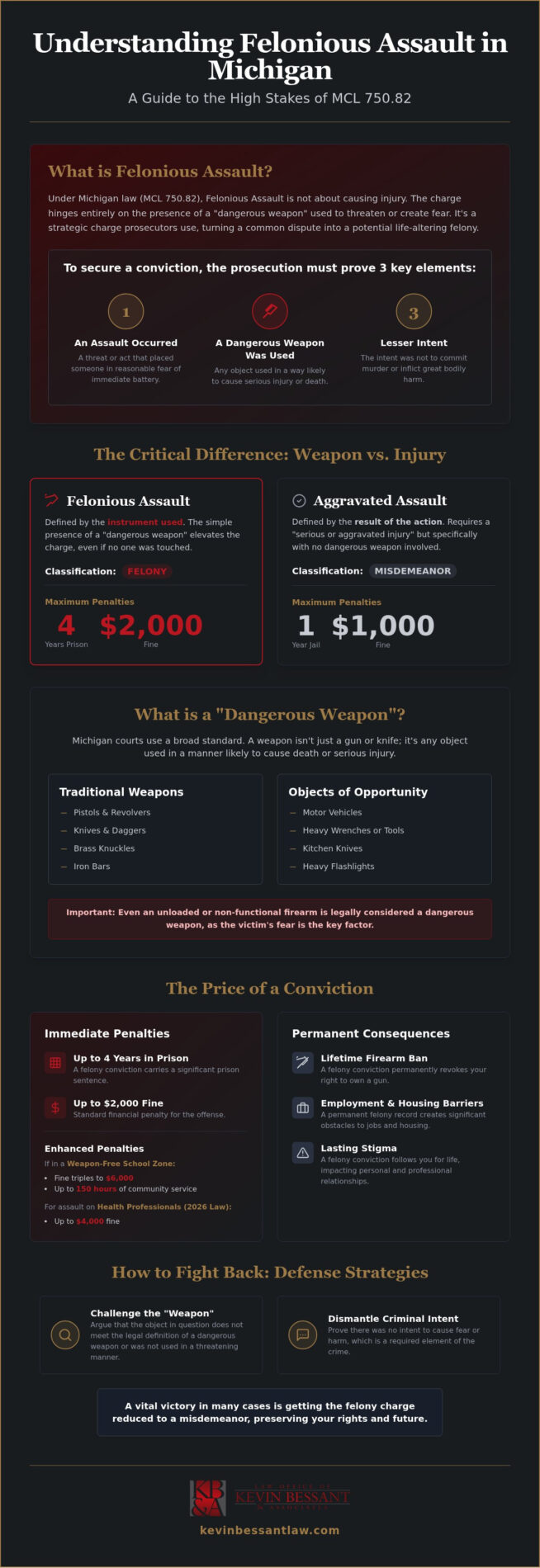
In Michigan, the law doesn’t wait for you to cause a physical injury to label you a felon. Under MCL 750.82, a charge of felonious assault Michigan hinges entirely on the presence of a “dangerous weapon” during an encounter. While the foundational legal definition of assault often involves the mere threat of violence, this specific felony requires the prosecution to prove you used an object to create fear or cause harm. They don’t need to prove you actually touched or injured anyone. They only need to prove you had the intent to place someone in fear of an immediate battery while armed with a dangerous instrument.
To secure a conviction, the state must prove three specific elements beyond a reasonable doubt. First, that an assault occurred. Second, that you used a dangerous weapon. Third, that you did not intend to commit murder or inflict great bodily harm. This last element is a strategic boundary; it distinguishes felonious assault from more severe charges like Assault with Intent to Do Great Bodily Harm. However, don’t let the “lesser” classification fool you. The system is designed to prosecute these cases aggressively, and without a vital shield in the courtroom, you are standing exposed to the full weight of the law.
The Legal Definition of a ‘Dangerous Weapon’
Don’t assume a “weapon” only means a firearm or a tactical knife. Michigan courts use a broad 2026 standard that includes any object used in a way that is likely to cause death or serious injury. This includes traditional weapons like pistols, revolvers, brass knuckles, and iron bars. It also covers “objects of opportunity” where everyday items become deadly in the eyes of the law. A motor vehicle, a heavy wrench, or a kitchen knife can all trigger a felony charge. Even if a gun was unloaded or non-functional, the law still classifies it as a dangerous weapon because the victim’s fear of harm is the primary concern of the statute.
Penalties and Long-Term Consequences
The immediate price of a conviction is steep. You face a maximum of four years in prison and a fine of up to $2,000. If the state alleges the incident occurred in a Weapon-Free School Zone, the financial penalty triples to $6,000, and the court can order 150 hours of community service. Beyond the prison walls, the collateral damage is permanent. You’ll face a lifetime ban on firearm ownership and significant barriers to employment and housing. This is a high-stakes crisis that demands a battle-ready defense. You can learn more about our firm’s approach to these cases by visiting our Why Us page.
The Critical Difference: Felonious vs. Aggravated Assault
Prosecutors in Michigan often look for the highest possible charge to secure a conviction, and the line between a misdemeanor and a life-altering felony is thinner than you think. The pivot point is usually the presence of a “dangerous weapon.” In many cases, a heated dispute that should be handled as a misdemeanor is overcharged as felonious assault Michigan. This is a strategic move by the state to force a plea, but it’s a move you can challenge. You need to understand that the system prioritizes the potential for harm over the actual injury sustained. You could be facing four years in prison for an incident where the other person didn’t suffer a single scratch, simply because the police claim an object in your hand was a weapon.
The law treats the tool as the threat. If you use your hands to cause a serious injury, the state may charge you with aggravated assault. However, if you hold a tool, a car key, or even a heavy flashlight during a threat, the charge jumps to a felony. This “weapon-first” logic is where many defendants get trapped by overzealous charging. Kevin Bessant specializes in identifying these gray areas and dismantling the prosecution’s narrative before it destroys your future. Don’t let a prosecutor’s interpretation of an everyday object define the rest of your life.
Aggravated Assault: The Serious Misdemeanor
Aggravated assault, governed by MCL 750.81a, is defined by the result of the action rather than the instrument used. It requires the victim to suffer a “serious or aggravated injury,” such as a concussion or a broken bone, but it specifically applies to situations where no dangerous weapon was present. Because this is a misdemeanor, it carries a maximum of one year in jail and a $1,000 fine. In many high-stakes cases, fighting to have a felony reduced to this misdemeanor is a vital victory that preserves your civil rights and keeps you out of prison.
Assault with Intent to Do Great Bodily Harm (GBH)
When the state wants to escalate the pressure even further, they reach for Assault with Intent to Do Great Bodily Harm. This is a severe 10-year felony. The critical distinction between this and felonious assault is your mindset. Felonious assault under MCL 750.82 specifically involves an assault where there was no intent to commit murder or inflict great bodily harm. If the prosecutor cannot prove you intended to cause permanent or severe injury, they cannot sustain a GBH charge. Understanding these nuances is the first step in building your shield. If you’re feeling overwhelmed by the weight of these charges, reach out to discuss your case today.
Assault of Health Professionals and Enhanced Penalties
Michigan has carved out special protections for those working on the front lines of healthcare. If you are accused of felonious assault Michigan against a medical volunteer or health professional while they are performing their duties, the legal stakes escalate instantly. The state views these individuals as vital assets to the community and punishes interference with their work severely. Consequently, the standard $2,000 fine for a felony assault conviction doubles to $4,000. This isn’t just a suggestion; it’s a statutory mandate designed to deter conflict in high-stress medical environments.
You’ll see these warnings posted prominently in hospitals throughout Detroit and Southfield. Facilities are required by law to display signs alerting the public to these enhanced penalties. In the chaotic atmosphere of an emergency room or a busy clinic, a misunderstanding can lead to a felony charge in seconds. The prosecution will use these signs as evidence that you were “warned,” but they often ignore the high-pressure reality of the situation. You need a defense that understands the local landscape of our regional medical centers and knows how to push back against these aggressive sentencing enhancements.
The ‘Patient Exception’ Defense
One of the most critical shields in these cases is the “patient exception.” Under Michigan law, the doubled fine does not apply if the defendant was a patient receiving treatment from the victim at the time of the incident. This is a vital distinction. Medical emergencies often involve diminished capacity, extreme pain, or adverse reactions to medication that can lead to involuntary or uncharacteristic outbursts. Our firm has extensive experience handling these high-stakes Homicide and Felony Assault cases where medical context is everything. We fight to ensure the court sees you as a person in crisis, not a violent criminal.
Weapon-Free School Zone Violations
The pressure intensifies even further if an incident occurs within a weapon-free school zone. In these areas, the law adds a layer of mandatory community service, up to 150 hours, and spikes the maximum fine to $6,000. These zones extend beyond just the classroom; they include school vehicles and property used for school purposes. For young adults or students, these charges can be catastrophic for their future. If your child is facing these allegations, you need a specialized Juvenile Crimes Defense that protects their record and prevents a single mistake from defining their adult life. Don’t let the system steamroll your family without a fight.
Aggressive Defense Strategies for Felonious Assault Charges
Defending against a charge of felonious assault Michigan requires more than a passive explanation; it demands a proactive strike against the prosecution’s evidence. We begin by scrutinizing the “dangerous weapon” itself. If the police seized a common household item, we demand the state prove that the object was truly used in a manner likely to cause serious injury. We also attack the “present ability” element of the charge. If you were standing behind a locked door or were at a distance where you couldn’t actually reach the other person, you lacked the immediate capability to carry out a battery. These technicalities are the cracks in the state’s case where we insert our shield.
Scrutinizing the “Intent” element is our next objective. The state must prove you specifically intended to place the victim in fear or intended to commit a battery. If your actions resulted from a mistake, a gesture taken out of context, or a reflexive movement, the felony charge cannot stand. Additionally, witness credibility is often the weakest link in Detroit precincts. In the heat of a conflict, police reports are frequently riddled with hearsay and contradictions. We investigate every angle, from conflicting statements to the physical layout of the scene. If the state’s story doesn’t hold up under pressure, the entire case can crumble.
Self-Defense and Defense of Others
Michigan law is clear: you have the right to protect yourself and those you love. Under the “Stand Your Ground” statutes, you have no duty to retreat if you are in a place where you have a legal right to be. We focus on establishing your “honest and reasonable belief” that force was necessary to prevent imminent harm. This defense is a powerful tool in a felony context. Once we raise a valid claim of self-defense, the burden of proof shifts back to the prosecutor, who must prove beyond a reasonable doubt that you did not act in self-defense.
Immediate Steps After an Arrest
Your actions in the first 24 hours determine the rest of your life. Exercise your right to remain silent immediately. Do not attempt to “clear things up” or “explain your side” to investigators; they are building a case against you, not looking for the truth. You must secure an aggressive criminal defense attorney before your arraignment. This is the only way to ensure your side is heard during your Bond Hearing and to fight for your immediate release. Stop the damage now. If you are facing a high-stakes felony charge, contact us immediately to build your defense.
Why You Need the Law Office of Kevin Bessant & Associates
Facing a charge of felonious assault Michigan is a high-stakes crisis that threatens to derail your entire life. You aren’t just fighting a legal statute; you’re fighting a system that is already moving to label you a violent felon for the next four years. Attorney Kevin Bessant stands in that gap for you. With over 20 years of battle-ready advocacy, our firm provides the aggressive representation necessary to dismantle the prosecution’s case in Southfield, Warren, and across the Metro area. We don’t just offer advice. We provide a vital shield against a complex and often unforgiving legal machine.
Every client we represent receives personalized, high-stakes attention because we understand exactly what is at risk. Your career, your firearm rights, and your reputation are all on the line. We act as your dedicated protector, ensuring that overzealous investigators and prosecutors don’t steamroll your defense. Our approach is proactive and vigorous. We hunt for the technical errors, the witness contradictions, and the lack of criminal intent that other firms might overlook. In the face of serious personal challenges, you need a voice that is both experienced and entirely focused on your freedom.
A Track Record in High-Stakes Felony Defense
Our deep expertise extends into the complexities of Gun and Weapons Offenses, where the legal definition of a “dangerous weapon” is frequently stretched to its breaking point by the state. We have spent decades navigating the inner workings of the courts in Wayne and Macomb Counties. We know the local judges, and we understand the specific tactics used by regional prosecutors to secure convictions. Our singular focus is achieving a dismissal, a significant reduction of charges, or a full acquittal at trial. We are not intimidated by the opposition, and we encourage you to feel that same level of confidence.
Secure Your Future Today
A felony conviction is a permanent stain that will limit your opportunities long after the court case ends. While Criminal Expungement can sometimes clear a past mistake, the most effective strategy is preventing a conviction from ever occurring. Don’t wait for the system to decide your fate. Take a decisive step to protect your liberty and your family’s future. The sooner we intervene, the stronger your shield becomes. Protect your freedom-Contact Kevin Bessant now to discuss your case and begin building a battle-ready defense today.
Secure Your Freedom and Fight for Your Future
The state is already moving to secure a conviction, and every hour you wait is an hour the prosecution uses to solidify its narrative. You’ve seen that a charge of felonious assault Michigan isn’t just about what happened; it’s about how the law defines your intent and the objects in your hand. Whether you’re facing enhanced penalties in a school zone or dealing with an overcharged misdemeanor, you need a battle-ready advocate who knows how to dismantle the state’s evidence before it’s too late.
Kevin Bessant brings over 20 years of criminal defense experience and specialized high-stakes felony expertise to your corner. We provide aggressive advocacy across Detroit and the surrounding Metro area, acting as a vital shield between you and a system that often ignores the truth. You have the right to defend your reputation and your liberty. Don’t leave your freedom to chance; schedule your free consultation with Kevin Bessant today. Take this moment to reclaim your life and secure a future free from the shadow of a felony record. We are ready to stand with you.
Legal Authority: Statute and Case Law
Michigan’s felonious assault statute is codified at MCL 750.82, with the Self-Defense Act at MCL 780.972.
- People v Avant, 235 Mich App 499, 505 (1999) — the Michigan Court of Appeals held that whether an object qualifies as a “dangerous weapon” depends on how it was used and the circumstances of the assault, not simply what the object is, which is exactly why an everyday object of opportunity can be charged as a felony weapon.
- People v Riddle, 467 Mich 116, 119 (2002) — held that a person is never required to retreat from a sudden, fierce, and violent attack, nor from an attacker reasonably believed to be about to use a deadly weapon, as long as the belief in the necessity of force is honest and reasonable.
For the current statutory text and published opinions, see the Michigan Legislature’s MCL database and the Michigan Courts case search.
Frequently Asked Questions
Is felonious assault a felony or misdemeanor in Michigan?
A charge of felonious assault Michigan is a felony punishable by up to four years in prison and a $2,000 fine. It’s governed by MCL 750.82 and is often referred to as “assault with a dangerous weapon.” Because this is a felony, a conviction will strip you of your firearm rights and create a permanent criminal record. You need an aggressive shield to prevent these life-altering consequences from becoming your reality.
Can you go to jail for a first-time felonious assault charge?
You can go to jail for a first-time felonious assault Michigan charge because it is a high-stakes felony offense. While some first-time offenders might receive probation, there is no guarantee of leniency in Michigan courts. Factors like the type of weapon used and the victim’s statements heavily influence the judge’s decision. You must act immediately to build a defense that keeps you out of a cell.
What qualifies as a ‘dangerous weapon’ under MCL 750.82?
A dangerous weapon includes any object used in a way that is likely to cause death or great bodily harm. This covers obvious items like guns and knives, but it also includes “objects of opportunity” like cars, hammers, or heavy flashlights. The law focuses on how the object was used during the incident. If the prosecution claims an everyday item was a weapon, you need an advocate to challenge that classification.
Can felonious assault charges be dropped if the victim doesn’t want to press charges?
No, the prosecutor is the only one with the authority to drop a felonious assault charge in Michigan. Once the police file a report, the case belongs to the state, not the victim. Even if the victim refuses to cooperate, the state can use 911 recordings or medical records to pursue a conviction. You must have a seasoned advocate to navigate this advocate-versus-system dynamic and protect your interests.
How much does a criminal defense lawyer cost for a felony assault case?
The cost of a criminal defense lawyer for a felony assault case depends on the complexity of the litigation and the severity of the charges. You should view this as an investment in your freedom rather than a simple expense. High-stakes cases require a battle-ready advocate who can dismantle the prosecution’s evidence. While costs vary across firms, the price of a conviction is far higher, involving years of prison and a permanent record.
Is a pocket knife considered a dangerous weapon in Michigan?
A pocket knife is considered a dangerous weapon in Michigan if it is used in a manner intended to cause fear or physical injury. While carrying one might be legal, using it during a dispute triggers the felony statute. The law doesn’t care about the size of the blade; it cares about the threat you allegedly created. This is why challenging the “dangerous weapon” classification is a vital part of your defense strategy.
Does an object have to look dangerous to count as a deadly weapon?
No. People v Avant, 235 Mich App 499 (1999), holds that whether an object is a “dangerous weapon” depends on how it was used and the circumstances of the assault, not what the object actually is, meaning the classification itself can be challenged.
What is the difference between felonious assault and battery?
The primary difference is physical contact; assault is the threat or attempt of violence, while battery is the actual forceful touching. You can be charged with felonious assault even if you never touched the other person. The mere act of pointing a weapon or brandishing an object is enough to trigger a four-year felony. If physical contact occurred, the state may add battery charges to the case, increasing your legal exposure.
Can a felonious assault conviction be expunged in Michigan?
Yes, a felonious assault conviction can be expunged in Michigan if you meet the statutory waiting periods and have a limited criminal history. Under the “Clean Slate” laws, you must generally wait several years after completing your sentence before applying. Expungement is the only way to clear your past and restore your reputation. Contact our firm to evaluate your eligibility and begin the process of reclaiming your future today.