

What if the state could send you to prison for five years because of a misdemeanor conviction you thought was behind you? In 2026, the definition of who counts as a felon in Michigan has shifted, and the consequences are more dangerous than ever. If you are facing a charge for being a felon in possession of a firearm Michigan law enforcement is likely looking to make an example out of you. It feels like the legal system is moving the goalposts, turning yesterday’s mistakes into today’s mandatory prison sentences. You aren’t alone in feeling that the deck is stacked against you.
We understand that you’re worried about your future and confused by the clash between state rights and federal bans. This guide provides the clarity you need to fight back. You will discover how an aggressive, battle-ready defense acts as a shield to protect your freedom from these expanded firearm prohibitions. We will break down the specific 2026 legislative changes, explain the path to rights restoration, and show you why having a lawyer who isn’t intimidated by the prosecution is your only real chance at avoiding a life-altering felony conviction.
Key Takeaways
- Understand why being a felon in possession of a firearm Michigan now includes those with misdemeanor convictions under the 2026 legal expansions.
- Recognize the specific high court misdemeanors that prosecutors use as traps to trigger felony-level prohibitions and prison time.
- Learn how to combat the Felony Firearm add-on, a dangerous charge that carries a mandatory two-year consecutive sentence.
- Explore how an aggressive defense can use motions to suppress to throw out evidence obtained through illegal police stops or unconstitutional searches.
- Find the exact steps and waiting periods needed to successfully petition the circuit court for the full restoration of your gun rights.
What is Felon in Possession of a Firearm (MCL 750.224f)?
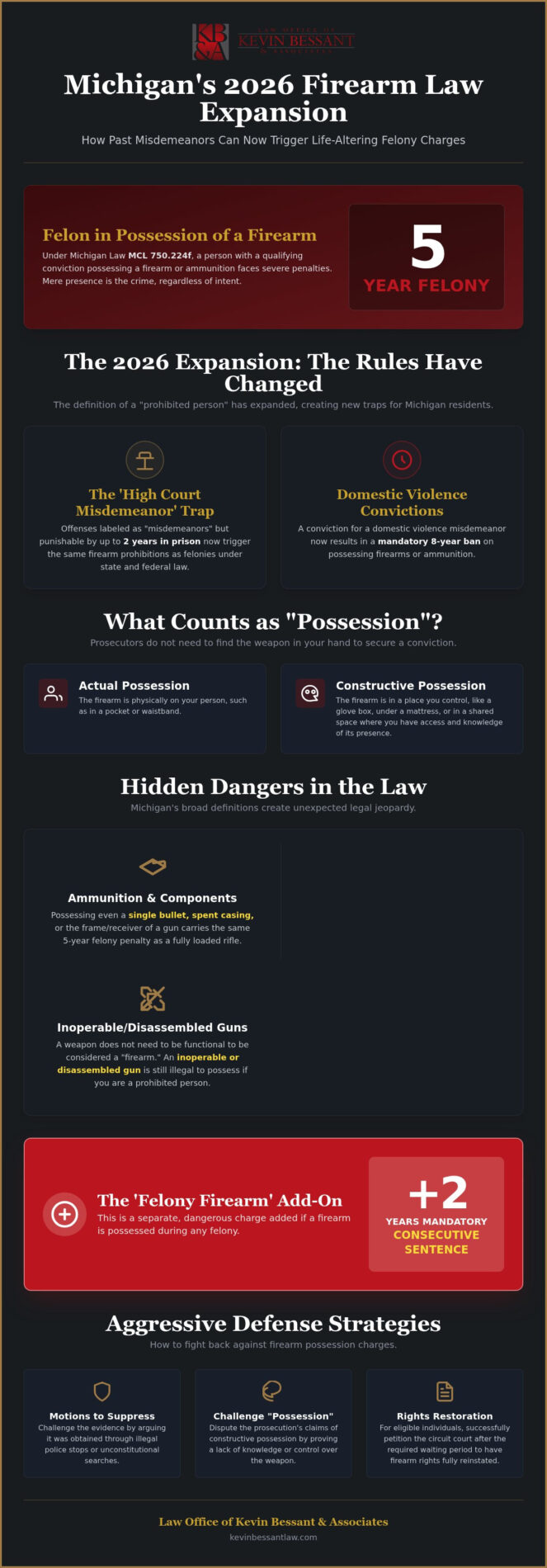
Michigan law MCL 750.224f is a powerful tool used by prosecutors to strip away your liberty based on your past. A charge for being a felon in possession of a firearm Michigan occurs the moment an individual with a qualifying conviction is found to have a gun or ammunition within their reach or control. This isn’t a minor technicality; it’s a five-year felony that the state pursues with aggressive vigor. The law doesn’t care if you were using the weapon for protection or just holding it for a friend. If you have the prior record, the mere presence of the weapon is the crime.
In 2026, the definition of a “prohibited person” has expanded to include individuals convicted of specific domestic violence misdemeanors within the last eight years, meaning you can now face a felony gun charge without ever having a prior felony on your record. This shift has caught many Michigan residents off guard. You must also understand the distinction between state and federal status. While Michigan may eventually allow for the restoration of your rights, federal law often imposes a lifetime ban under 18 U.S.C. § 922(g)(1). This conflict creates a legal minefield where the state might say you’re clear, but the feds are still waiting to pounce. You need a defense that understands both arenas.
Actual vs. Constructive Possession
The prosecution doesn’t need to see the gun in your hand to convict you of Criminal possession of a weapon. Actual possession is straightforward: the firearm is physically on your person. However, most cases involve “constructive possession.” This means the gun is in a place you control, such as your glove box, under your mattress, or in a shared kitchen drawer. Prosecutors use “proximity” to build their case, arguing that if you knew the gun was there and had the power to grab it, you are guilty. Don’t let them use your living situation against you. We challenge these assumptions by proving a lack of knowledge or control.
Firearm vs. Ammunition Prohibitions
One of the most dangerous traps in Michigan law is the treatment of ammunition. Possessing even a single spent casing or one live bullet carries the same legal weight as possessing a fully loaded semi-automatic rifle. Additionally, Michigan’s definition of a “firearm” is broad enough to include inoperable weapons or those that are disassembled. If the frame or receiver is present, the law considers it a gun. If you live in a household where others own legal firearms, you are standing on thin ice. Every day you remain in that environment without a clear legal strategy, you risk a mandatory prison sentence. If you’re currently under investigation, contact us immediately to begin building your shield.
The 2026 Expansion: Why Misdemeanors Now Trigger Felony Charges
The legal system just moved the goalposts, and the consequences for you are severe. MSP Legal Update No. 159 has weaponized your past record in ways you likely didn’t see coming. In 2026, being a felon in possession of a firearm Michigan doesn’t always require a traditional “felony” label on your previous conviction. The state has expanded the net to catch people who thought their misdemeanor status protected them from weapons charges. This legislative shift is catching thousands of Michigan residents off guard, turning what used to be legal firearm ownership into a high-stakes criminal crisis.
The ‘High Court Misdemeanor’ Trap
Michigan uses a unique category of crime called “high court misdemeanors.” These are offenses that the state labels as misdemeanors but carries a potential sentence of up to two years in prison. Because these crimes are punishable by more than one year, they trigger the same firearm prohibitions as standard felonies under both Michigan and federal law. A non-violent prior that you thought was a minor mark on your record can suddenly lead to a fresh felony weapons charge if a gun is found in your home or vehicle. A conviction for being a felon in possession does not require the prosecutor to prove you had a specific intent to commit a new felony; the mere act of possession while having that prior record is the crime. This trap allows the prosecution to secure a conviction without ever proving you intended to do harm.
Domestic Violence and Gun Prohibitions
The most aggressive shift involves domestic violence convictions. Under the 2023 legislative package that reached full implementation by 2025 and 2026, anyone convicted of a domestic violence misdemeanor faces a mandatory eight-year ban on possessing firearms or ammunition. This is a massive jump from previous standards. It creates a direct conflict with older rights restoration timelines that many people still rely on. If you were convicted five or six years ago, you might have believed your rights were intact. Today, that same possession is a felony. This is why you need an aggressive weapons offense attorney to audit your record and identify these hidden risks before the police do. The prosecution won’t give you credit for being confused by the new laws. They will simply use your lack of knowledge to push for a conviction. Don’t wait for a routine interaction with law enforcement to find out where you stand. If you are concerned about how these 2026 expansions affect your freedom, speak with our team today to protect your future.
Michigan Penalties and the ‘Felony Firearm’ Add-On
If you are charged as a felon in possession of a firearm Michigan authorities aren’t just looking to slap your wrist. They want a conviction that carries up to five years in prison and a fine of $5,000. But the real danger lies in the stacking of charges. Prosecutors rarely stop at the possession charge. They almost always add a second, separate felony that can double your time behind bars before the trial even begins. This isn’t just about one mistake; it’s about a legal system designed to keep you trapped in a cycle of incarceration.
Sentences for these gun crimes must be served consecutively. This means you don’t serve your time all at once. You serve one full sentence, and only after that is finished do you start the next one. This stacking effect can turn a relatively short prison stay into a decade-long nightmare. Beyond the walls of a cell, a conviction brings permanent destruction to your lifestyle. You face the loss of your rights, the denial of housing applications, and the end of many career opportunities. You need a battle-ready advocate who understands how to dismantle these threats before they dismantle your life.
The Mandatory 2-Year ‘Add-On’
MCL 750.227b, known as “Felony Firearm,” is the ultimate trap. It carries a flat, mandatory two-year sentence for a first offense. If you are convicted, the judge has zero power to give you probation or a shorter stay. You go to prison for two years, period. Prosecutors use this add-on as leverage to bully you into a plea deal, hoping you’ll be too terrified of the mandatory time to fight. We don’t let them. Our strategy focuses on attacking the foundation of the case to get these mandatory counts dismissed. If the police violated your rights during the search, that mandatory two-year clock never starts ticking.
Sentencing Guidelines in Detroit and SE Michigan
Your fate depends heavily on Prior Record Variables (PRVs) and Offense Variables (OVs). These scores determine your specific sentencing grid and the length of your stay. In Detroit and surrounding areas, the court’s attitude varies wildly. Wayne County judges may look at your case differently than those in Oakland or Macomb, where sentencing trends often lean toward maximum severity. This is why your first bond hearing is critical to your defense. Securing your release early allows us to fight the case from a position of strength rather than from a jail cell. Don’t wait for the system to decide your future. Demand a defense that acts as a shield against these high-stakes penalties.
Aggressive Defense Strategies: How We Fight Gun Charges
The prosecution expects you to roll over. They rely on the stigma of your past record to secure a conviction for being a felon in possession of a firearm Michigan. We don’t play by their rules. Our approach is built on dismantling their evidence piece by piece, starting with the very first moment the police made contact with you. We identify the cracks in their case and widen them until the entire charge collapses. This is a battle for your freedom, and we are your primary shield.
4Th Amendment and Illegal Search/Seizure
Police officers frequently overstep their bounds during traffic stops and home visits. They often claim a gun was in “plain view” to justify a search that actually required a warrant. We scrutinize every second of bodycam footage and every line of the police report to find where they violated your rights. If a search warrant lacked specific probable cause or was based on unreliable tips, we move to have it invalidated. A single constitutional violation by law enforcement can lead to a total case dismissal, effectively erasing the evidence against you. Don’t let a badge intimidate you into thinking their search was legal.
Challenging Constructive Possession
Many charges for being a felon in possession of a firearm Michigan arise when a gun is found in a shared space, like a family car or a common area in a house. The state tries to use the Knowledge and Control test to link you to the weapon. However, simply being near a firearm is not a crime. We force the prosecution to prove beyond a reasonable doubt that you knew the gun was there and that you intended to exercise control over it. We use the lack of DNA and fingerprint evidence to create reasonable doubt. If your prints aren’t on the trigger and your DNA isn’t on the grip, the state’s proximity argument begins to fall apart. Proximity does not equal guilt.
Our danger-then-rescue strategy means we confront the highest stakes head-on. We identify the specific legal threats you face and immediately implement a decisive counter-strike. We are seasoned guides who know the inner workings of the Detroit metro area courts. We aren’t here to negotiate your surrender; we are here to achieve a favorable outcome. If you are ready to stand up to the system and protect your future, contact our defense team today to start building your shield.
Reinstating Your Firearm Rights in Michigan
Regaining your second amendment rights is not an automatic process. The legal system is designed to keep you disarmed and vulnerable long after you’ve paid your debt to society. If you attempt to possess a weapon before the statutory waiting periods have expired, you will face a fresh charge for being a felon in possession of a firearm Michigan law enforcement will use this to justify further incarceration. You must follow a precise, aggressive legal path to restore your freedom without triggering new felony counts.
Michigan law divides these waiting periods into three distinct tiers based on the severity of your prior offense. For non-specified felonies, you must wait three years after completing all terms of your sentence, including parole and fines. Specified felonies, which involve force, explosives, or controlled substances, require a five-year wait followed by a formal court petition. The 2026 legal landscape now includes an eight-year prohibition for domestic violence misdemeanors. Often, the most effective way to bypass these hurdles is through criminal expungement. Clearing your record entirely removes the “prohibited person” label at its source, providing a cleaner path to restoration.
The Petition Process Step-by-Step
If you have a specified felony, you must file a petition in the circuit court of the county where you reside. This is a high-stakes evidentiary hearing. You must prove by clear and convincing evidence that your record and reputation demonstrate you are no longer a threat to public safety. The circuit judge or the local licensing board will scrutinize your life since the conviction. We build a comprehensive case to demonstrate your rehabilitation, ensuring the court sees a citizen who has earned their rights back. Don’t walk into a circuit court hearing without a battle-ready advocate who knows how to meet this high burden of proof.
The Federal Firearm Ban Warning
You must understand the dangerous “Catch-22” of gun rights. Even if a Michigan judge grants your petition, you might still be a prohibited person under federal law 18 U.S.C. § 922(g). A state-level restoration does not always protect you from a federal ATF agent. This conflict between MCL 750.224f and federal statutes is a trap that leads many people back to prison. You need a seasoned guide to audit your specific record and determine if you are truly safe from federal prosecution. Ready to clear your record? Contact Kevin Bessant & Associates today to start building your shield.
Legal Authority: Statute and Case Law
Michigan’s felon (“prohibited person”) in possession statute is codified at MCL 750.224f, with the eight-year domestic violence misdemeanor firearm ban added at subsection (5) by 2023 PA 199, effective February 13, 2024. The mandatory two-year Felony Firearm add-on is codified separately at MCL 750.227b.
- People v Tice, 220 Mich App 47, 52; 558 NW2d 245 (1996) — the Michigan Court of Appeals held that MCL 750.224f applies even to a felony conviction that occurred before the felon-in-possession statute took effect, confirming the law looks at your record as it stands today, not when the underlying conviction happened.
For the current statutory text, see the Michigan Legislature’s MCL database.
Take Control of Your Future Today
The landscape of Michigan gun laws has shifted, and the state is actively looking for reasons to put you back in the system. Whether you are facing a charge for being a felon in possession of a firearm Michigan due to a high court misdemeanor or an expanded domestic violence prohibition, the stakes couldn’t be higher. You’ve seen how the 2026 regulations and mandatory consecutive sentencing are designed to trap you in a cycle of incarceration. But you don’t have to accept defeat. The law is complex, but it also provides the tools for your defense if you know how to use them.
Victory in these cases requires more than just a lawyer; it requires an aggressive Detroit defense specialist who understands how to weaponize the 4th Amendment. With over 20 years of high-stakes trial experience, Kevin Bessant is an expert in gun and weapons litigation who isn’t intimidated by aggressive prosecutors. We identify the constitutional violations that others miss and use them to force a dismissal. Don’t stand alone against a felony gun charge; shield your future with Kevin Bessant today. Your freedom is worth the fight, and we’re ready to stand in the gap for you.
Frequently Asked Questions
Is felon in possession a mandatory prison sentence in Michigan?
The charge itself, MCL 750.224f, does not carry a mandatory minimum sentence, but it allows for up to five years in prison. However, prosecutors frequently add a “Felony Firearm” count under MCL 750.227b. If you are convicted of that specific add-on, the judge is legally required to sentence you to a mandatory two years in prison. This sentence must be served consecutively to any other time. We fight to get these mandatory counts dismissed immediately.
Can I be charged if the gun was in my wife’s name and kept in the house?
Yes, you can be charged under the legal theory of constructive possession. If a firearm is in a shared home or a place you control, such as a nightstand or a vehicle glove box, the state argues you have “access and control.” It doesn’t matter whose name is on the registration. To protect your freedom, legal firearms must be kept in a locked safe that you cannot access. We challenge the prosecution’s claim that you had knowledge of the weapon.
What is the 2025/2026 expansion for domestic violence misdemeanors?
The expansion means a person convicted of a misdemeanor involving domestic violence is now prohibited from possessing firearms or ammunition for eight years after completing their sentence. This change, which became a critical focus for law enforcement in early 2026, elevates a misdemeanor record into a felony-level prohibition. If you are caught with a weapon during this window, you will be charged as a felon in possession of a firearm Michigan law now treats with extreme severity.
How long do I have to wait to get my gun rights back in Michigan?
Your waiting period depends entirely on the specific crime on your record. Non-specified felonies require a three-year wait after you finish probation or parole and pay all fines. Specified felonies, which involve force or explosives, require five years and a formal petition to the circuit court. Those with domestic violence misdemeanors must now wait eight years. Don’t guess which timeline applies to you. We audit your record to ensure you don’t pick up a new felony by acting too early.
Can a felon in possession charge be expunged later?
Yes, a conviction for being a felon in possession of a firearm Michigan can often be expunged under the state’s “Clean Slate” laws. Generally, you must wait five years after completing your sentence for a single felony or seven years if you have multiple offenses. However, an expungement at the state level doesn’t automatically fix federal prohibitions. We guide you through the process of clearing your past mistakes so you can move forward without the constant threat of a weapons charge.
What happens if I am caught with a taser or pepper spray as a felon?
Michigan law prohibits felons from possessing “pneumatic guns” and stun guns or Tasers. Being caught with a Taser can lead to the same high-stakes felony charges as carrying a traditional handgun. While standard pepper spray is typically allowed for self-defense, any device that meets the legal definition of a dangerous weapon puts you at risk. Don’t carry any self-defense tool until you’ve confirmed its legality with an expert who knows how local police interpret these specific statutes.
What is the difference between state and federal felon in possession charges?
The primary difference is the path to restoration and the severity of the agencies involved. Michigan law allows you to petition a local judge to regain your rights, but federal law under 18 U.S.C. § 922(g) imposes a lifetime ban for most convictions. This means a state judge can say you’re legal, but an ATF agent can still arrest you for a federal felony. We help you navigate this conflict to ensure your state-level victory isn’t undermined by federal authorities.
Can I fight a gun charge if the police didn’t have a warrant for my car?
Absolutely. If the police searched your vehicle without a warrant, probable cause, or your valid consent, that evidence may be unconstitutional. We file motions to suppress to throw out any gun found during an illegal search. If the judge agrees the stop or search was invalid, the prosecutor’s case usually falls apart. Never assume the police followed the rules. We hold them accountable for every constitutional violation they commit during your arrest to protect your future.
Does a firearm prohibition apply even if my conviction happened before this law existed?
Yes. People v Tice, 220 Mich App 47 (1996), holds that MCL 750.224f applies to a person’s record as it exists today, even if the underlying conviction predates the felon-in-possession statute itself.