

A Michigan OWI arrest is not an automatic conviction; it’s a high-stakes legal battle where your freedom is the prize. Right now, you’re likely facing intense anxiety over a potential 93-day jail sentence or the sudden loss of your driver’s license. The system is designed to move fast, but you don’t have to let it steamroll your future. Understanding the mechanics of a Michigan OWI first offense is the first step in building a wall between yourself and a permanent criminal record.
You deserve a defense that acts as a vital shield against aggressive prosecution tactics. We’re going to show you how to protect your license, avoid the harshest penalties of the “Super Drunk” laws, and fight for a charge reduction to OWVI. This guide outlines the exact roadmap to preserve your reputation, stay out of a jail cell, and secure the peace of mind you need to move forward with your life.
Key Takeaways
- Understand the legal thresholds and why a Michigan OWI first offense is a serious criminal charge rather than a simple traffic ticket.
- Identify the immediate risks to your freedom and driving privileges, including potential jail time and the severe penalties of the “Super Drunk” law.
- Learn how a strategic charge reduction to OWVI can preserve your ability to drive and mitigate the long-term impact on your record.
- Discover tactical defense strategies to challenge police conduct, from the validity of the initial traffic stop to the accuracy of field sobriety tests.
- See how aggressive advocacy and local legal expertise act as a vital shield against the complexities of the Michigan judicial system.
Understanding Michigan OWI First Offense Charges: More Than a Traffic Ticket
Michigan treats drunk driving with extreme severity. If you’ve been arrested, you aren’t just looking at a fine and some points. You’re facing a criminal charge that can derail your career and strip away your freedom. In Michigan, the primary charge is Operating While Intoxicated (OWI). While many people colloquially refer to this as Driving under the influence (DUI), the legal reality in our state is much broader and far more dangerous than most realize.
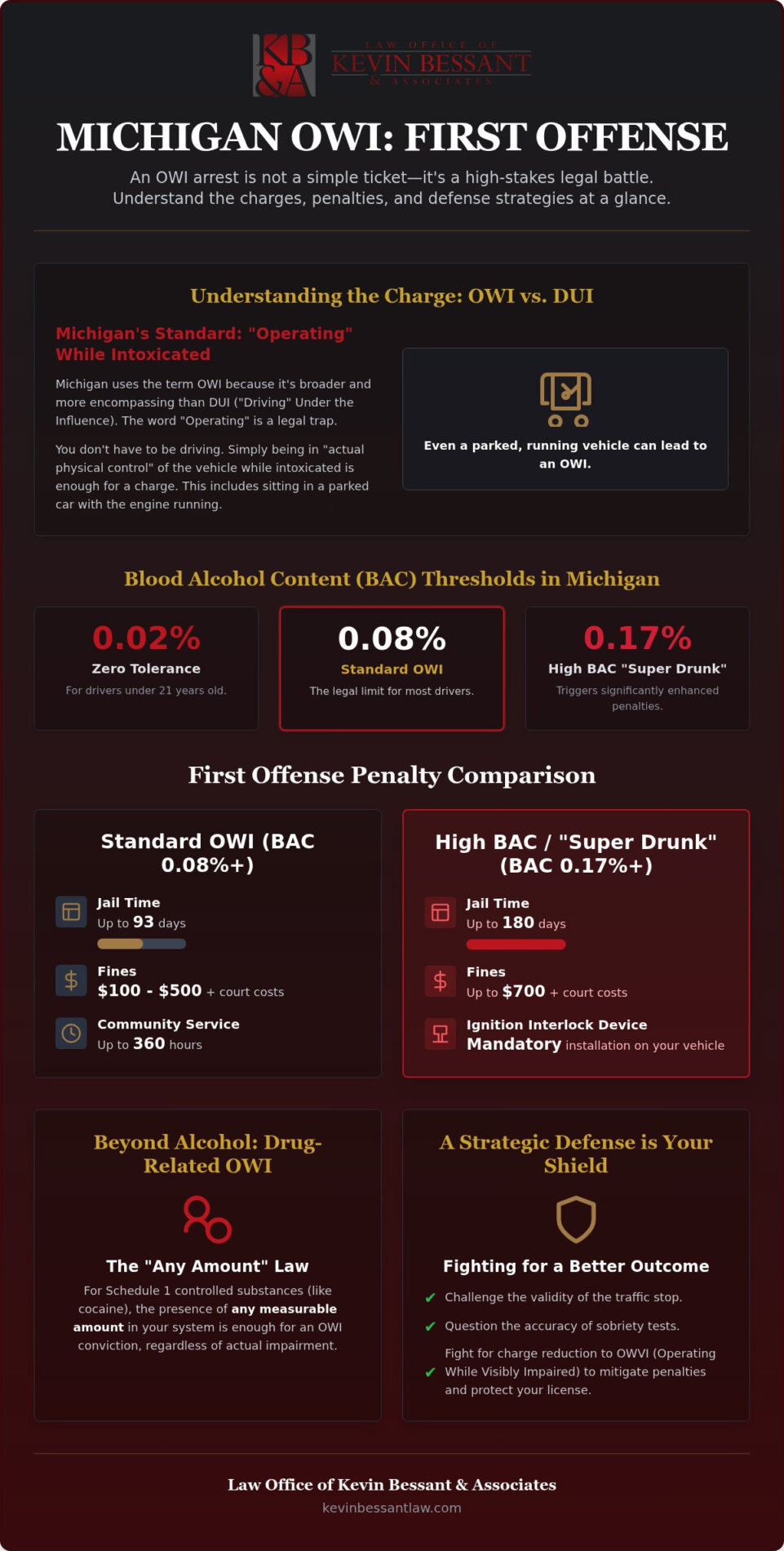
The standard threshold for a Michigan OWI first offense is a Blood Alcohol Content (BAC) of 0.08% or higher. However, the law doesn’t stop there. If you’re under 21, Michigan enforces a “Zero Tolerance” policy where a BAC as low as 0.02% can trigger a conviction. You also need to realize that OWI isn’t limited to alcohol. The state can prosecute you for being under the influence of controlled substances or even legally prescribed medications if they impair your ability to operate a vehicle safely. The prosecution is already mounting an offensive against your future. Every report filed and every statement recorded is a brick in the wall they’re building to secure a conviction for your Michigan OWI first offense. You need an aggressive shield to stand in that gap and fight back.
OWI vs. DUI: What’s in a Name in Michigan?
Most states use the term DUI, but Michigan uses OWI because it’s more encompassing. The word “Operating” is the trap. You don’t have to be speeding down I-75 to be charged. If you’re sitting in a parked car with the engine running to stay warm, the law considers you to be “operating” that vehicle. This broad definition gives prosecutors a massive advantage. They don’t need to prove you were moving; they only need to prove you were in actual physical control of the vehicle while intoxicated. It’s a subtle distinction that leads to life-altering consequences for those who don’t have expert advocacy.
The ‘Any Amount’ Law for Schedule 1 Substances
Michigan’s stance on drugs is uncompromising. While alcohol requires a specific BAC percentage, Schedule 1 drugs like cocaine or certain synthetic substances fall under the “Any Amount” rule. This means the presence of any measurable amount in your system is enough for a conviction, regardless of whether you actually appeared impaired. A first offense drug-based OWI carries the same weight and penalties as an alcohol-related offense. Under the ‘Any Amount’ rule, Michigan law dictates that a driver can be convicted of OWI simply for having a detectable level of a Schedule 1 controlled substance in their body.
The High Stakes: Jail Time, Fines, and ‘Super Drunk’ Penalties
The Michigan judicial system is a machine designed to secure convictions; the penalties for a Michigan OWI first offense are the fuel that keeps it running. Don’t let the “first offense” label fool you into thinking the court will be lenient. Judges in Wayne, Oakland, and Macomb counties often use these cases to set an example. You’re facing a criminal record that could follow you for the rest of your life. If you’re wondering about the national landscape of these charges, understanding the difference between OWI vs DUI can help you grasp why Michigan’s “Operating” standard is so aggressive and the penalties so severe.
A standard conviction for a first-time offender involves a massive disruption of your daily life. You need to be prepared for the following statutory maximums and requirements:
- Jail Time: Up to 93 days in a county facility.
- Fines: Financial penalties ranging from $100 to $500, plus significant court costs.
- Community Service: Up to 360 hours of labor.
- Probation: A period of up to 2 years where your every move is monitored by the court.
Beyond the courtroom, the collateral consequences are often what hurt the most. Your car insurance rates will skyrocket, often doubling or tripling for years. Employment background checks will flag your conviction, potentially costing you current or future job opportunities. If you feel the weight of these penalties closing in, it’s time to speak with a battle-ready advocate who can mount a defense before your first court date.
Michigan’s ‘Super Drunk’ Law (High BAC)
If your Blood Alcohol Content was 0.17% or higher, the stakes double. Under Michigan’s “Super Drunk” law, you face up to 180 days in jail and fines reaching $700. The court also mandates completion of a substance abuse program. Perhaps most frustrating is the mandatory Ignition Interlock Device (IID). You’ll be forced to blow into a tube just to start your car, paying for the privilege through monthly rental and calibration fees. This isn’t just a penalty; it’s a constant, humiliating reminder of the state’s control over your life.
Driver’s License Sanctions and Restricted Driving
Your ability to drive is under immediate threat from the Michigan Secretary of State (SOS). For a standard Michigan OWI first offense, you face a 180-day suspension. This begins with a 30-day “hard” suspension where no driving is permitted for any reason. Only after those 30 days can you apply for a restricted license to drive to work, school, or medical appointments. You’ll also need to verify the current 2026 SOS reinstatement fees to get back on the road. For High BAC cases, the hard suspension increases to 45 days, followed by 320 days of restricted driving with a mandatory IID installed.
OWI vs. OWVI: Can Your Michigan First Offense Be Reduced?
An OWI charge is a direct assault on your future, but it doesn’t have to be the final word. In many cases, the most effective path to protecting your livelihood is securing a reduction to Operating While Visibly Impaired (OWVI). This is a lesser included offense that carries significantly lighter burdens. While a Michigan OWI first offense relies on the “per se” standard of 0.08% BAC, OWVI focuses on whether your ability to drive was visibly weakened by alcohol or drugs. This technicality is the opening we use to dismantle the prosecution’s case.
The distinction between “intoxicated” and “impaired” is critical. To convict you of OWI, the prosecutor usually just needs a lab result showing you hit the 0.08% mark. For OWVI, they must prove that your driving performance was actually affected. This gap in the state’s evidence is where a battle-ready advocate like Kevin Bessant finds the leverage to negotiate. We don’t just ask for leniency; we demand it by exposing the weaknesses in the officer’s observations and the chemical testing procedures. Standing in the gap for you means we never accept the state’s first offer without a fight.
The Benefits of an OWVI Reduction
Securing an OWVI reduction is a major victory because it eliminates the most crippling parts of a standard Michigan OWI first offense conviction. The most immediate benefit is the preservation of your right to drive. Unlike an OWI, which forbids all driving for a 30-day “hard” suspension period, an OWVI allows for immediate restricted driving privileges. You’ll also receive 4 points on your Michigan driving record instead of 6, and fines are capped at $300. These reductions save you thousands in long-term insurance costs and keep you on the road so you can keep your job.
The Negotiation Process in Detroit Courts
Prosecutors in Detroit and throughout Wayne County are notoriously tough, but they aren’t machines. They respond to strength and preparation. Standing alone in a courtroom is a recipe for disaster. You need a shield that understands the local landscape and the specific tendencies of the prosecutors you’re facing. Our 20+ years of experience allows us to navigate these treacherous waters with confidence.
We often utilize proactive defense strategies to force a reduction. This might include completing an early alcohol assessment or providing evidence that contradicts the officer’s claims of impairment. By the time we sit down to negotiate, the state needs to know that a trial will be a long, difficult struggle for them. This aggressive posture makes a reduction to OWVI much more likely. Discover why our experience makes the difference in these high-stakes negotiations.
Fighting Back: Tactical Defense Strategies for OWI Cases
The prosecution wants you to believe their evidence is airtight. They want you to feel that the police report is an undisputed record of facts. This is a lie. A Michigan OWI first offense is built on a foundation of police observations and chemical data that is far more fragile than the state wants you to believe. You aren’t a victim of the system; you’re a fighter who needs a shield to expose the vulnerabilities in the government’s case. We don’t just review the evidence. We dismantle it piece by piece.
Our strategy begins with the initial contact. If the officer lacked reasonable suspicion to pull you over, every piece of evidence gathered after that moment is “fruit of the poisonous tree.” We investigate every detail of the stop. Did you actually cross the fog line? Was your driving truly erratic, or was the officer looking for any excuse to make an arrest? If we can prove the stop was unconstitutional, the judge may suppress the evidence, effectively ending the case before it even reaches a jury. If you want to challenge the evidence against you, contact our firm immediately to begin your defense.
Deconstructing the Police Report
Officers are trained to write reports that justify their arrests. However, their memory often fails when compared to dashcam and bodycam footage. We look for inconsistencies between what the officer claimed to see and what the video actually shows. A single procedural error by the arresting officer, such as failing to establish reasonable suspicion before the stop, can lead to a full dismissal of all charges. We force the prosecution to prove every element of the charge beyond a doubt, and we don’t give an inch of ground.
Challenging Blood and Breath Evidence
The science used by the state is often flawed. In Michigan, the DataMaster DMT is the standard for breath testing, but these machines are prone to mechanical errors and calibration drift. We demand maintenance logs and officer certification records to ensure the machine was functioning perfectly. If it wasn’t, the results shouldn’t be used against you.
Blood draws are equally vulnerable. We analyze the chain of custody and the specific protocols used during the draw. Contamination, improper storage, or a lack of medical oversight can lead to inaccurate BAC readings. By using expert witnesses to dismantle the state’s scientific claims, we stand in the gap to protect your freedom from faulty technology and human error.
Finally, we analyze your “Implied Consent” rights. Michigan law requires officers to properly advise you of your rights regarding chemical testing. If they failed to read these rights or coerced your “consent,” your refusal or the subsequent test results may be challenged. Never assume the evidence is too strong to fight. With the right advocacy, even the most daunting cases have a path to victory.
Kevin Bessant & Associates: Your Shield Against the Michigan System
The Michigan legal system is an indifferent machine designed to process you and secure a conviction for your Michigan OWI first offense. It doesn’t care about your job, your family, or your future. You don’t have to face this overwhelming pressure alone. Kevin Bessant & Associates acts as your vital shield. We stand in the gap between you and the crushing weight of the law. With over 20 years of criminal defense experience, we’ve seen every tactic the prosecution uses in Wayne, Oakland, and Macomb counties. We handle the intense pressure of the courtroom so you don’t have to. Our commitment follows a danger then rescue pattern: we identify the legal threats against you and provide the decisive intervention required to dismantle them.
Call our office immediately. The clock is already ticking on your driver’s license suspension and the state’s window to gather evidence. Every hour you wait gives the prosecution more time to solidify their case. By engaging an aggressive advocate now, you stop the momentum of the system and begin building a battle-ready defense. We don’t just offer consultations; we offer a methodical path forward for those who refuse to be intimidated by a Michigan OWI first offense.
A Local Advocate for Detroit and Surrounding Suburbs
In the legal world, local knowledge is power. A lawyer who isn’t familiar with the specific tendencies of judges in Troy, Royal Oak, or Eastpointe is at a severe disadvantage. Our firm is deeply rooted in the local landscape of Detroit, Southfield, and Warren. We know how local law enforcement operates and how specific prosecutors negotiate. If you or a loved one is currently held in custody, securing immediate release is the first priority. As a dedicated Bond Hearing Lawyer Detroit, we provide the aggressive advocacy needed to secure your release and protect your rights from the moment of arrest.
The Path to Expungement: The Michigan Clean Slate Law
A single mistake shouldn’t define your entire life. Under Michigan’s Clean Slate Law, a first offense OWI is no longer a permanent stain on your record. After a designated waiting period, you may be eligible to have the conviction completely expunged. We don’t just fight for a favorable outcome in court today; we protect your entire future. Our Expungement Attorney Michigan services ensure that once your legal battle is over, you have a clear path to restoring your reputation and clearing your past. We are the shield that protects your freedom today and your opportunities tomorrow.
Take Control of Your Defense and Protect Your Freedom
A Michigan OWI first offense is a high-stakes crisis that demands an immediate, aggressive response. You’ve seen the severity of the penalties, ranging from potential jail time to the long-term loss of your driving privileges. However, you’ve also seen that these charges are not invincible. By challenging the legality of the initial stop and attacking the reliability of chemical evidence, you can fight for a reduction to OWVI or even a full dismissal of the case. You need Detroit’s trusted criminal defense shield to stand in the gap. With 20+ years of experience and a reputation for battle-ready advocacy, Kevin Bessant & Associates is ready to fight for your future. Don’t wait for the system to decide your fate. Secure Your Aggressive OWI Shield; Contact Kevin Bessant Today. Your life is too important to leave to chance. Take the first step toward peace of mind and reclaim control over your life starting now.
Legal Authority: Statute and Case Law
Michigan’s OWI statute is codified at MCL 257.625, with the “operating” requirement defined at MCL 257.35a.
- People v Wood, 450 Mich 399, 404-405 (1995) — the Michigan Supreme Court held that a person “operates” a vehicle once they have put it in motion or in a position posing a risk of collision, and continues to operate it until that risk is gone, even if the car is parked with the engine running when police arrive.
- People v Hammerlund, 504 Mich 442, 451 (2019) — held that a warrantless OWI arrest made without probable cause requires suppression of the resulting breath-test results and statements, the controlling case for challenging a weak initial stop.
For the current statutory text and published opinions, see the Michigan Legislature’s MCL database and the Michigan Courts case search.
Frequently Asked Questions
Can I really go to jail for a first offense OWI in Michigan?
Yes, you can be sentenced to up to 93 days in jail for a standard first conviction. While some first-time offenders avoid jail, judges in Wayne and Oakland counties often impose time to deter future violations. Don’t assume you’ll get a pass just because it’s your first arrest. You need an aggressive defense to fight for alternative sentencing or a full dismissal to keep you out of a cell.
How long will my driver’s license be suspended after a first OWI?
A standard Michigan OWI first offense triggers a 180-day license suspension. This includes a 30-day “hard” suspension where no driving is permitted. After that, you may qualify for a restricted license for the remaining 150 days. These restrictions only allow travel to work, school, and medical appointments. It’s vital to act quickly to understand your rights before the Secretary of State takes action.
What is the difference between OWI and ‘Super Drunk’ charges?
The primary difference is the Blood Alcohol Content (BAC) level and the resulting penalties. A standard OWI applies to a BAC between 0.08% and 0.16%. A “Super Drunk” charge is triggered at 0.17% or higher. High BAC convictions carry doubled jail time of up to 180 days, higher fines, and mandatory use of an ignition interlock device for at least one year during the restricted driving period.
Can a first offense OWI be expunged from my record under the Clean Slate law?
Yes, Michigan law now allows for the expungement of a first-offense OWI. You must wait five years after your probation ends before you can apply to have the conviction removed from your public record. This is a complex process that requires a formal petition to the court. It’s a critical tool for restoring your reputation and opening doors for future employment opportunities that a conviction would otherwise block.
Do I have to take the field sobriety tests if I am pulled over?
No, you aren’t legally required to perform field sobriety tests (FSTs) in Michigan. These tests are highly subjective and designed to build evidence against you. While an officer might make it sound mandatory, you can politely refuse. Be aware that refusing these roadside tests may lead to an arrest, but it prevents the prosecution from using flawed physical performance data against you in court later.
What happens if I refused the breathalyzer at the police station?
Refusing the chemical test at the station triggers an automatic Implied Consent violation. This results in a one-year driver’s license suspension and six points on your record, regardless of the OWI case outcome. You only have 14 days to appeal this suspension through a circuit court hearing. This is a high-stakes separate legal battle that requires immediate intervention from an experienced advocate to save your driving privileges.
How much does an aggressive OWI defense lawyer cost in Michigan?
Legal fees for an aggressive defense vary based on the complexity of the case and the attorney’s experience level. You should prioritize value and a proven track record over the lowest price. A cheap lawyer might cost you your freedom and your career in the long run. Focus on finding a shield who understands the local courts and has the vigor to fight for a charge reduction.
Will an OWI conviction affect my professional license or job?
Yes, a Michigan OWI first offense conviction can jeopardize professional licenses for nurses, pilots, and commercial drivers. Most licensing boards require you to report any criminal convictions immediately. Employers also look at these records during background checks for new hires. Protecting your career starts with mounting a battle-ready defense to prevent the conviction from ever appearing on your permanent record.
What does “operating” a vehicle actually mean under Michigan’s OWI law?
Under People v Wood, 450 Mich 399 (1995), a driver “operates” a vehicle for OWI purposes once they’ve put it in motion or in a position posing a risk of collision, and continue to operate it until that risk is gone, meaning you can be found guilty even if the car was parked when police arrived.