
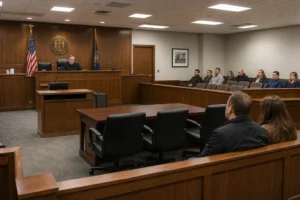

Getting arrested for OWI in Michigan is frightening, and the first court date, your arraignment, usually comes before you’ve had time to think clearly. You have questions about what the judge will say, how you should plead, and whether you’ll go home that day. This page walks you through exactly what happens at a Michigan OWI arraignment, step by step, so you can show up prepared instead of panicked.
Key takeaways
-
At your OWI arraignment, a judge reads the charge against you, informs you of your constitutional rights, sets your bond and release conditions, and takes your plea. In most Michigan OWI cases you plead not guilty so your defense has time to work.
-
If you were held in jail after the arrest, Michigan law requires arraignment without unnecessary delay, usually within 24 to 48 hours. If you were released with a ticket or appearance date, your arraignment may be weeks away.
-
Your driver’s license is handled separately from the criminal case. If you refused the chemical test, you have only 14 days from the arrest to request an implied consent hearing with the Michigan Secretary of State, or your license is suspended automatically for one year.
-
An OWI first offense under MCL 257.625 carries up to 93 days in jail, fines, and 6 points on your license, so the choices you make at arraignment matter from day one.
What is an arraignment in a Michigan OWI case?
An arraignment is your first formal court appearance after an OWI arrest, where the court officially tells you what you are charged with and what your rights are. Think of it as the starting line of the criminal case, not the trial. No one decides your guilt at the arraignment, and no witnesses testify. The judge or magistrate handles four things: reading the charge, advising you of your rights, setting bond, and recording your plea.
OWI stands for Operating While Intoxicated, Michigan’s term for drunk or drugged driving under MCL 257.625. The charge can be based on a blood alcohol content of 0.08 or higher, a reading of 0.17 or higher (the “high BAC” or “super drunk” charge), or evidence that any amount of alcohol or a controlled substance impaired your driving. The specific charge read at arraignment tells your attorney a great deal about how the prosecution plans to proceed.
It helps to understand that being arrested and being formally charged are two different steps. Many people are released after an arrest while the prosecutor decides what to file. For a fuller breakdown, see our explanation of the difference between being arrested and charged in Michigan.
How soon after an OWI arrest does the arraignment happen?
The timing depends on whether you were held in custody. If you stayed in jail after the arrest, Michigan requires that you be arraigned without unnecessary delay, which in practice usually means within 24 to 48 hours, including over a weekend in many districts through video arraignment. If you were released at the scene or from the jail with a citation and a future court date, your arraignment could be anywhere from a few days to several weeks later.
Do not treat a delay as good news. The clock on your license is already running, and the gap before arraignment is the best window to get a lawyer involved. We return consultation requests within 24 hours, and the sooner we review the police report and the breath or blood evidence, the more options we can protect before the first hearing.
What actually happens at your OWI arraignment, step by step?
At the arraignment the judge moves through a fixed sequence, and knowing it removes most of the fear. Here is what to expect:
-
The charge is read. The court states the exact OWI offense, whether it is a first offense, a high BAC charge, or a repeat offense, and the maximum penalty attached to it.
-
You are advised of your rights. The judge explains your right to an attorney, your right to remain silent, and your right to a trial. If you cannot afford a lawyer, the court will note your request for a court-appointed one.
-
You enter a plea. You will be asked how you plead. Your realistic choices are guilty, not guilty, or no contest. In nearly every OWI case, not guilty is the correct plea at this stage.
-
Bond and conditions are set. The judge decides whether you are released on your own recognizance, released after posting bond, or held, and attaches conditions you must follow until the case ends.
-
The next date is scheduled. You leave with a date for a pretrial conference, where your attorney and the prosecutor begin negotiating.
In many Michigan district courts, a defense attorney can appear for a misdemeanor OWI arraignment on your behalf or even waive the arraignment, meaning you may not have to stand before the judge yourself. That is one of the first practical reasons to retain counsel before the date.
How should you plead at your OWI arraignment?
You should plead not guilty at your OWI arraignment, in almost every case, because pleading guilty at the first hearing throws away your leverage before anyone has looked at the evidence. A not guilty plea is not a claim that you did nothing. It is a procedural step that keeps the case open so your attorney can review the traffic stop, the arrest, the breath test calibration, and the blood draw chain of custody.
Prosecutors and judges are not on your side at the arraignment, and they are not required to tell you about weaknesses in the state’s case. We have seen stops made without valid reason, breath machines that were not properly maintained, and blood samples handled in ways that undermine the reading. None of that gets examined if you plead guilty on day one. Pleading not guilty costs you nothing and preserves every defense, which is why we treat a guilty plea at arraignment as a mistake we work to prevent.
What bond and release conditions can a judge set after an OWI arrest?
After reading the charge, the judge sets the terms for your release until the case is resolved, and for a first OWI these are often manageable. Common outcomes and conditions include:
|
Release type |
What it means |
Typical OWI conditions |
|---|---|---|
|
Personal recognizance (PR bond) |
Released on a written promise to appear, no money down |
No alcohol or drugs, show up to all dates |
|
Cash or surety bond |
You post a set amount to be released |
Same as above, plus possible testing |
|
Conditional release |
Release tied to monitoring |
Random breath or drug testing, SCRAM alcohol tether, no driving without a valid license |
For a high BAC charge or a repeat offense, judges more often require alcohol testing or an ankle tether. Breaking a bond condition, such as drinking while your case is open, can land you back in jail and hurt your position before trial. Follow every condition exactly, and tell your attorney immediately if a condition is unworkable so it can be addressed in court rather than violated.
What happens to your driver’s license after an OWI arrest?
Your license faces two separate threats, and the deadlines do not wait for your arraignment. The first comes from the criminal case: a first OWI conviction under MCL 257.625 typically triggers a license suspension and 6 points. The second is the implied consent law, which is handled entirely by the Michigan Secretary of State, not the criminal court.
If you refused to take the chemical breath or blood test at the time of arrest, you have only 14 days from the arrest date to request an implied consent hearing in writing. Miss that deadline and the Secretary of State suspends your license for one year and adds 6 points automatically, regardless of what happens in your criminal case. This is one of the most common and most costly mistakes we see, because people focus on the court date and let the 14-day window close. If your license has already been lost from a prior matter, our license restoration services address Secretary of State reinstatement separately.
Do you need a lawyer for your OWI arraignment in Michigan?
Yes, and getting one before the arraignment is far better than after. The arraignment itself is brief, but the decisions locked in that day, your plea, your bond conditions, and the preservation of your implied consent deadline, shape the entire case. An attorney can often appear for you at a misdemeanor arraignment, argue for a lower or condition-free bond, and make sure you do not plead guilty before the evidence is reviewed.
We have defended individuals facing OWI and other criminal charges across Michigan since 2006. Many firms take a plea quickly and move on. We read the police report line by line, challenge the stop and the testing, and push back against the prosecution at every stage. If you want a clearer picture of the hearings that follow, our guide on what to expect in court for a first DUI walks through the full timeline.
Call us at 313-658-8159 or submit a consultation request, and we will respond within 24 hours. We accept cash, credit card, check, and electronic payment, and payment plans are available so cost does not keep you from a defense.
Frequently asked questions
Can I go to jail at my OWI arraignment in Michigan?
Usually no. The arraignment decides your bond and release conditions, not your guilt, and most people charged with a first-offense OWI are released the same day on a personal recognizance or cash bond. You could be held if you have prior offenses, outstanding warrants, or a very high BAC that concerns the judge, which is another reason to have an attorney present to argue for your release.
What should I say at my OWI arraignment?
Keep it simple: state your name when asked and plead not guilty. Do not explain what happened the night of the arrest, do not apologize, and do not argue your innocence, because anything you say can be used against you later. If you have a lawyer, let them speak for you, and answer only the direct questions the judge asks.
How long after an OWI arrest will I be charged in Michigan?
If you were released with a citation, you may already have an arraignment date on the ticket. If the prosecutor is reviewing a warrant request, formal charges can take days to several weeks to be filed. Our page on what happens after a DUI arrest in Michigan explains how the state moves from arrest to formal charge.
Do I lose my license right away after an OWI arrest in Michigan?
Not automatically from the arrest alone, but the risk is immediate. If you refused the chemical test, you have 14 days to request an implied consent hearing or your license is suspended for one year by the Secretary of State. If you took the test, the license consequences generally follow a conviction, so acting fast with an attorney protects your ability to keep driving.