

What if the single biggest mistake of your life didn’t have to be a permanent stain on your reputation? For years, a drunk driving conviction in Michigan was a life sentence of missed job opportunities and social stigma. The law changed, and the path to expunging a DUI in Michigan is now open for those ready to fight for it. You’ve served your time, yet the system continues to punish you every time a background check is run. Stop letting a past mistake dictate your potential. It’s an exhausting cycle, and you need a shield to break through it.
You understand that a clean record is the only way to move forward, but the legal hurdles often feel like an impenetrable brick wall. This comprehensive guide provides the exact roadmap you need to clear your Michigan OWI record and reclaim your future. We’ll dive into the strict eligibility requirements, the mandatory five-year waiting period, and the specific evidence a judge needs to see before granting your petition. Michigan’s “Clean Slate” isn’t an automatic right. It’s a high-stakes legal battle you must be prepared to win.
Key Takeaways
- Learn how the 2021 legislative shift transformed Michigan’s legal landscape, making it possible to set aside a conviction that once lasted a lifetime.
- Identify the strict eligibility criteria for expunging a DUI in Michigan, including the mandatory five-year waiting period and the “first-offense only” rule.
- Master the step-by-step application process, from securing certified court records in Detroit to filing the MC 227 form with absolute precision.
- Discover how to dismantle common prosecutor objections and prove your rehabilitation to a judge who holds the power over your future.
- Understand why an aggressive, battle-tested advocate is your only vital shield when facing a system designed to keep your record stained.
Understanding Michigan’s DUI Expungement Laws: The High-Stakes Reality
A DUI conviction isn’t just a fine or a suspended license; it’s a permanent digital scarlet letter. In Michigan, the legal process of removing this stain is technically called “setting aside” a conviction. Understanding Expungement is the first step in realizing that the law now works in your favor if you know how to wield it. For decades, an OWI was a life sentence. That changed on February 19, 2022, when Michigan’s legislative shift finally opened the door for expunging a DUI in Michigan. This wasn’t just a minor tweak to the books. It was a seismic overhaul of the criminal justice system designed to give people their lives back. You’ve been trapped by a single mistake, but the “Clean Slate” framework is the key to your cell.
The Life-Altering Impact of a DUI Record
The danger of a public record in our hyper-connected world is absolute. Every time you apply for a high-level position, a landlord runs a credit check, or you seek a professional license, your past is hauled into the present. Michigan employers often view an OWI as a liability, a sign of poor judgment that disqualifies you before the interview even starts. This record blocks you from nursing licenses, commercial driving opportunities, and even volunteer positions at your child’s school in Detroit or surrounding communities. It’s a barrier to professional growth that costs you thousands in lost wages over a lifetime. You’re being held back by a version of yourself that no longer exists. This is the high-stakes reality of living with a record in 2026.
Why Expungement is Not Automatic
Don’t fall for the myth that the system will fix itself. While Michigan’s “Clean Slate” laws do provide automatic relief for some minor misdemeanors, DUI convictions are strictly excluded from that process. You must be proactive. Expunging a DUI in Michigan requires a formal, written petition to the court where you were convicted. It’s a complex legal maneuver, not a clerical update. The court will scrutinize your behavior over the mandatory five-year waiting period, looking for any reason to keep you in the system. Judges have broad discretion to deny your request, often citing public safety concerns or incomplete documentation. This is where the struggle happens. You shouldn’t stand alone against a prosecutor who is paid to keep your record exactly as it is. You need a battle-ready advocate to navigate this treacherous territory. If you’re ready to stop the bleeding, visit our contact page to start your defense.
Eligibility: Do You Qualify for a Clean Slate in 2026?
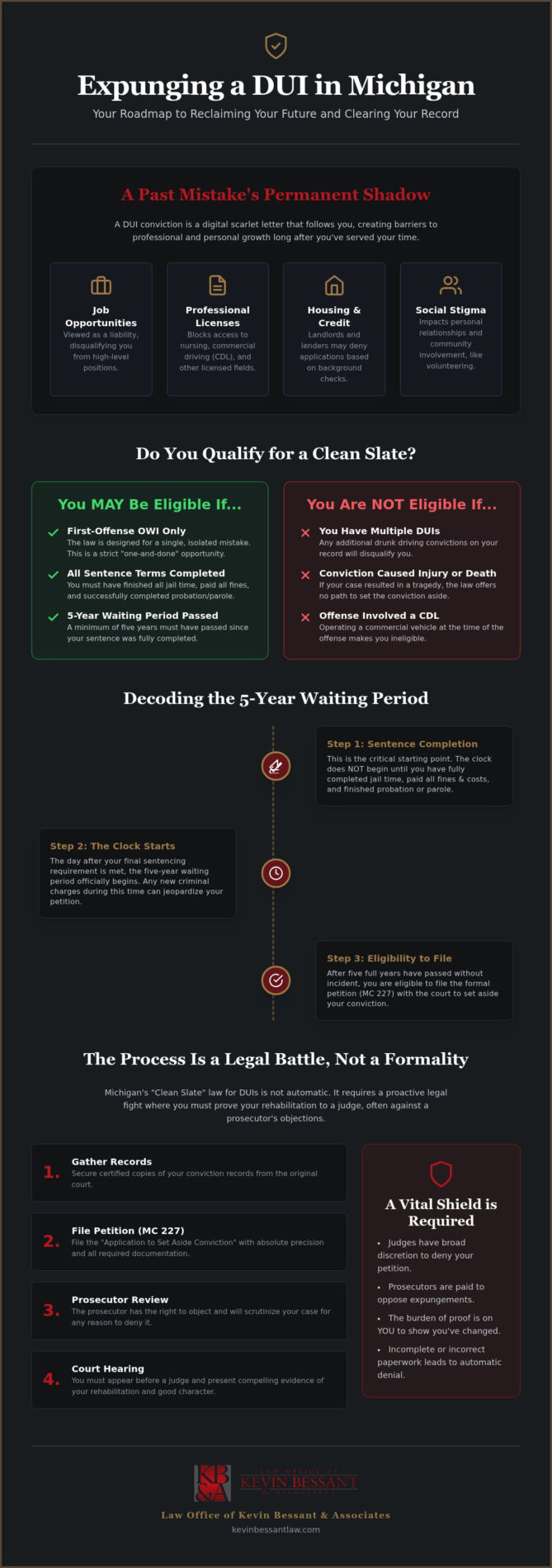
The law for expunging a DUI in Michigan is generous, but it’s not a free pass. It’s a specific legal remedy designed for those who made a single, isolated mistake. Under the current statutes, only a first-offense OWI is eligible for removal. If you have multiple drunk driving convictions on your record, the door remains closed. The state is uncompromising on this point: you get one shot at a clean slate in your lifetime. Furthermore, the conviction must not have involved serious impairment or the death of another individual. If your case resulted in a tragedy, the law offers no path to set that conviction aside. You must also prove that your offense didn’t occur while operating a commercial vehicle with a CDL. The system is built to reward those who have truly moved past their mistake, but it demands absolute compliance with these eligibility rules.
Any new contact with law enforcement can jeopardize your standing. If you’ve picked up additional criminal charges since your DUI, even unrelated misdemeanors, a judge may view you as a recurring threat to public safety rather than a candidate for relief. You can review the Michigan Attorney General’s expungement guidance for a baseline of these requirements, but the real battle happens in the courtroom. If you’re unsure where your timeline stands or if your specific OWI code qualifies, reach out to a professional who can verify your eligibility before you waste time on a doomed petition.
The Five-Year Waiting Period Decoded
The clock doesn’t start the moment the judge bangs the gavel at your sentencing. This is a common trap that leads to rejected applications. The mandatory five-year waiting period begins only after you’ve completed every single requirement of your sentence. This includes jail time, payment of all fines and costs, and the successful completion of probation or parole. For example, if your probation ended in June 2021, you are eligible to file your application in June 2026. If you file even one day early, the court will reject your petition, and you might be barred from reapplying for several years. Precision is your only shield here. Don’t guess; verify your discharge dates through official court records to ensure your timeline is bulletproof.
The “First-Offense” Limitation
Michigan law follows a strict “One Bad Night” philosophy for DUI relief. This means that if you were charged with multiple counts during a single incident, such as an OWI and a related traffic offense, you might still qualify. However, if you have two separate DUI convictions from two different nights, you’re disqualified from expunging a DUI in Michigan. The statute specifically targets OWI (Operating While Intoxicated), OWVI (Operating While Visibly Impaired), and Zero Tolerance violations. These codes are the only ones the court will consider “setting aside.” If your record contains a felony DUI or a second-offense charge, the “Clean Slate” framework doesn’t apply to you. You are fighting for a rare second chance, and the court will look for any reason to deny it.
The Step-by-Step DUI Expungement Process in Michigan
The process of expunging a DUI in Michigan is a meticulous legal procedure where one clerical error can cost you years of progress. You must start by obtaining a certified copy of your conviction from the local court, such as the 36th District Court in Detroit or the 3rd Circuit Court in Wayne County. This isn’t a suggestion; it’s a requirement. Once you have the record, you must undergo a formal fingerprinting process through an approved vendor to trigger a Michigan State Police background check. This check ensures your record matches your application and that no new crimes have reset your five-year clock.
After gathering your documents, you’re required to serve the petition to both the Michigan Attorney General and the local prosecutor’s office. They are the gatekeepers. They will review your history and decide whether to file an official objection. Navigating Michigan’s Clean Slate laws requires more than just filling out forms. It requires a tactical approach to serving these parties to ensure your petition isn’t ignored or delayed by bureaucratic red tape. The system doesn’t work for you; you have to make it work through aggressive adherence to the rules.
Preparing the Petition (MC 227)
The MC 227, or the “Application to Set Aside Conviction,” is the foundation of your case. In Wayne County courts, the administrative hurdles are high and the dockets are crowded. Filing fees must be paid exactly, and the information provided must be 100% accurate. A single misspelling or an incorrect statute citation leads to immediate dismissal. This is why Kevin Bessant handles the heavy lifting. We don’t leave your future to chance. We ensure every line of the petition is bulletproof, removing the procedural risks that sink thousands of unrepresented applicants every year. Discover why us is the right choice for protecting your record from administrative failure.
The Hearing: Standing Before the Judge
The hearing is the most critical moment in the process of expunging a DUI in Michigan. You’ll stand before a judge in a high-pressure environment where the burden of proof rests entirely on your shoulders. You aren’t just asking for a favor. You must prove through clear evidence that you’re fully rehabilitated. The judge will scrutinize your life since the conviction, looking for proof that setting aside the OWI is in the best interest of the public. This isn’t a conversation; it’s a legal battle. You need an advocate who can present your growth with authority and silence the prosecutor’s attempts to keep you anchored to your past.
Overcoming Obstacles: Why Prosecutors Fight Your Freedom
Prosecutors are not your allies in this process. Their primary mandate is to preserve the integrity of the public record, which often means fighting tooth and nail to keep your conviction visible to the world. When you attempt the process of expunging a DUI in Michigan, you’re challenging a system that prefers permanence over second chances. Prosecutors frequently object based on a broad “Public Safety” argument, claiming that removing the offense from your record puts the community at risk of future harm. If your original case involved even minor property damage or a fender bender, they’ll amplify those facts to paint you as a liability. You need a shield to dismantle these narratives with cold, hard evidence of your transformation.
Judicial discretion is the ultimate hurdle in any OWI set-aside case. Even if you meet every technical requirement under the law, a judge can still deny your petition simply because they don’t believe you’ve earned it yet. This is where unrepresented petitioners often fail. They walk into court expecting a rubber stamp and instead face a hostile interrogation from the bench. You must be prepared to prove that your life today bears no resemblance to the night of your arrest. If you aren’t ready to fight for your character, the system will keep you trapped in your past. Speak with an aggressive advocate to prepare your defense before you step into the courtroom.
Countering the “Rehabilitation” Challenge
Judges look for more than just a clean record; they want proof of active, sustained change. This means presenting certified alcohol treatment records, certificates from educational programs, or powerful character references from community leaders who can vouch for your integrity. Rehabilitation is a consistent pattern of law-abiding behavior since the conviction. We don’t just tell the judge you’ve changed; we show them. We aggregate every piece of evidence to build a wall of credibility that the prosecutor cannot tear down. Your growth must be undeniable.
Navigating Local Court Nuances
The atmosphere in a Detroit courtroom is vastly different from the environment in Warren or Royal Oak. Every jurisdiction has its own culture and every judge has a unique history of rulings on OWI set-asides. Knowing whether a specific judge prioritizes community service over clinical therapy is a vital tactical advantage that can’t be found in a law book. We use our 20 years of experience to tailor your presentation to the specific person sitting on the bench. Our aggressive shield approach ensures your character is defended with the same vigor used in a high-stakes felony trial, ensuring your voice is heard above the prosecutor’s objections.
Why Kevin Bessant is Your Vital Shield for DUI Expungement
The legal system isn’t designed to be your friend. It’s a complex, often cold machine that prioritizes procedures over people. When you’re expunging a DUI in Michigan, you aren’t just submitting an application; you’re entering a high-stakes arena where the opposition is paid to keep your record stained. Kevin Bessant acts as your vital shield in this environment. With over 20 years of battle-tested experience in Michigan courts, he knows exactly how to anticipate the moves of aggressive prosecutors. He doesn’t just stand by you; he stands in the gap, offering a confident and unwavering voice when your future is on the line.
Our “Aggressive Defense” philosophy is what sets us apart. Many firms treat expungement as a clerical task, simply filling out forms and hoping for the best. We don’t operate that way. We fight for your future with the same vigor we use in high-stakes felony trials. We handle the heavy lifting of the petition process, ensuring that the Attorney General and local prosecutors are met with a formidable case for your rehabilitation. This proactive approach gives you the peace of mind to focus on what matters most: your career, your family, and your reputation. You’ve carried this burden long enough. It’s time to let a seasoned expert clear the path forward.
The Law Office of Kevin Bessant & Associates Advantage
We have deep roots in Detroit, Southfield, and the surrounding Michigan communities. This local knowledge is a tactical weapon in your favor. We understand the specific nuances of different jurisdictions and develop a personalized strategy for every single client. We don’t believe in a one-size-fits-all approach because every case has its own unique set of challenges and opportunities. Our reputation as a dominant force in the region is built on decades of achieving favorable outcomes for people just like you. Learn more about why us is the right choice to protect your interests and secure your second chance.
Take the Next Step Toward Your Future
Do not let a past mistake dictate your 2026 and beyond. The window of opportunity is open, but the system won’t wait for you to find your footing. Secure an aggressive advocate before you file your petition to ensure you don’t fall victim to avoidable procedural errors or hostile prosecutorial objections. You deserve a clean slate and the freedom that comes with it. Take control of your narrative today. Contact Kevin Bessant today for a confidential consultation and start the process of expunging a DUI in Michigan with a battle-ready advocate by your side.
Legal Authority: The Set-Aside Statute
Michigan’s expungement (set-aside) process, including the first-offense OWI provision, is codified at MCL 780.621 through MCL 780.624, part of the Clean Slate framework enacted by 2020 PA 188 through 193. The first-offense OWI set-aside eligibility took effect February 19, 2022, and the five-year waiting period, the “one bad night” rule, and the disqualification for offenses involving injury, death, or a CDL are all set out directly in MCL 780.621.
For the current statutory text, see the Michigan Legislature’s MCL database and the Michigan State Police’s Clean Slate resources.
Reclaim Your Future and Restore Your Reputation
You’ve carried the weight of a conviction for too long. The 2022 law change provides the opening you need, but it’s a high-stakes legal battle that requires absolute precision. Expunging a DUI in Michigan isn’t a clerical update; it’s a fight against a system that prefers permanence. You must meet the strict five-year waiting period and present undeniable evidence of rehabilitation to a judge who has the power to deny your request. Don’t walk into a courtroom alone.
Kevin Bessant brings 20+ years of Michigan legal experience to your side. As an aggressive Detroit DUI defense specialist with a proven track record in expungement litigation, he acts as the vital shield you need to silence prosecutor objections. It’s time to stop looking over your shoulder and start looking toward your next career move. Secure Your Aggressive DUI Expungement Advocate Today. Your clean slate is within reach, and we’re ready to help you seize it.
Frequently Asked Questions
Can I expunge a second or third DUI in Michigan?
No, you cannot set aside a second or third OWI. Michigan law is absolute on this point. The 2022 expansion of the law only applies to a single first-time conviction. If you have multiple drunk driving offenses on your record, you are disqualified from this specific legal remedy. This rule exists to target those who made an isolated mistake rather than habitual offenders. You cannot clear a second or third OWI.
How much does it cost to expunge a DUI in Michigan in 2026?
The standard filing fee for a DUI expungement application is $50. You should also account for administrative costs like fingerprinting fees through the Michigan State Police and fees for certified copies of court records from Detroit or regional courts. While these state-mandated costs are relatively low, the real investment is in the legal representation required to navigate the hearing successfully. Don’t risk a rejection over a small filing error.
Will my DUI expungement also clear my driving record (Secretary of State)?
No, an expungement only removes the conviction from your public criminal record. The Michigan Secretary of State maintains a separate driving record where the OWI will remain visible. This means that while employers running criminal background checks won’t see the conviction, insurance companies and law enforcement can still access your driving history. A subsequent OWI will still be charged as a second offense because the driving record remains intact.
How long does the entire DUI expungement process take from start to finish?
The process generally takes between three and six months. This timeline includes gathering certified records, completing the fingerprinting background check, and serving the Attorney General. Once the petition is filed, the court must schedule a hearing date, which depends on the specific docket in cities like Detroit or Southfield. Starting the process of expunging a DUI in Michigan immediately is vital because court backlogs can cause significant delays.
Do I have to appear in person for my expungement hearing?
Yes, you are typically required to appear in person before the judge. This hearing is your opportunity to prove your rehabilitation. The judge needs to see you and hear your testimony to determine if granting the expungement is in the public interest. In some jurisdictions, remote video hearings may be an option, but you must be prepared to face the court directly to defend your character and your future with your advocate.
What happens if my petition for expungement is denied?
If a judge denies your petition, you must wait at least three years before you can reapply. This is a severe penalty for an unsuccessful attempt. Denials often happen because of procedural errors or a failure to convince the judge of your rehabilitation. This high-stakes risk is why you need a battle-ready advocate to ensure your first application is bulletproof. You don’t want to lose another three years of your life.
Can an expunged DUI be used against me if I get another OWI later?
Yes, law enforcement and prosecutors can still see the set-aside conviction. If you are arrested for another drunk driving offense, the expunged DUI will be used to enhance the new charge to a second or third offense. Expungement provides a clean slate for public and professional purposes, but it does not grant immunity from the escalating penalties of Michigan’s OWI laws for any future incidents on the road.
Is a lawyer really necessary for a Michigan DUI expungement?
While you can technically file on your own, it’s a dangerous gamble. The process of expunging a DUI in Michigan involves complex service requirements and a high-pressure court hearing where prosecutors will likely object. A seasoned advocate acts as your shield, handling the heavy lifting of the paperwork and aggressively defending your character. One small mistake can lead to a three-year ban on reapplying, making professional representation a vital necessity for success.