

The evidence the police claim will put you behind bars might be legally invisible, but only if you have the grit to fight back. If officers forced their way into your home or blocked your car without a valid reason, they didn’t just find evidence; they violated the law itself. Understanding the complex rules of illegal search and seizure Michigan is the first step in reclaiming your life from a system that often prioritizes convictions over your constitutional rights. You shouldn’t have to stand alone against aggressive tactics that ignore your privacy and your future.
You likely feel that the authorities overstepped their bounds, and you’re right to fear a long prison sentence. This article will teach you how to identify unconstitutional police conduct and the aggressive legal strategies used to suppress evidence and protect your freedom. We’ll preview critical updates, including the 2020 Michigan Constitutional amendment protecting your electronic data and the 2024 Supreme Court ruling in People v. Duff. You’ll learn how a fierce defense can dismantle a prosecutor’s case, leading to dismissed charges and a restored sense of justice.
Key Takeaways
- Understand how Article I, Section 11 of the Michigan Constitution acts as a vital shield to protect your electronic data and physical property from government intrusion.
- Identify the critical warning signs of an illegal search and seizure Michigan police often attempt, including warrant overreach and lack of probable cause.
- Learn how the latest 2024 Supreme Court rulings change your rights during traffic stops and why your home’s curtilage remains a strictly protected zone.
- Discover the power of the “Exclusionary Rule” to suppress illegally obtained evidence and potentially force a full dismissal of your criminal charges.
- See how aggressive defense strategies expose police misconduct and challenge the credibility of law enforcement affidavits to secure your freedom.
Michigan Constitution Article I, § 11: Your Primary Shield
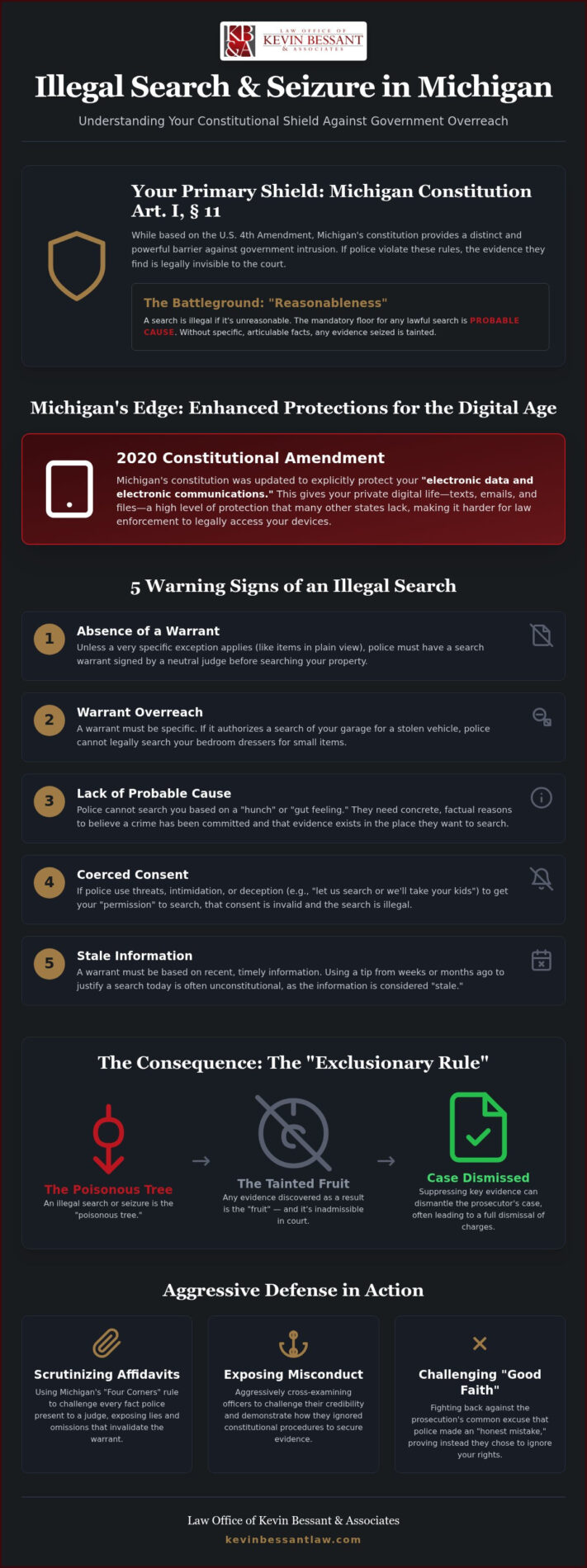
The law is your only weapon when the state turns its sights on you. Article I, Section 11 of the Michigan Constitution acts as your primary shield against government overreach. While this provision was built on the foundation of the Fourth Amendment to the U.S. Constitution, it’s a separate and powerful legal barrier. In high-stakes felony cases, a single constitutional violation is often the only thing standing between a prison cell and your freedom. If the police violated these rules, the evidence they found shouldn’t exist in the eyes of the court.
You need to understand that Michigan judges use a specific lens to look at police conduct. They don’t just ask if a crime was committed; they ask if the police respected the boundaries of the constitution while investigating it. When those boundaries are crossed, it’s called an illegal search and seizure Michigan, and it’s grounds for an aggressive legal challenge. Kevin Bessant understands that the system is designed to favor the prosecution, which is why he uses the constitution to level the playing field.
The Difference Between State and Federal Protections
Michigan law doesn’t just mirror federal standards; it often provides more specific protections for its citizens. For example, our state constitution was amended on December 19, 2020, to explicitly include “electronic data and electronic communications” as protected categories. This means your private digital life has a high level of protection that many other states lack. Michigan courts also maintain a strict interpretation of what constitutes “possessions” and “houses.”
The requirement for an “oath or affirmation” before a warrant is issued isn’t a mere formality. It’s a mandatory procedural hurdle that police often try to skip or rush through. Kevin Bessant scrutinizes every word of the affidavits used to secure warrants. He looks for “creative writing” or flat-out lies that police use to convince a judge to sign off on a search. If the foundation of the warrant is cracked, the entire case can crumble.
Why “Reasonableness” is the Battleground
Judges evaluate police conduct based on a “reasonableness” standard. An unreasonable search occurs when the government invades your privacy without a compelling, legally sanctioned justification. Probable cause is the mandatory floor for any lawful search. Without it, any evidence seized is tainted. In Detroit and surrounding areas, prosecutors often rely on the “good faith” exception to save a botched investigation. They’ll argue the police made an honest mistake. We don’t accept those excuses. We fight to prove that the police didn’t act in good faith but instead chose to ignore your rights. This aggressive litigation is the only way to ensure illegal search and seizure Michigan tactics are punished by the court.
What Makes a Search “Illegal” in Michigan? The 5 Warning Signs
Police officers often carry themselves as if their authority is absolute. It isn’t. In the heat of a Detroit traffic stop or a home raid, law enforcement frequently skips the constitutional requirements that protect you. Identifying an illegal search and seizure Michigan requires looking for specific tactical red flags that suggest the police are cutting corners to secure a conviction. When officers bypass the rules, they aren’t just doing their jobs; they’re breaking the law.
Recognize these five warning signs of unconstitutional conduct during your encounter:
- Absence of a Warrant: Unless a narrow exception applies, police must have a warrant signed by a neutral magistrate.
- Warrant Overreach: Officers searching your attic when the warrant only authorized a search of the garage.
- Lack of Probable Cause: Relying on “hunches” or “gut feelings” rather than specific, articulable facts.
- Coerced Consent: Using threats, like promising to “take your kids” or “tear the house apart,” to force you to agree to a search.
- Stale Information: Using tips or evidence that are weeks or months old to justify a raid today.
Invalid Warrants and Technical Flaws
A warrant isn’t a blank check. Under Michigan’s “Four Corners” rule, a judge can only consider the facts actually written within the affidavit to determine if probable cause exists. If the police lied or omitted critical facts that would have changed the judge’s mind, the warrant is invalid. Kevin Bessant tears through these affidavits to find misrepresentations that others miss. Even a small clerical error, like a wrong house number or an expired date, can be the key to a successful challenge under foundational search and seizure law.
The Myth of “Voluntary” Consent
Police love to use the “voluntary” consent trap. They might say, “If you have nothing to hide, you won’t mind if we look.” This is a calculated psychological tactic designed to make you bypass your own rights. In Metro Detroit traffic stops, officers often claim “implied consent” to search vehicles without a shred of evidence. Don’t fall for it. You have the absolute right to say no. Never consent to a search; always demand to see a warrant. If you’ve already been searched against your will, it’s time to reach out for a legal review of the officer’s conduct to see if the evidence can be thrown out.
High-Stakes Scenarios: Vehicles, Homes, and Digital Privacy
Police often act as if your car or phone is their personal evidence locker. They’re wrong. In the heat of a Detroit roadside investigation or a late night encounter, officers frequently rely on your confusion to bypass constitutional limits. Whether you’re in your living room or behind the wheel, you have rights that law enforcement cannot simply ignore. Understanding the specific boundaries of these high-stakes scenarios is the only way to identify an illegal search and seizure Michigan before it ruins your life.
The “Plain View” doctrine is one of the most abused tools in the police arsenal. It allows officers to seize contraband without a warrant, but only if they’re legally allowed to be in the spot where they saw it. If an officer invades your private space to get a better look, the “plain view” claim is dead on arrival. We fight to prove that the officer’s presence was a trespass, not a legal observation.
Vehicle Searches and the “Terry Stop”
Roadside investigations often begin with a “Terry Stop,” which allows for a limited pat-down for weapons if the officer fears for their safety. It does not give them a license to dig through your pockets or console. In cities like Southfield and Warren, where traffic enforcement is notoriously high, police frequently overstep by searching trunks or glove boxes without probable cause. If you’ve been pulled over for a traffic violation, you need an aggressive DUI Defense Lawyer Detroit to ensure the entire stop wasn’t just a pretext for an illegal fishing expedition.
Your Digital Life: Cell Phones and Privacy
Your cell phone contains your entire life, and the law recognizes its unique privacy status. Under the landmark Riley v. California ruling, police generally must obtain a warrant to search your digital data, even after a lawful arrest. This protection is vital because a phone is not a simple “container” like a cigarette pack or a bag. It’s a portal to your private communications and history.
As of 2026, Michigan standards for biometric data like FaceID and fingerprints are strictly enforced to prevent police coercion. Officers cannot physically force you to unlock your phone or use your biometric markers through intimidation. If the police accessed your digital life through threats or without a specific warrant, that evidence is a prime candidate for suppression. We don’t let the prosecution use your own data against you when it was seized through illegal search and seizure Michigan tactics.
Home Privacy and the “Curtilage”
Your home is your most protected space, but that protection doesn’t stop at your front door. The law protects the “curtilage,” which includes your front porch, driveway, and yard. Police cannot linger on your porch or peek through side windows without a warrant or a very specific emergency. If they gathered evidence by trespassing on your curtilage, they’ve violated your constitutional rights. We hold them accountable for every inch they overstep.
The “Fruit of the Poisonous Tree” and Evidence Suppression
The prosecution’s entire case often rests on a single piece of evidence found during a moment of police overreach. If that evidence was obtained through an illegal search and seizure Michigan, it shouldn’t be used to destroy your future. The Exclusionary Rule is the court’s primary tool for punishing police misconduct. It dictates that evidence seized in violation of your constitutional rights is inadmissible in court. This rule isn’t a loophole; it’s a vital protection that ensures law enforcement follows the same laws they are sworn to uphold.
The “Fruit of the Poisonous Tree” doctrine extends this protection even further. If the initial search (the tree) was illegal, then any secondary evidence found as a result (the fruit) is also tainted and must be suppressed. For example, if an officer illegally searches your car and finds a key to a storage locker, the contents of that locker are “poisoned” by the initial illegal act. We use this doctrine to dismantle complex cases where one mistake by the police leads to a cascade of unconstitutional evidence gathering. You need aggressive advocacy to ensure every piece of tainted evidence is identified and removed from the record.
Winning Your Case Before the Trial Starts
A trial is a risk you shouldn’t have to take if the police broke the rules. We focus on winning your case during the pre-trial phase through a Motion to Suppress. This is the formal legal vehicle used to challenge the admissibility of evidence. If the judge grants our motion, the prosecution often loses their key proof, making the case “un-triable.”
The battleground for this motion is the Evidentiary Hearing. This is where Kevin Bessant cross-examines the arresting officers under oath. We don’t just accept their version of events. We look for inconsistencies between their testimony and their written reports to expose police lies. When we strip away the illegal evidence, the prosecution is often forced to offer an immediate dismissal of charges.
Exceptions the Police Use to Fight Back
Prosecutors don’t give up easily. They often try to use the “Inevitable Discovery” rule, claiming they would have found the evidence anyway through legal means. We counter this by showing the court that their “legal means” are purely speculative and lack a factual basis. We also fight against misapplied “Good Faith” exceptions, where police claim they made an honest mistake. In Michigan, these exceptions are often used as a blanket excuse for poor training or intentional misconduct. Aggressive litigation is the only way to prevent these exceptions from swallowing your constitutional rights. If your rights were ignored, contact us immediately to start building your defense and fighting for a suppression of evidence.
Aggressive Defense: How Kevin Bessant Fights Illegal Seizures
When the police violate your rights, they expect you to roll over. They count on you being intimidated by their uniforms and their official reports. At the Law Office of Kevin Bessant & Associates, we know that a police report is often just one side of the story, frequently polished to hide an illegal search and seizure Michigan. We don’t take their word for it. We conduct a deep-dive investigation into body camera footage, dispatch logs, and witness statements to find the truth they tried to bury. The system is rigged to favor the state. We un-rig it by exposing the cracks in their narrative.
Cross-examining police credibility is our primary weapon. We look for “creative writing” in affidavits and search for misrepresentations that officers use to trick judges into signing warrants. By scrutinizing the specific judicial tendencies in Wayne and Oakland counties, we tailor our motions to the specific judge hearing your case. This local knowledge is vital. A strategy that works in Detroit might need adjustment in Troy or Southfield. The first 48 hours after a search are critical. This is the window where we can often secure vital evidence or witness accounts before they disappear or get distorted by the prosecution’s influence.
A Shield Against High-Stakes Felony Charges
If you are facing serious time, you need a battle-ready advocate who isn’t afraid to stand in the gap. We provide an aggressive defense for individuals charged with:
- Gun and Weapons Offenses: Many firearm arrests stem from illegal vehicle stops or “Terry stops” that overstepped constitutional bounds.
- Controlled Substance Charges: Drug cases are often built on illegal warrants or coerced consent that we can successfully challenge in court.
Battle-ready advocacy is the only way to survive the Michigan legal system. We don’t just “handle” cases; we litigate them with vigor and determination to ensure an illegal search and seizure Michigan doesn’t result in a life-altering conviction.
Securing Your Release and Your Future
The fight for your freedom begins at the very first stage of the process. Illegal searches often lead to inflated charges that prosecutors use to demand high bail amounts. We use the fact of an illegal search to fight for lower bail or personal recognizance at Bond Hearings. This puts you back home with your family while we dismantle the state’s evidence. Do not talk to the police without Kevin Bessant standing in the gap for you. They aren’t looking for the truth; they’re looking for a confession. Schedule your aggressive defense consultation today and let us start building the shield you need to protect your future.
Legal Authority: Statute and Case Law
Michigan’s search-and-seizure protections are codified at Article I, § 11 of the Michigan Constitution.
- People v Duff, ___ Mich ___ (July 26, 2024) (Docket No. 163961) — the Michigan Supreme Court held that a police vehicle partially blocking a person’s ability to leave can constitute a seizure under the Fourth Amendment when the totality of the circumstances, including nighttime timing, spotlighting, and positioning, would make a reasonable person feel they were not free to leave, even before any signs of a crime are observed.
- Riley v California, 573 US 373; 134 S Ct 2473; 189 L Ed 2d 430 (2014) — the U.S. Supreme Court held that police generally must obtain a warrant before searching the digital contents of a cell phone seized incident to an arrest, because a phone’s data is categorically different from a physical container.
For the current constitutional text and published opinions, see the Michigan Constitution and the Michigan Courts case search.
Take Control of Your Defense Today
You don’t have to let a single night of police overreach define the rest of your life. Whether officers violated your privacy during a Detroit traffic stop or forced their way into your home without a valid warrant, the law provides a way to fight back. By understanding the rules of illegal search and seizure Michigan, you can challenge the prosecution’s evidence before it ever reaches a jury. A successful motion to suppress can dismantle even the most aggressive felony case, turning a potential prison sentence into a full dismissal.
With 20+ years of criminal defense experience, Kevin Bessant specializes in high-stakes felony litigation where constitutional rights are the primary battleground. He is a fierce advocate for citizens across Metro Detroit who refuse to be intimidated by the legal system. Don’t wait for the prosecution to finish building their case; start tearing it down now. Demand an Aggressive Defense: Contact Kevin Bessant Now to stand behind a shield of battle-ready advocacy. Your future is worth the fight.
Frequently Asked Questions
Can Michigan police search my car if they smell marijuana in 2026?
Michigan courts have moved away from “smell alone” justifying a search because marijuana is legal for adults. However, police often use the odor as a pretext to claim impairment or “plain smell” of illegal amounts. If officers used a faint scent to tear apart your car, it likely constitutes an illegal search and seizure Michigan defense. We’ll challenge their justification to ensure your rights aren’t bypassed by outdated or illegal tactics.
What should I do if the police show up at my house with a search warrant?
Do not resist physically, but do not assist them either. Demand to see the warrant and verify that the address and date are correct. Keep your mouth shut and call Kevin Bessant immediately. Anything you say can be used to “fill in the gaps” of a weak warrant. Let your attorney handle the communication while the police are on your property. Your silence is your strongest shield during a raid.
Can my case be dismissed if the police didn’t read me my Miranda rights?
A failure to read Miranda rights won’t automatically dismiss your charges, but it can be a fatal blow to the prosecution’s evidence. It prevents the state from using any statements you made while in custody against you at trial. If your confession or admissions were coerced without a proper warning, we’ll fight to have those statements suppressed. This often makes the case impossible for the state to prove or win.
Do Michigan police need a warrant to search my trash on the curb?
Michigan law generally considers trash left on the curb for pickup as abandoned property. Police don’t need a warrant to rummage through your garbage once it’s placed in a public area for collection. However, if they entered your “curtilage,” such as a private yard or porch, to grab the bags, they’ve violated the constitution. We’ll investigate exactly where the seizure occurred to protect your privacy from illegal government intrusion.
Is a “pat-down” search legal if I am not being arrested?
A “Terry pat-down” is legal only if the officer has a specific, articulable reason to believe you’re armed and dangerous. It’s limited to a search for weapons, not a fishing expedition for drugs or contraband. If an officer reaches into your pockets and pulls out non-weapon items without your consent, they’ve overstepped. We’ll litigate the “reasonableness” of their suspicion to throw out that evidence immediately and protect your freedom.
What happens if the police search the wrong house in Michigan?
If police raid the wrong address, any evidence they find is usually inadmissible under the exclusionary rule. A warrant must describe the place to be searched with particularity. Searching the wrong home is a gross violation of Article I, Section 11. Beyond suppressing the evidence, this type of illegal search and seizure Michigan misconduct opens the door for aggressive legal challenges against the department’s training and their internal procedures.
How much does a criminal defense lawyer cost to fight an illegal search?
Fighting a high-stakes felony case is an investment in your future and your freedom. Every case is unique, and fees depend on the complexity of the investigation and the volume of evidence we need to challenge. We focus on providing a battle-ready defense that prioritizes outcomes over cutting corners. You shouldn’t put a price on avoiding a long-term prison sentence and restoring your sense of justice and security.
Can I sue the police for an illegal search and seizure in Detroit?
You can sue for damages, but these cases are complex due to “qualified immunity” protections for officers. In Detroit, civil rights lawsuits often follow a successful motion to suppress in a criminal case. If the police acted with malicious intent or gross negligence, you may be able to regain a sense of justice through a civil claim. Focus on winning the criminal battle first to build your case for damages.