
You have exactly 14 days to save your driver’s license before the state of Michigan effectively shuts down your life. The moment you said “no” to that chemical test at the station, a silent clock started ticking. Many drivers believe that by declining the test, they’ve protected their rights. In reality, the refusing breathalyzer Michigan consequences are immediate and devastating. You’re now facing an automatic one-year hard suspension and six points on your driving record. This isn’t just a legal hurdle; it’s a direct threat to your livelihood and your freedom.
It’s natural to feel anxious and confused when your independence is on the line. You shouldn’t have to face this aggressive legal system alone. This guide will show you how to fight back against the Secretary of State’s administrative penalties and explain why that 14-day appeal window is your only shield. We’ll break down the vital differences between roadside PBTs and evidentiary tests, explore new 2026 options like Senate Bill 580’s interlock provisions, and outline the exact steps you must take to keep yourself behind the wheel.
Key Takeaways
- Stop the 14-day clock immediately. You must request an administrative hearing within two weeks or face a mandatory one-year license suspension.
- Distinguish between the roadside PBT and the station test. Understanding the refusing breathalyzer Michigan consequences is critical because station-based refusals trigger much harsher administrative penalties.
- Fight the six-point penalty and “hard suspension.” Use specific tactical defenses to challenge whether the police had reasonable grounds for your initial stop.
- Leverage the latest 2026 legal trends to stay on the road. New interlock device options may offer a vital lifeline to drivers who act quickly to protect their mobility.
- Demand a vigorous defense from a battle-ready advocate. Put an expert in your corner who knows how to navigate the high-stakes environment of the Michigan Secretary of State.
Roadside PBT vs. Evidentiary Breath Test: Identifying the Legal Trap
Michigan’s roads are a legal minefield where one wrong decision during a traffic stop can strip away your driving privileges for a full year. Police officers often present breath tests as a mandatory requirement, but they rarely explain that you’re dealing with two entirely different sets of rules. Understanding the distinction between a roadside Preliminary Breath Test (PBT) and the evidentiary chemical test at the station is your first line of defense. If you don’t know which test you’re being asked to take, you’re walking straight into a trap designed to secure your conviction.
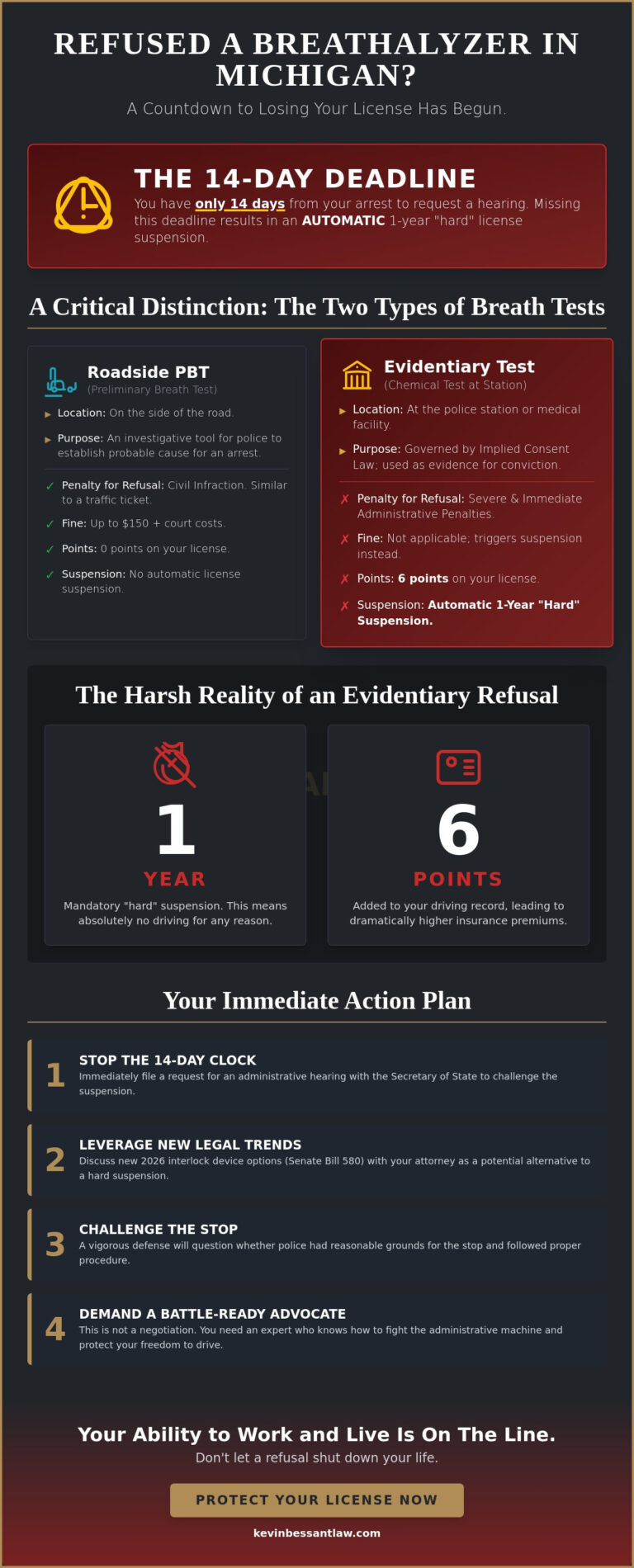
The roadside PBT is essentially a mobile investigative tool. Officers use these handheld devices to gather the “probable cause” they need to put you in handcuffs. While the officer might act like your cooperation is required, the reality is that the legal fallout for a roadside refusal is minor compared to what happens later. However, the situation shifts dramatically once you’re transported to the precinct. This is where the refusing breathalyzer Michigan consequences become life-altering and immediate.
To better understand this concept, watch this helpful video:
The Preliminary Breath Test (PBT) Penalty
If you refuse the handheld PBT on the side of the road, you’re committing a civil infraction. It’s similar to a speeding ticket. You’ll likely face a fine of up to $150 plus court costs, but you won’t see points on your license or an immediate suspension. For most drivers, this is a strategic choice. By refusing the PBT, you deny the officer the digital evidence they want to justify an arrest. There are exceptions. If you’re under 21 or operating a commercial vehicle, refusing the PBT carries harsher penalties and can lead to immediate legal complications that require an aggressive defense.
The Evidentiary (Chemical) Test at the Station
The real danger begins at the police station or a medical facility. Once you’ve been arrested, the officer will request an evidentiary chemical test, usually via a DataMaster machine or a blood draw. This isn’t a civil infraction; it’s a high-stakes demand governed by Michigan’s Implied Consent Law. By holding a Michigan driver’s license, the state claims you’ve already agreed to this test in exchange for the privilege of driving.
Refusing this specific test triggers a “Report of Refusal” sent directly to the Secretary of State. This is where the system tries to break you. You aren’t just fighting a DUI charge; you’re fighting an administrative machine that wants to seize your license for 12 months. Navigating the refusing breathalyzer Michigan consequences requires an immediate, tactical response to protect your ability to work and provide for your family. You have a narrow window to stop this from happening, and you need a battle-ready advocate to challenge the officer’s procedure. If the police didn’t follow the law during the arrest, that “refusal” might not stand up in court.
Michigan’s Implied Consent Law: The 14-Day Deadline You Cannot Miss
When you signed for your Michigan driver’s license, you unknowingly signed a contract with the state. This agreement, known as the Implied Consent Law, means you’ve already given your permission to submit to a chemical test if a police officer has reasonable grounds to believe you’re driving while intoxicated. You can’t simply opt out of this agreement at the police station without triggering a massive administrative backlash. The moment you refuse the evidentiary test, the officer will confiscate your plastic license and hand you a paper form. This document, the Officer’s Report of Refusal, serves as your temporary permit, but it’s actually a ticking time bomb for your driving privileges.
The refusing breathalyzer Michigan consequences are not suggestions; they are mandatory administrative actions that happen outside of a courtroom. You aren’t just facing a judge for an OWI; you’re facing the Michigan Secretary of State in a battle for your right to drive. If you don’t act immediately, the state will move to crush your independence. Securing a battle-ready DUI Defense is the only way to intercept this process before the state takes permanent action against your record.
The 14-Day Appeal Window
You have exactly 14 calendar days from the date of your arrest to challenge the suspension. This isn’t a loose guideline. It’s a hard, procedural guillotine. Look at the date printed on your temporary paper license right now. If you fail to file a formal, written request for a hearing with the Michigan Department of State (MDOS) within that two-week window, you waive your right to a defense. The MDOS doesn’t care about your excuses or your need to drive to work. They operate on strict timelines. A written request is the only mechanism that pauses the automatic suspension process, allowing you the chance to argue your case before an administrative law judge.
What Happens if You Miss the Deadline?
If that 14-day window closes and you haven’t filed your request, the consequences are automatic and non-negotiable. Your license will be hit with a one-year hard suspension. This means no driving for any reason. There are no restricted licenses for work, school, or medical emergencies during this time. To make matters worse, the Secretary of State will add 6-Point Penalties to your master driving record. These points stay with you, skyrocketing your insurance rates and haunting your record for years. Recovering from an automatic suspension is an uphill battle that most drivers lose because they waited too long to seek professional intervention. Don’t let a clerical deadline dictate your future; the system is designed to move fast, and you must move faster.
The Harsh Reality of Refusal: License Suspensions and 6-Point Penalties
The state of Michigan does not take “no” for an answer. When you decline an evidentiary test, the system shifts into an aggressive, punitive gear. Under the Michigan Vehicle Code § 257.625a, the penalties for a first-time refusal are severe: an automatic one-year suspension of your driver’s license and six points added to your record. This is not a suggestion or a fine you can simply pay away. It is an administrative strike that targets your mobility and your reputation before you even see a judge for your OWI charge.
The most devastating part of this penalty is the “hard suspension.” For the initial period of this one-year ban, typically the first 30 to 60 days, you are prohibited from driving for any reason whatsoever. There are no restricted licenses for work, no exceptions for school, and no mercy for family emergencies. If you are caught driving during this time, you face additional criminal charges. While a first offense is brutal, the refusing breathalyzer Michigan consequences escalate for repeat offenders. A second refusal within seven years triggers a mandatory two-year suspension. Additionally, while the old “Driver Responsibility Fees” were phased out, you will still face significant financial assessments and reinstatement fees that can total thousands of dollars over time.
Collateral Consequences of a Refusal
The damage extends far beyond the Secretary of State’s office. In the Detroit metro area, a refusal on your record makes you a high-risk liability in the eyes of insurance companies. Expect your premiums to skyrocket, often doubling or tripling, if you can find coverage at all. For professionals, the stakes are even higher. A refusal record can trigger disciplinary actions for those holding commercial licenses, medical certifications, or legal bar memberships. Prosecutors also use your refusal as a tactical weapon in your criminal case. They will argue to a jury that you refused the test because you knew you were over the limit, creating a powerful perception of guilt that is difficult to overcome without a battle-ready advocate.
Can the Police Force a Blood Draw?
Do not assume that refusing the breathalyzer keeps your BAC evidence out of the prosecutor’s hands. The police are trained to bypass your refusal by contacting a on-call judge to secure a search warrant. Once a warrant is signed, they have the legal authority to use reasonable force to obtain a blood sample. You can still be charged and convicted of OWI based on that blood evidence, meaning you could end up with both a DUI conviction and the one-year refusal suspension. Refusing the test doesn’t stop the investigation; it only adds another layer of legal peril to an already high-stakes situation. You must act quickly to challenge the validity of the stop itself if you want to protect your future.
Tactical Defenses: How to Fight a Refusal Charge at an Implied Consent Hearing
An Implied Consent hearing isn’t a trial about your sobriety. It’s a precise, tactical surgical strike against the officer’s version of events. While the state wants you to believe the refusing breathalyzer Michigan consequences are set in stone, an experienced advocate knows the Secretary of State hearing is actually limited to four specific legal issues. If the officer fails on even one of these points, the suspension must be vacated. We don’t just ask for mercy; we demand procedural perfection from law enforcement. The hearing focuses on whether the officer had reasonable grounds to believe you were driving under the influence, whether you were actually arrested, whether you were properly advised of your rights, and whether your refusal was reasonable.
The battle often centers on whether the officer had “reasonable grounds” to stop and arrest you. This is the first and most common point of failure for the police. If the initial traffic stop was based on a hunch rather than a specific violation, the entire case crumbles. We also verify that the officer explicitly read you your chemical test rights. If they skipped this step or provided confusing information, your refusal cannot legally trigger a suspension. While claiming a “reasonable” refusal is difficult, we examine every detail, from medical emergencies to language barriers, to find the leverage you need to keep your license.
Challenging the Arrest Procedure
Police often rush the arrest process, leading to critical errors that we exploit. Field Sobriety Tests are notoriously subjective and frequently administered incorrectly. We scrutinize whether the officer followed the strict National Highway Traffic Safety Administration guidelines. Additionally, Michigan law requires a “20-minute observation period” before a breath test. If the officer was distracted or failed to monitor you continuously, the test request itself is flawed. In Detroit, we aggressively pursue body cam and dash cam footage. This video evidence often tells a very different story than the officer’s written report, providing the evidence needed to win your hearing.
Winning the Hearing: The Bessant Strategy
Winning requires more than just showing up. It demands a DUI defense lawyer Detroit who can dismantle an officer’s testimony through aggressive cross-examination. We force the officer to justify every decision they made on the night of your arrest. Sometimes, the best victory happens before the hearing even begins. We look for opportunities to negotiate with the officer or the department, highlighting the weaknesses in their case to secure a withdrawal of the refusal report. This proactive approach is the only way to shield your license from the administrative machine. Don’t wait for the state to act. Secure a battle-ready DUI Defense today to protect your right to drive.
Why an Aggressive Detroit DUI Attorney is Your Only Shield Against Suspension
The Michigan legal system is a relentless administrative machine designed to strip you of your rights without a second thought. When you’re caught in the gears of an Implied Consent violation, the state isn’t looking to hear your side of the story; it’s looking to finalize your suspension. You are facing a system that prioritizes procedural efficiency over your personal freedom. Standing alone against the Secretary of State is a losing strategy. You need a battle-ready advocate who understands that the refusing breathalyzer Michigan consequences are a direct assault on your livelihood. Kevin Bessant brings over 20 years of experience in high-stakes criminal defense to your corner, providing the vigorous protection you need to stop the state in its tracks.
We don’t just “handle” cases. We launch a proactive defense designed to shield your license from the moment of arrest. The system is aggressive, but we are more aggressive. By positioning ourselves as a vital shield between you and a complex legal landscape, we ensure that every procedural error made by the police is exposed and used to your advantage. You aren’t just another case number here; you’re a person whose independence is worth fighting for. Our firm is built on the principle of standing in the gap for our clients, offering a confident and unwavering voice when the stakes couldn’t be higher.
Experience in Detroit and Metro Courts
Local knowledge is the difference between keeping your license and taking the bus for a year. We have an intimate understanding of the inner workings of the courts in Detroit, Southfield, Royal Oak, and Troy. This regional presence allows us to navigate the specific tendencies of local judges and officers in Wayne and Oakland Counties. Familiarity with these specific legal environments helps us in several ways:
- Strategic Negotiations: We know which prosecutors and officers are more likely to negotiate license outcomes before a hearing begins.
- Aggressive Shielding: Our firm specializes in aggressive driver’s license shielding, tailored to the specific procedural requirements of the metro Detroit court systems.
- Local Expertise: We understand the unique administrative nuances of the Secretary of State offices in Warren and surrounding areas.
Take Immediate Action to Save Your Freedom
The clock is your greatest enemy right now. Don’t wait for the 14 days to expire before you realize the gravity of your situation. Once that window closes, your right to an administrative hearing vanishes, and the one-year hard suspension becomes a reality. This is the moment for decisive action. We offer a free consultation to review the specifics of your stop and identify the flaws in the officer’s report. You have a very narrow path to victory, and we know exactly how to walk it. Contact the Law Office of Kevin Bessant & Associates today. Let a seasoned DUI Defense expert take the lead and fight to keep you on the road. Your future is on the line; don’t leave it to chance.
Secure Your Driving Future Today
The state’s administrative machine is already moving against you. You now understand that the distinction between a roadside PBT and an evidentiary test is a legal trap designed to trigger Michigan’s Implied Consent Law. You also know that missing the 14-day appeal window results in an automatic, non-negotiable one-year hard suspension. This system doesn’t offer second chances to those who wait for a court date that might be months away. The time to intercept this process is right now.
Understanding the refusing breathalyzer Michigan consequences is only the first step. You need a battle-ready shield. Kevin Bessant offers over 20 years of aggressive criminal defense experience and a proven track record in Implied Consent hearings across Wayne, Oakland, and Macomb County courts. We know the local procedures and the specific officers involved. Don’t stand alone against a system that wants to take your freedom and your mobility. You have the right to a defense, but you must claim it before the clock runs out.
Protect your license-schedule your aggressive DUI defense consultation now.
You can fight this, and you can win. With the right advocate in your corner, you can navigate this crisis and secure the outcome you need to keep your life moving forward.
Frequently Asked Questions
Is refusing a breathalyzer a crime in Michigan?
Refusing the evidentiary breath test at the police station is an administrative violation rather than a criminal offense. While you won’t face jail time specifically for the refusal, you’ll suffer immediate refusing breathalyzer Michigan consequences like a mandatory one-year license suspension. This penalty is handled by the Secretary of State and exists entirely separate from your OWI criminal case. Don’t confuse the two; the state can punish your license even if you’re never convicted of a crime.
Can I get a restricted license if I refuse the breathalyzer?
You cannot get a restricted license during the initial “hard suspension” period, which typically lasts 30 to 60 days. Michigan law is exceptionally strict on this point. Unlike a standard OWI conviction where restricted driving might be available immediately, a refusal blocks all driving privileges. Your only path to a restricted license is winning your administrative hearing or successfully appealing to the circuit court after the hard suspension period ends.
How long does a breathalyzer refusal stay on my record?
A breathalyzer refusal stays on your Michigan master driving record permanently. It never “drops off” like insurance points might. This record is visible to law enforcement and the Secretary of State forever. Because this refusal adds six points to your record, you’ll likely face significantly higher insurance premiums for several years. Protecting your record at the hearing is the only way to avoid these long-term financial burdens.
What is the “14-day rule” for Michigan DUI cases?
The “14-day rule” is the strict deadline to request an administrative hearing with the Secretary of State after refusing a chemical test. This two-week window starts the moment you’re arrested and served with the Officer’s Report of Refusal. If you miss this deadline by even one hour, you forfeit your right to a defense. The one-year suspension becomes automatic and non-negotiable, leaving you with no legal recourse to save your license.
Can I win an Implied Consent hearing without a lawyer?
You can technically represent yourself, but winning an Implied Consent hearing without an aggressive advocate is nearly impossible. These hearings are highly technical and focus on specific legal procedures rather than personal excuses. Police officers are trained to testify in these settings. Without a lawyer to cross-examine the officer and identify procedural flaws, the hearing officer will almost always rule in favor of the state’s suspension request.
Does a refusal make me look guilty in my OWI trial?
Prosecutors will aggressively use your refusal as evidence of “consciousness of guilt” during your OWI trial. They’ll tell the jury that you only refused the test because you knew you were intoxicated. While the refusal itself isn’t a crime, the perception it creates is a massive hurdle for your defense. You need a battle-ready advocate to counter this narrative and explain the legal reasons why the officer’s request was flawed or improper.
What happens if I refused but the police didn’t get a warrant for blood?
You still face the full weight of the refusing breathalyzer Michigan consequences even if the police never obtained a blood warrant. The administrative penalty for refusal is based entirely on your choice to decline the test, not on whether the police eventually secured evidence. Even if your OWI case is dismissed because there’s no BAC data, the Secretary of State can still suspend your license for the refusal alone.
Can I refuse field sobriety tests in Michigan?
You have the absolute right to refuse roadside field sobriety tests in Michigan. Unlike the evidentiary chemical test at the station, field sobriety tests are entirely voluntary. Officers use these tests to build the probable cause they need to make an arrest. Declining them often deprives the officer of the evidence they need to put you in handcuffs. Always remain polite but firm when declining these subjective and often inaccurate roadside exercises.