

A single moment of conflict can instantly jeopardize your career, your freedom, and your reputation. In 2024, aggravated assaults accounted for 78.6% of all violent crimes in our state, showing just how aggressively prosecutors pursue these charges. If you’re currently facing a case, you need to understand exactly what is aggravated assault in Michigan and why the “aggravated” label is so dangerous. This isn’t a simple scuffle; it’s a high-stakes charge involving serious physical injury that can lead to a year in jail or, in domestic situations with prior convictions, up to five years in prison.
It’s natural to feel overwhelmed by a legal system that seems designed to crush you. You’re likely worried about how a violent crime record will impact your employment and your family’s future. We’re here to provide the shield you need. This 2026 guide explains the specific legal definitions you’re up against, the severe penalties on the table, and the battle-ready defense strategies used to get charges dropped or reduced to simple assault. We will walk through the specific criteria for serious injury and the proven methods for avoiding jail time and securing a future through expungement.
Key Takeaways
- Learn exactly what is aggravated assault in Michigan by focusing on the “serious injury” requirement that elevates a simple scuffle into a high-stakes legal battle.
- Understand the immediate risks of conviction, including up to one year in county jail and thousand-dollar fines that can shatter your financial stability and reputation.
- Discover why the presence of a weapon transforms your case into a four-year felony and how to challenge the prosecution’s classification of your charges.
- Identify aggressive defense strategies like “Stand Your Ground” and lack of intent that can force the prosecution to reduce or drop your charges entirely.
- Recognize why standing alone against Michigan prosecutors is a losing strategy and how professional advocacy acts as a vital shield for your future.
Defining Aggravated Assault Under Michigan Law (MCL 750.81a)
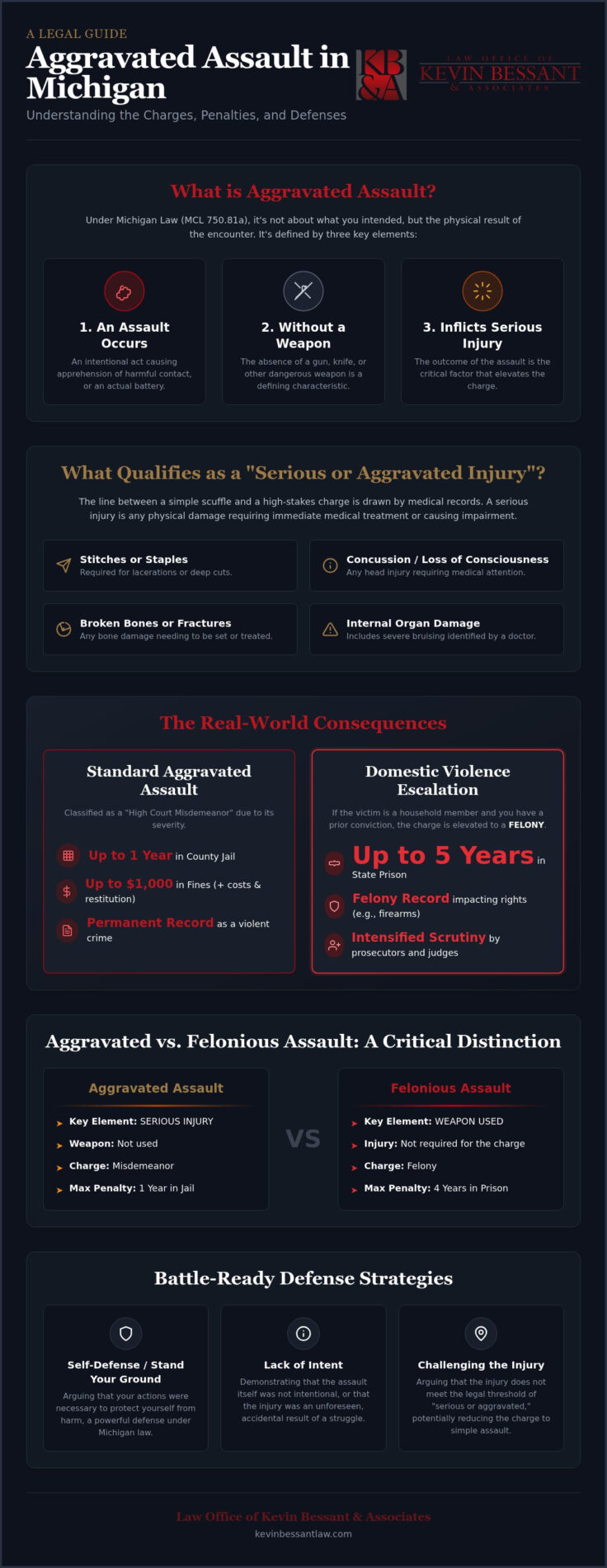
Do not let the legal jargon fool you. Aggravated assault is a high-stakes “bridge” charge that Michigan prosecutors use when they want to punish you more severely than a simple assault would allow. Under Michigan Compiled Law 750.81a, aggravated assault occurs when an individual assaults another person without a weapon and inflicts a serious or aggravated injury. You aren’t necessarily being charged for what you intended to do; you are being charged for the physical outcome of the encounter. While the legal definition of assault covers a broad range of behaviors, the “aggravated” tag in Michigan specifically targets the physical damage left behind. Understanding what is aggravated assault in Michigan starts with recognizing that the prosecution does not need to prove you intended to commit a murder or even cause permanent damage. They only need to show that you intended the assault itself and that a serious injury resulted.
What Qualifies as a “Serious or Aggravated Injury”?
In a Michigan courtroom, the line between a simple misdemeanor and an aggravated charge hinges entirely on medical records and victim testimony. A “serious or aggravated injury” is legally defined as physical damage that requires immediate medical treatment or causes an impairment of health or a body part. This is a broad net that catches many common physical altercations. If the other party required any of the following, you are likely facing an aggravated charge:
- Stitches or medical staples for lacerations.
- Treatment for a concussion or loss of consciousness.
- Setting of broken bones or treatment for fractures.
- Internal bruising or organ damage identified by a physician.
The defining characteristic of this specific charge is the lack of a weapon. If a gun, knife, or even a heavy club was involved, the state would likely escalate the case to felonious assault. Because no weapon was used, the prosecution focuses entirely on the severity of the physical harm to justify the “aggravated” label.
The Role of Intent in Michigan Assault Cases
Michigan law distinguishes between general intent and specific intent. Aggravated assault is generally considered a “specific intent” crime regarding the assaultive act, but the “aggravated” portion is about the result. A momentary lapse in judgment during a heated argument can lead to a criminal record that haunts you for decades. Prosecutors will use the police report to frame you as the aggressor, often ignoring the context of the situation. Your version of the events matters. If the injury was accidental or occurred during a struggle where you were not the primary aggressor, that intent must be challenged immediately. Don’t wait for the system to “figure out” the truth. You need a shield to stand between you and a motivated prosecutor. If you are ready to fight these charges, contact Kevin Bessant & Associates to start building your defense today.
The Real-World Consequences: Jail Time and Fines in 2026
The “misdemeanor” label is a dangerous trap. In Michigan, an aggravated assault conviction carries a maximum sentence of one year in county jail. This is the highest possible penalty for a misdemeanor, often referred to as a “high court misdemeanor” because of its severity. Along with jail time, you face fines up to $1,000 plus court costs that can easily double that figure. Restitution to the victim for medical bills is also mandatory. When you ask what is aggravated assault in Michigan, you aren’t just asking about a statute; you’re asking about a life-altering event that creates a permanent violent crime record. This record follows you forever, visible to every employer, landlord, and licensing board that runs a background check. The system is designed to punish, and without an aggressive shield, you are at its mercy.
Domestic Aggravated Assault Penalties
If the alleged victim is a spouse, dating partner, or household member, the legal pressure intensifies immediately. Michigan law treats domestic incidents with extreme scrutiny. While a first offense remains a misdemeanor, having a single prior conviction for a similar act can escalate a new charge to a felony punishable by up to five years in prison. You can find more detail on Aggravated Domestic Assault penalties through official county resources. Beyond prison, a domestic conviction often results in the immediate loss of your Second Amendment rights and can be used as leverage in child custody battles. Judges frequently impose “no-contact” bond conditions that force you out of your own home before you even have a chance to tell your side of the story.
Collateral Consequences Beyond the Courtroom
The damage doesn’t stop when you leave the courtroom. A violent crime conviction is a major red flag for Michigan professional licensing boards. Nurses, real estate agents, and CDL holders often find their careers ended by a single conviction. Landlords frequently reject applicants with violent records, and banks may view you as a higher risk for loans. The stigma of being a “violent offender” is a heavy burden to carry in your community. You need an aggressive defense to prevent these outcomes and keep your record clean. If you’re ready to protect your future, it’s time to discuss your case with a professional who knows how to fight these specific charges in Wayne, Oakland, and Macomb counties.
The state also provides enhanced protections for specific workers. If the victim is a health professional or medical volunteer performing their duties, the fine doubles to $2,000 while the jail time remains up to one year. Understanding what is aggravated assault in Michigan requires looking at these specific victim categories, as they significantly change your financial exposure and the prosecutor’s willingness to negotiate.
Aggravated vs. Felonious Assault: Why the Distinction Matters
Misinformation about the Michigan legal system is rampant, and even some legal professionals fail to grasp the nuances of assault classifications. To understand what is aggravated assault in Michigan, you must understand where it sits on the scale of severity. It is a “bridge” charge. It sits higher than simple assault but lower than felonious assault. In many Detroit courtrooms, aggravated assault is referred to as a “High Court Misdemeanor.” This is legal shorthand for a crime that carries a one-year jail sentence, placing it in a gray area where it is processed with the gravity of a felony but technically remains a misdemeanor. Do not let the terminology relax your guard. A one-year sentence in a county jail is a brutal reality that requires an aggressive shield to avoid.
The primary factor that separates these charges is the presence of a weapon. Felonious assault, governed by MCL 750.82, is an Assault with a Dangerous Weapon. It is a four-year felony that carries much harsher long-term consequences. If a prosecutor can prove you used an object to threaten or inflict harm, they will bypass the aggravated charge entirely. The distinction is thin, and prosecutors often overcharge defendants to gain leverage during negotiations. You need a battle-ready advocate who understands how to challenge these classifications before your first court date. At Kevin Bessant & Associates, we focus on the specific details of your case to ensure the state isn’t inflating your charges. Learn more about why our experience matters in these high-stakes moments.
When a Misdemeanor Becomes a Felony
How does a misdemeanor escalate into a life-altering felony? It usually comes down to the “dangerous weapon” clause. In Michigan, the law defines a dangerous weapon broadly. It isn’t just guns and knives. A prosecutor may argue that a glass bottle, a heavy tool, or even a motor vehicle constitutes a dangerous weapon depending on how it was used. Furthermore, if you have prior convictions for similar violent acts, the state has the power to escalate a misdemeanor aggravated assault into a felony. This escalation is why immediate intervention is critical. We work to dismantle the prosecution’s narrative before it hardens into a felony conviction.
Simple Assault vs. Aggravated Assault
Simple assault (MCL 750.81) is the lowest level of assault in Michigan, carrying a maximum of 93 days in jail. The jump from simple to aggravated happens the moment a “serious injury” is documented. However, the line between “pain” and “serious injury” is often subjective. A police officer might see a victim’s swelling and immediately check the box for an aggravated charge without medical confirmation. Our strategy involves de-escalating these charges by challenging the medical evidence. If the injury did not require immediate, intensive medical intervention, the charge should be simple assault, not aggravated. We fight to force the prosecution to acknowledge the reality of the encounter rather than their exaggerated version of it.
Aggressive Defense Strategies to Fight Assault Charges
You aren’t a victim of the system unless you choose to stay silent. When you’re asking what is aggravated assault in Michigan, you’re really asking how to dismantle the state’s case against you. The prosecution wants you to believe their evidence is ironclad, but we know better. We look for every crack in their narrative, starting with your right to defend yourself. Michigan’s Self-Defense Act provides a powerful shield for those who acted out of necessity. If you had an honest and reasonable belief that force was required to prevent imminent harm to yourself or someone else, the law is on your side. We don’t just mention self-defense; we weaponize it to protect your freedom. You need an advocate who isn’t afraid to challenge a motivated prosecutor in Wayne, Oakland, or Macomb County.
The Michigan Self-Defense Act
Michigan law is clear: you don’t have a duty to retreat if you’re in your own home or vehicle and someone threatens you. This is often called the “Castle Doctrine,” and it extends to any place you have a legal right to be under the “Stand Your Ground” principles. In Detroit courts, presenting a self-defense claim requires more than just your word. It requires a strategic presentation of facts that forces the jury to see the situation through your eyes. If you were cornered or felt your life was in danger, you had every right to act. We ensure the court understands that your actions were a response to a threat, not an unprovoked attack.
Intent is the foundation of any assault charge. If the injury was the result of a freak accident or a mutual struggle where you never intended to strike the other person, the prosecution cannot meet their burden of proof. We also take a sledgehammer to the “serious injury” claim. Just because a police officer wrote it in a report doesn’t make it true. We pore over medical records to see if the treatment was truly immediate and intensive. If it wasn’t, we fight to drop the “aggravated” label entirely. Don’t let an exaggerated report dictate your future; reach out to us immediately to start building your defense.
Challenging Victim Credibility and Police Reports
Police reports are notoriously one-sided. They often reflect the first story the officer heard, which usually comes from the person who called 911 first. We conduct our own independent investigation to find what the police missed. We look for inconsistencies in witness statements and 911 calls that contradict the victim’s later testimony. Finding these holes is essential to destroying the prosecution’s credibility. Forcing the state to prove every single element of what is aggravated assault in Michigan is the only way to win. We don’t wait for the system to play fair. We create the pressure that leads to reduced charges or total dismissals by exposing constitutional violations and illegal police conduct during your arrest.
Why You Need a Detroit Felony Assault Lawyer Immediately
The legal system isn’t your ally. It’s a machine built to secure convictions, not to ensure fairness or protect your reputation. When you’re facing a charge as serious as this, you aren’t just fighting a case; you’re fighting for your life. Understanding what is aggravated assault in Michigan is the first step, but knowledge alone won’t save you from a motivated prosecutor. You need an aggressive shield between you and a system that wants to see you in a jail cell. Every second you wait allows the state to solidify its narrative and gather evidence against you. Early intervention is the only way to expose the flaws in their evidence before the damage becomes permanent. Stop talking to the police immediately. They aren’t looking for the truth; they’re looking for a confession or a slip-up. Contact a battle-ready advocate who can silence the noise and take total control of your defense.
Local Expertise in Detroit, Southfield, and Warren Courts
Success in the Michigan legal system often depends on who you know and where you are. We’ve spent over 20 years navigating the high-stakes courtrooms of Wayne, Oakland, and Macomb Counties. This regional knowledge isn’t just a detail; it’s a critical advantage that can change the outcome of your case. We know the specific tendencies of local judges and how to negotiate with prosecutors who are used to winning. This familiarity allows us to fight for favorable bond terms that keep you out of jail while your case is pending. Don’t leave your freedom to chance in a complex and unfamiliar system. Contact the Law Office of Kevin Bessant & Associates for a free consultation to discuss your specific situation.
Investing in Your Freedom: Why Kevin Bessant?
Your future is too valuable to trust to a general practitioner or an overworked public defender. You need a specialist who understands the nuances of high-stakes felony and assault litigation. Kevin Bessant acts as a fierce protector for every client, treating your crisis with the absolute urgency it deserves. We don’t just “manage” cases; we dismantle the prosecution’s arguments and win. Our track record of getting charges reduced or dismissed speaks to our relentless approach. You can read more about our commitment to aggressive advocacy on our Why Us page. We stand in the gap for the accused, providing the strength and experience required to navigate treacherous legal territory. If you want to know what is aggravated assault in Michigan defense at its highest level, you want us in your corner. We don’t back down, we don’t get intimidated, and we never stop fighting for your freedom.
Take Command of Your Legal Defense Today
A single charge doesn’t have to define your future. Understanding what is aggravated assault in Michigan is the first step toward reclaiming your life from a system that prioritizes convictions over people. You’ve seen how the “serious injury” label can lead to a year in jail and how the right defense strategy, like self-defense or challenging medical records, can dismantle the prosecution’s narrative. The state is already moving to secure a conviction; you must act now to protect your livelihood and your freedom.
The Law Office of Kevin Bessant & Associates brings over 20 years of battle-ready criminal defense experience to your corner. We specialize in expert representation for Detroit Homicide and Felony Assault cases, providing aggressive advocacy for bond hearings and immediate release. You don’t have to stand alone against a complex and intimidating legal machine. Secure Your Aggressive Defense Shield—Contact Kevin Bessant Now. We’re ready to fight for you and secure the favorable outcome you deserve. Your future is worth every effort.
Frequently Asked Questions
Is aggravated assault a felony or misdemeanor in Michigan?
Aggravated assault is typically a misdemeanor in Michigan, but it’s often called a “high court misdemeanor” because it carries a one-year jail sentence. Don’t let the misdemeanor label fool you into a false sense of security. If the incident involves a domestic partner and you have prior convictions for similar offenses, the state can escalate the charge to a felony punishable by up to five years in prison.
What is the maximum penalty for aggravated assault in Michigan?
The standard maximum penalty is one year in county jail and a fine of up to $1,000. If the victim is a health professional or medical volunteer performing their duties, the fine increases to $2,000. In domestic cases where the defendant has one or more prior convictions, the penalty jumps to five years in prison and a fine of $5,000. You’ll also likely face mandatory restitution for the victim’s medical expenses.
Can aggravated assault charges be dropped if the victim refuses to testify?
No, the victim does not have the power to drop charges; only the prosecutor can do that. Prosecutors in Wayne and Oakland Counties frequently pursue cases even when a victim is uncooperative. They’ll use 911 recordings, medical reports, and police bodycam footage to build a case against you. You need a fierce advocate to challenge this secondary evidence and force the state to prove every element of their claim.
What counts as a “serious injury” for an aggravated assault charge?
A serious injury is legally defined as physical damage that requires immediate medical treatment or causes an impairment of health or a body part. Examples include broken bones, concussions, internal bruising, or lacerations that require stitches or staples. Understanding what is aggravated assault in Michigan requires a deep dive into medical records to see if the injury truly meets this high legal threshold or if the police overcharged you.
Can I get aggravated assault expunged from my record in Michigan?
Yes, you can apply for a criminal expungement for an aggravated assault conviction under Michigan’s Clean Slate laws. Generally, you must wait a specific period after your probation or jail sentence ends before you are eligible to petition the court. Clearing your record is a vital step toward restoring your reputation and ensuring a violent crime conviction doesn’t block your future employment or housing opportunities.
What is the difference between aggravated assault and assault and battery?
The primary distinction is the severity of the injury caused to the victim. Simple assault and battery (MCL 750.81) involves intentional force or the threat of force but results in no serious physical harm, carrying a 93-day maximum sentence. Aggravated assault (MCL 750.81a) occurs when that same force results in a serious or aggravated injury, which immediately increases the potential jail time to one year.
Will I go to jail for a first-offense aggravated assault in Michigan?
Jail is a very real threat for a first offense because the law allows for up to one year of incarceration. While some first-time offenders may receive probation, many judges in Detroit and surrounding areas take a hard line on violent crimes. Without an aggressive shield in the courtroom, you’re at the mercy of the system. We fight to keep you out of jail by humanizing your case and exposing the weaknesses in the prosecution’s evidence.
Can I use self-defense as a legal strategy for an aggravated assault charge?
Yes, self-defense is a battle-ready strategy that can lead to a total dismissal of your charges. If you had an honest and reasonable belief that force was necessary to prevent imminent harm to yourself or another person, your actions are protected under the Michigan Self-Defense Act. We don’t just mention self-defense; we vigorously prove you were protecting yourself from an aggressor to ensure the court sees the truth of the encounter.