

In a Detroit courtroom, a common household item like a heavy flashlight or a pair of work boots can carry the same legal weight as a loaded handgun. If you’re facing charges under MCL 750.82, the state isn’t just reviewing an incident; they’re pursuing a felony conviction that carries a mandatory maximum of four years in prison. You need an assault with a deadly weapon defense Detroit expert who treats your case with the urgency it deserves. A charge is never a final verdict; it is the beginning of a high-stakes battle for your future.
We understand the fear of a permanent felony record and the confusion surrounding what truly counts as a “dangerous weapon” in Michigan. It’s an overwhelming position to be in, but you don’t have to stand in the gap alone. This article promises to reveal the aggressive legal strategies used to dismantle felonious assault charges and protect your freedom in Detroit courts.
We’ll preview the specific defense options available to you, from challenging the prosecution’s definition of intent to fighting for a full dismissal or a reduction to a misdemeanor. You can avoid jail time and regain control of your life by understanding exactly how to fight back effectively.
Key Takeaways
- Learn why the prosecutor must prove specific intent to instill fear and how challenging this requirement can dismantle the state’s case.
- Discover how everyday items like motor vehicles or common tools are categorized as dangerous weapons and how to fight these broad legal interpretations.
- Master the use of Michigan’s Self-Defense Act as a powerful shield when executing an assault with a deadly weapon defense Detroit strategy.
- Navigate the Detroit legal pipeline from your initial arraignment at the 36th District Court to high-stakes felony proceedings at Frank Murphy Hall of Justice.
- Understand why a battle-ready advocate with over 20 years of experience in Wayne County is essential for protecting your future against the system.
Understanding Felonious Assault Under Michigan Law (MCL 750.82)
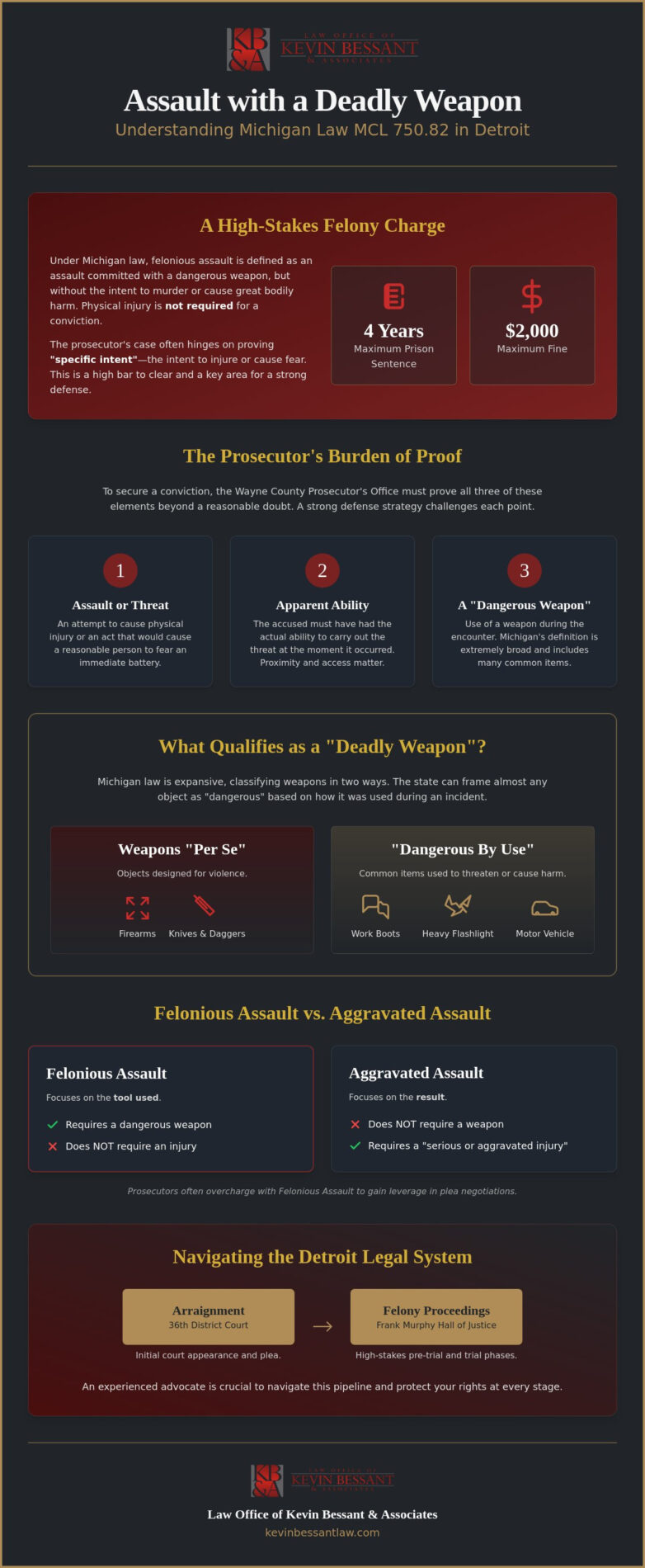
Michigan law defines felonious assault under MCL 750.82 as an assault committed with a dangerous weapon but without the intent to commit murder or inflict great bodily harm. This is a high-stakes felony that carries a mandatory maximum of four years in prison and a $2,000 fine for a first offense. Don’t let a prosecutor’s narrative dictate the rest of your life. You need a battle-ready assault with a deadly weapon defense Detroit strategy that targets the prosecution’s weakest link: intent. Because the law is written broadly, many people find themselves facing life-altering consequences for split-second decisions or simple misunderstandings.
In Detroit courts, the prosecutor must prove “specific intent.” This means they must show you intended to either injure the person or put them in reasonable fear of an immediate battery. This is a high bar for the state to clear. If the incident was an accident, a defensive reaction, or a misunderstanding, they haven’t met their burden. It’s also vital to realize that actual physical injury is not required for a conviction in Detroit. You can be charged and sentenced to years in prison even if you never made physical contact with the other person. The mere presence of a weapon and a perceived threat is enough for the state to move forward with a felony prosecution.
The Legal Elements the Prosecutor Must Prove
To secure a conviction, the Wayne County Prosecutor’s Office must establish three distinct elements beyond a reasonable doubt. First, they must prove an offer of force or an attempt to cause physical injury. Second, they must show you had the actual ability to carry out that threat at the moment it occurred. If you were too far away or the weapon was inaccessible, the “ability” element fails. Finally, they must prove you used a “dangerous weapon” during the encounter. Understanding What Qualifies as a ‘Deadly Weapon’ is critical. Michigan courts interpret this term broadly to include everything from firearms to pocketknives and even motor vehicles. We dismantle these elements one by one to expose the holes in the state’s case.
Felonious Assault vs. Aggravated Assault
There’s a major difference between these two charges that often confuses defendants. Aggravated assault focuses on the result; it requires a “serious or aggravated injury” but does not require a weapon. Conversely, felonious assault focuses on the tool used; it requires a weapon but no injury at all. Detroit prosecutors often overcharge individuals with felonious assault to gain leverage during plea negotiations. They want you to feel the pressure of a four-year felony so you’ll accept a lesser deal just to avoid the risk of trial. Don’t fall for this tactic. If you’ve been charged, contact our firm immediately to begin building your shield against these aggressive tactics. Our goal is to protect your freedom and ensure the system doesn’t run over your rights.
What Qualifies as a “Deadly Weapon” in Detroit Courts?
In Detroit, the legal definition of a “dangerous weapon” is far broader than most people realize. While firearms and knives are obvious examples, Michigan law also targets objects that are only “dangerous by use.” This means a common household item or a work tool can suddenly trigger a high-stakes felony charge. If you’ve been accused of using an everyday object to threaten someone, you need an assault with a deadly weapon defense Detroit expert who understands how to challenge the prosecution’s interpretation of the law. The state will try to frame your actions as life-threatening; our job is to bring the reality of the situation back into focus.
Michigan courts generally divide weapons into two categories. Weapons “per se” are items designed specifically for violence, such as pistols or daggers. Everything else falls under the “dangerous by use” category. According to MCL 750.82, a dangerous weapon can be almost anything if it is used in a way that could cause serious physical harm. Prosecutors often use this broad language to escalate simple arguments into felony cases. They look at the “intended use” of the object during the incident. Did you hold the kitchen knife in a way that suggested a threat? Did you swing that baseball bat with the intent to injure? These are the questions that will define your future in court.
Common “Non-Traditional” Weapons
Motor vehicles are among the most common “deadly weapons” cited in Detroit assault cases. Using a car to “nudge” another vehicle in traffic or driving toward a pedestrian to intimidate them can lead to a four-year felony charge. Tools such as hammers, wrenches, or even screwdrivers brandished during a heated dispute at a job site are also frequent targets. In social settings, recreational items like golf clubs or pool cues can quickly be reclassified as deadly weapons if the prosecution believes they were used to threaten serious harm. If you find yourself in this position, speaking with a battle-ready advocate is the first step in dismantling the state’s narrative.
The “Brandishing” Misconception
There’s a critical difference between simply showing a weapon and using it to commit an assault. Brandishing is often a misdemeanor, whereas felonious assault is a serious felony. A skilled Detroit defense lawyer can argue that while a weapon may have been visible, it was never “used” to assault or put another person in reasonable fear of an immediate battery. Under Michigan Criminal Jury Instruction 17.10, a dangerous weapon is defined as any object used in a way that is likely to cause serious physical injury or death. We aggressively challenge whether your specific actions met this high legal standard, often forcing the prosecution to realize they have overreached.
Aggressive Defense Strategies for Assault with a Deadly Weapon
Facing a felonious assault charge in Detroit can feel like the entire weight of the legal system is crashing down on you. The prosecution wants you to believe their case is ironclad, but a charge is merely an accusation, not a conviction. To protect your freedom, you need an assault with a deadly weapon defense Detroit strategy that is as aggressive as the charges you face. We don’t wait for the trial to begin our counter-offensive. We immediately look for the cracks in the state’s narrative, focusing on affirmative defenses that can lead to a full dismissal or a significant reduction in charges.
The Wayne County criminal prosecution screening process often relies on one-sided police reports that fail to capture the full context of an encounter. Our job is to inject the truth into that process. Whether the incident involved a firearm, a vehicle, or a common household tool, we utilize every available legal shield to dismantle the prosecutor’s claims of criminal intent. We look at constitutional violations, such as illegal searches that led to the seizure of a weapon, and we aggressively challenge the “specific intent” requirement that the state often fails to prove.
Michigan’s Self-Defense Act (MCL 780.972)
Michigan law provides a powerful protection known as the “No Duty to Retreat” rule. Under MCL 780.972, if you are in your home or your vehicle and you aren’t engaged in a crime, you have no legal obligation to run away from an attacker. You have the right to use a weapon in self-defense if you have an honest and reasonable belief that you are in imminent danger of death or great bodily harm. This also applies to the defense of others, such as protecting a family member or a third party from a violent threat. Our firm’s battle-tested experience in self-defense litigation ensures that your right to protect yourself is never ignored by the court.
Challenging the Credibility of the Accuser
In many high-conflict Detroit neighborhoods, police officers often fall into the “first caller” trap. They arrive on the scene and arrest the person who didn’t call 911 first, assuming the “victim” is whoever spoke to them first. We refuse to accept this “he-said, she-said” narrative. We investigate the prior motives, biases, and histories of violence of the alleged victim. Our team often utilizes private investigators to track down Ring camera footage or gas station CCTV that the police conveniently overlooked. When we expose that an accuser is lying or has a history of false reporting, the prosecution’s case often collapses before it ever reaches a jury.
Navigating the Detroit Criminal Justice System
Detroit’s legal landscape is a minefield for the unprepared. If you’re charged with felonious assault, your case begins in a high-pressure environment where the Wayne County Prosecutor’s Office takes an exceptionally aggressive stance, especially on gun-related allegations. You aren’t just fighting a charge; you’re fighting a system designed to move quickly toward a conviction. Securing an effective assault with a deadly weapon defense Detroit requires knowing exactly how these courts operate. We stand as your shield through every hearing and every procedural hurdle.
Your journey starts at the 36th District Court on Madison Street. This is the busiest court in the state, and it’s where the initial stages, like your arraignment and the Preliminary Examination, take place. If the judge finds enough evidence to move forward, the case is “bound over” to the Frank Murphy Hall of Justice (3rd Circuit Court). This is where the stakes reach their peak, as felony trials and sentencings occur here. Understanding this transition is vital because the strategies we use in District Court set the foundation for your defense in Circuit Court. We don’t just react to the prosecution; we anticipate their next move.
Arraignment and Bond Hearings
The arraignment is your first appearance before a judge, and it’s a critical moment for your immediate future. The court will decide if you can go home or if you’ll sit in jail awaiting trial. In Detroit assault cases, judges often impose strict bond conditions, including no-contact orders with the complainant and GPS tethers. You cannot afford to walk into this hearing alone. A bond hearing lawyer Detroit can argue for your release by highlighting your ties to the community and challenging the prosecution’s request for high cash bail. We fight to keep you out of custody so you can actively participate in your defense.
The Preliminary Examination: A Critical Turning Point
Within weeks of your arraignment, you’ll face a Preliminary Examination. This is a “mini-trial” where the prosecutor must meet the “Probable Cause” standard. It’s our first real chance to get the felony dismissed. We use this hearing to cross-examine the complainant and expose inconsistencies or outright lies before the case ever reaches a jury at Frank Murphy. If the evidence is weak, we leverage these flaws to negotiate a reduction to a misdemeanor. This stage is a tactical battleground where a strong defense can stop a felony conviction in its tracks. If you’re facing charges, contact us today to ensure your rights are protected from day one.
Why Kevin Bessant is the Shield You Need in Detroit
Detroit’s legal system is designed to process people, not protect them. When you’re facing a felonious assault charge, you aren’t just a defendant; you are a target for a prosecutor’s office that measures success in convictions. Kevin Bessant provides the assault with a deadly weapon defense Detroit residents need to level the playing field. With over 20 years of battle-tested experience in Wayne County courts, he understands the nuances of the local system that other lawyers overlook. He doesn’t just manage cases; he fights them with an aggressive “Advocate-versus-System” philosophy that forces the prosecution to prove every single element of their claims.
The Detroit Police Department has operated below recommended staffing levels for several years. This often leads to rushed investigations, incomplete witness statements, and a failure to secure vital evidence like Ring camera footage or nearby gas station CCTV. We exploit these systemic failures. As a specialized gun charge lawyer Detroit, Kevin Bessant knows how to dismantle a prosecutor’s narrative by showing where the police cut corners. Our track record includes countless dismissals, not guilty verdicts, and charges reduced from life-altering felonies to manageable misdemeanors.
Standing in the Gap for the Accused
When you hire this firm, you get a dedicated protector who stands in the gap between you and a potentially overwhelming legal machine. You won’t be passed off to a junior associate or a paralegal. You work directly with Kevin Bessant. This personalized attention allows us to build a strategic advocacy plan tailored specifically to the facts of your arrest. We dig into the details that matter, from the exact way a “weapon” was handled to the prior history of the accuser. Check out our why us page to see our unwavering commitment to every client we represent.
Take Immediate Action to Protect Your Future
The first 48 hours after an arrest are the most critical period for your case. The police are looking for any statement they can use against you to solidify a four-year mandatory maximum sentence. Do not talk to them without an attorney present. A felony conviction doesn’t just mean jail time; it means the permanent loss of your gun rights, the destruction of your career, and a ruined reputation. We act as your immediate shield. Contact the Law Office of Kevin Bessant & Associates today for a free, confidential consultation. Your future depends on the actions you take right now. Don’t let the system decide your fate without a fight.
Legal Authority: Statute and Case Law
Michigan’s felonious assault statute is codified at MCL 750.82, with the Self-Defense Act at MCL 780.972.
- People v Avant, 235 Mich App 499, 505 (1999) — holds that whether an object qualifies as a “dangerous weapon” depends on how it was used and the circumstances of the assault, not simply what the object is.
- People v Riddle, 467 Mich 116, 119 (2002) — holds that a person is never required to retreat from a sudden, fierce, and violent attack, as long as the belief in the necessity of force is honest and reasonable.
For the current statutory text and published opinions, see the Michigan Legislature’s MCL database and the Michigan Courts case search.
Take Decisive Action to Shield Your Future
A felonious assault charge is an aggressive attempt by the state to strip away your freedom and your rights. We’ve explored how Michigan’s broad weapon definitions can turn everyday tools into felony evidence and why the Preliminary Examination at the 36th District Court serves as your first critical opportunity to stop a conviction. You now understand that the prosecution’s requirement to prove specific intent is a high bar that can be dismantled with the right strategy. Navigating an assault with a deadly weapon defense Detroit requires a fierce protector who isn’t intimidated by the Wayne County Prosecutor’s Office.
With 20+ years of criminal defense experience and specialized expertise in high-stakes felony litigation, Kevin Bessant provides the aggressive representation necessary to win in Detroit’s toughest courtrooms. We don’t just manage your case; we fight to win it. Do not let a single mistake or a false accusation define the rest of your life. Secure Your Aggressive Defense—Contact Kevin Bessant Now. You have the right to fight back, and we have the tools to help you succeed.
Frequently Asked Questions
Is assault with a deadly weapon a felony in Michigan?
Yes, assault with a deadly weapon is a Class F felony under MCL 750.82. It is officially known as felonious assault. A conviction carries a mandatory maximum penalty of up to four years in prison and a fine of up to $2,000. Because it is a felony, a conviction will result in a permanent criminal record that can never be expunged in most cases, stripping you of your gun rights and career opportunities.
Can I go to jail for a first-offense felonious assault in Detroit?
Yes, jail time is a very real possibility even if you have a clean criminal record. Judges in the 3rd Circuit Court take weapon-related offenses seriously and often use jail time to deter future violence. Your specific sentence depends on the nature of the weapon used and the prosecutor’s narrative. You need an aggressive assault with a deadly weapon defense Detroit strategy to fight for a sentence that avoids incarceration entirely.
What if I was only defending myself during the incident?
Self-defense is a complete affirmative defense that can lead to a full dismissal of your charges. If you had an honest and reasonable belief that you were in imminent danger of physical harm, your use of a weapon may be legally justified. We don’t wait for the prosecutor to realize this. We proactively gather evidence and witness statements to prove you acted as a shield for yourself or your family.
Does a car count as a deadly weapon in Michigan?
Yes, a motor vehicle is frequently classified as a dangerous weapon in Detroit courts. While a car isn’t a weapon by design, it becomes one “by use” if it’s used to intimidate, nudge, or threaten another person. Prosecutors often use this classification to escalate simple traffic disputes into high-stakes felony cases. We work to dismantle these claims by proving there was no specific intent to use the vehicle as a weapon.
What is the difference between felonious assault and attempted murder?
The primary difference lies in the specific intent of the defendant. Felonious assault requires the intent to put someone in fear of a battery or to commit a battery with a weapon, but without the intent to kill. Attempted murder requires the state to prove you specifically intended to end the victim’s life. While both are serious felonies, attempted murder carries much harsher penalties, including the possibility of life in prison.
Can a felonious assault charge be reduced to a misdemeanor?
Yes, it is possible to have a felony charge reduced to a misdemeanor through aggressive negotiation or by exposing weaknesses in the state’s evidence. We often fight to reduce these charges to simple assault or brandishing a weapon, which carry much lighter penalties and don’t result in a permanent felony record. This requires an assault with a deadly weapon defense Detroit expert who knows how to leverage the “intended use” doctrine.
Do I have to retreat before using a weapon in self-defense in Detroit?
No, Michigan is a “Stand Your Ground” state, meaning you have no duty to retreat if you are in a place you have a legal right to be. This includes your home, your vehicle, or a public street. As long as you aren’t engaged in a crime yourself and have a reasonable fear of imminent harm, you can legally stand your ground. We ensure the court respects this right during your defense.
What happens if the victim wants to drop the charges?
Only the Wayne County Prosecutor’s Office has the authority to drop charges, not the victim. In Detroit, prosecutors often proceed with a case even if the complainant stops cooperating or explicitly asks to drop the charges. They may even subpoena a reluctant victim to testify against you. You cannot rely on the victim’s change of heart to save you; you need a battle-ready advocate to handle the prosecutor directly.