

What if the most damaging evidence the police have was never supposed to reach a courtroom? In Michigan, aggressive law enforcement tactics often trample over your Fourth Amendment rights, leaving you feeling powerless against a system that seems rigged for a conviction. It’s a high-stakes crisis where your privacy and your future are on the line. If you are facing charges, an aggressive illegal search and seizure defense Detroit is not just a suggestion; it is your most powerful weapon to stop the prosecution in its tracks.
You already know that your rights should be respected, but the reality on the streets of Detroit can be very different. We believe that an unconstitutional search is a fatal flaw in the government’s case that can be exploited for your benefit. In this guide, you’ll learn how the exclusionary rule works to suppress evidence and how recent 2026 legal shifts, like the Supreme Court’s ruling in Chatrie v. United States, are creating new protections for your digital data. We will preview the strategies used to get charges reduced or dismissed, giving you a clear path to protect your life from a permanent prison sentence. Don’t stand alone against the system; it’s time to fight back.
Key Takeaways
- Recognize the line between a legal warrant and government overreach to ensure your Fourth Amendment rights remain intact.
- Identify common police errors during traffic stops on I-75 or M-10 that provide the foundation for a strong illegal search and seizure defense Detroit.
- Master the mechanics of a Motion to Suppress and see how the “Fruit of the Poisonous Tree” doctrine can lead to a total case dismissal.
- Protect your privacy by learning the specific steps to take during a search, such as requesting a warrant inventory and avoiding implied consent.
- Leverage aggressive defense strategies that put the prosecution on the defensive and fight for your freedom in the Wayne County court system.
Understanding Illegal Search and Seizure Rights in Detroit
Your privacy isn’t a privilege granted by the police; it’s a constitutional mandate. In Wayne County, the line between a routine investigation and a gross violation of your civil rights is often razor thin. When police cross that line, you need a battle-ready illegal search and seizure defense Detroit to protect your future. An unreasonable search is any government intrusion lacking a warrant or valid exception. If an officer enters your home, searches your person, or digs through your vehicle without legal authority, the evidence they find shouldn’t be used to destroy your life.
The primary weapon in your legal arsenal is the Exclusionary Rule. This legal doctrine demands that any evidence obtained through unconstitutional means must be thrown out of court. It acts as a vital check on power, ensuring that the government cannot profit from its own lawlessness. Your privacy rights don’t disappear just because you are the target of an investigation. In fact, that’s exactly when those rights matter most. Building a strong illegal search and seizure defense Detroit starts with holding the police accountable to the very laws they’re sworn to uphold.
The 4th Amendment: Your Shield Against Government Overreach
The Fourth Amendment to the U.S. Constitution serves as a hard limit on what the Detroit Police Department and Michigan State Troopers can do. They cannot simply act on a “hunch” or a feeling. Before they can legally invade your private space, they generally must present evidence to a neutral magistrate who then signs a warrant. This process ensures your right to be secure in your person, house, papers, and effects is protected by more than just an officer’s discretion. In serious felony cases, the stakes are too high to let a warrant requirement be ignored.
Probable Cause vs. Reasonable Suspicion in Michigan Law
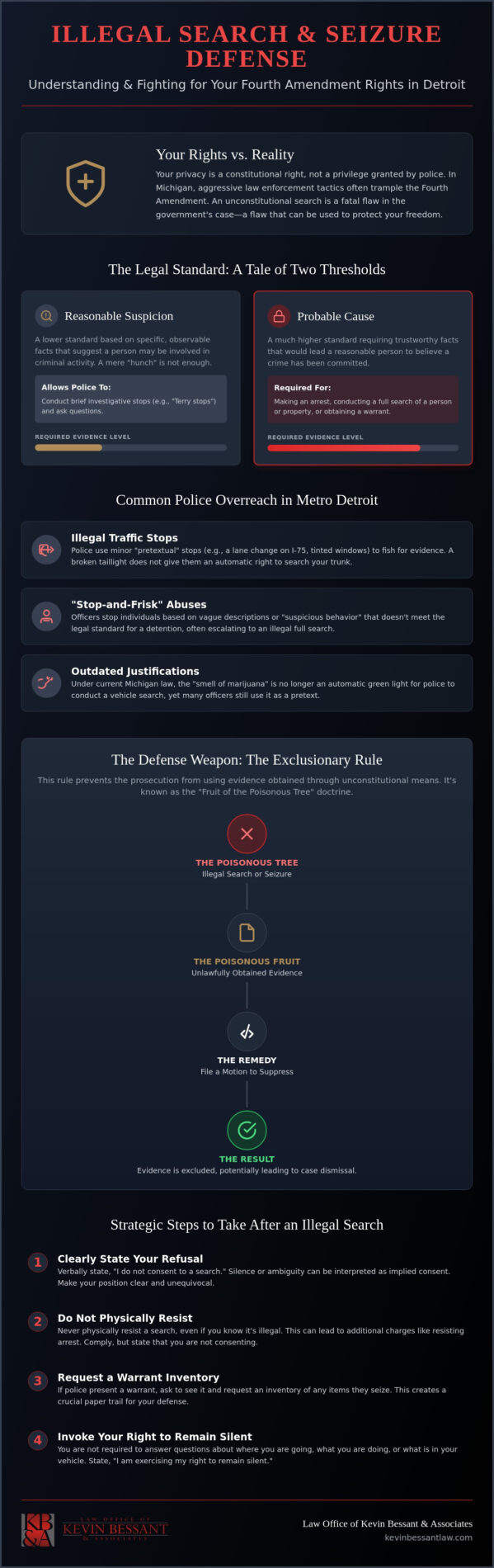
Understanding the specific terminology used in Michigan courts is vital for your defense. Police often rely on “reasonable suspicion” to justify brief investigative stops, commonly called Terry stops. This is a low bar, but it doesn’t give them a blank check. To perform a full search or make an arrest, the law requires “probable cause,” a much higher standard backed by articulable facts. Detroit courts frequently see cases where officers confuse these two standards. If an officer cannot point to specific, objective facts that suggest a crime was committed, their actions are illegal. We identify these procedural failures to expose the government’s overreach.
Common Scenarios of Unlawful Police Conduct in Metro Detroit
Police in Metro Detroit often treat constitutional rights as obstacles rather than rules. Whether you’re cruising down I-75, navigating The Lodge (M-10), or heading east on I-94, you aren’t exempt from Fourth Amendment Protections just because you’re behind the wheel. Law enforcement frequently uses pretextual stops to fish for drugs or weapons without any real legal justification. They’ll pull you over for a minor lane change or a tinted window, then immediately begin an interrogation. A minor traffic violation like a broken taillight does not automatically grant police the right to search your trunk. If they do, they’ve crossed a line that only a vigorous illegal search and seizure defense Detroit can rectify.
In high-patrol neighborhoods across the city, “Stop-and-Frisk” abuses remain a persistent threat. Officers frequently stop individuals based on vague descriptions or “suspicious behavior” that doesn’t meet the legal threshold for a detention. These encounters often escalate into full searches that violate your dignity and your rights. You don’t have to accept this overreach as a fact of life in Detroit. If you’ve been targeted by aggressive police tactics, discussing your case with a professional can help determine if the evidence against you was stolen through misconduct.
Illegal Traffic Stops and Vehicle Searches
The legal landscape in Michigan has shifted, yet many officers haven’t caught up. For years, “I smelled marijuana” was an automatic green light for a vehicle search, but that’s no longer the case under current Michigan law. Similarly, police canine sniffs are often misused to bypass warrant requirements. If an officer extends a routine traffic stop just to wait for a drug-sniffing dog, they’ve likely committed an illegal detention. Whether you were stopped on Woodward Ave or a side street in Southfield, we challenge the duration and the basis of the stop. If the officer lacked probable cause from the first second of the encounter, the entire search is tainted.
Warrantless Home Entry and Plain View Misuse
Your front door is a legal fortress that police cannot breach without a warrant or a very narrow set of “exigent circumstances.” The threshold of your home is one of the most significant boundaries in the legal system. Unfortunately, Detroit police sometimes ignore the “Knock and Announce” rule or manipulate the “Plain View Doctrine” to seize items that weren’t actually in the open. They may also pressure you into a “Consent” search by using intimidation or confusing language. Never forget that “consent” given under duress is not legal consent. We fight to prove when officers exploited their authority to enter your private space illegally, ensuring that your illegal search and seizure defense Detroit is built on the bedrock of the law.
The Motion to Suppress: Dismantling the Prosecution’s Evidence
The Motion to Suppress is the technical heart of an illegal search and seizure defense Detroit. It’s a formal request to the court to exclude evidence that was obtained in violation of your constitutional rights. In the 3rd Circuit Court, the judge acts as the ultimate gatekeeper of evidence. They decide what a jury is allowed to see and what must be buried forever. If the judge determines that the police acted outside the law, that evidence vanishes from your case. This tactical strike often leaves the prosecution with no choice but to dismiss your charges entirely.
A successful defense relies on the “Fruit of the Poisonous Tree” doctrine. This legal principle states that if the source of the evidence is tainted by illegal conduct, anything that grows from it is also tainted. If the initial stop was illegal, everything found afterward—drugs, guns, or statements—must be suppressed. We don’t just look at the moment of arrest; we analyze the very first second of the police encounter. By proving the foundation was rotten, we can bring the government’s entire house of cards crashing down around them.
How the Exclusionary Rule Works in Wayne County Courts
The window for filing a motion to suppress opens shortly after your arraignment. Timing is critical. Your defense team must prepare for a high-stakes evidentiary hearing at the Frank Murphy Hall of Justice. During this hearing, we cross-examine the officers involved to expose inconsistencies in their “probable cause” testimony. This aggressive approach is vital for a DUI defense lawyer Detroit when challenging blood draws or field sobriety tests. When we win these hearings, the prosecution’s leverage disappears instantly.
Challenging the Validity of Search Warrants
Just because an officer has a piece of paper signed by a judge doesn’t mean the search was legal. We meticulously attack the “Affidavit,” looking for instances where officers lied or misled the magistrate to secure the warrant. We also look for “stale” information where the evidence was likely gone before the warrant was even served. An overbroad warrant that allows police to search areas not specifically listed is another common point of failure. A skilled gun charge lawyer Detroit knows that warrant precision is often the difference between a prison sentence and freedom. To truly protect yourself, you must Know Your Rights and understand when a warrant is nothing more than a piece of paper used to bypass the law.
Strategic Steps to Take After an Illegal Search or Seizure
The moments following an unconstitutional search are some of the most critical of your entire life. You likely feel violated, angry, and overwhelmed, but your next moves will determine if that illegally obtained evidence stays in your case or gets tossed into the trash where it belongs. To build a winning illegal search and seizure defense Detroit, you must act as your own first investigator. Your primary goal is to protect your record while providing your legal team with the ammunition needed to fight back. Remain silent but polite. Do not give the police a reason to add “resisting” to your charges, but do not give them any information either.
Always request a copy of the warrant immediately. If the officers claim they don’t need one, make a mental note of their exact justification. Demand an inventory of every item seized before they leave the scene. This prevents “lost” evidence or mysterious items appearing in the police report later. If there are bystanders or witnesses, try to identify them. Get the names and badge numbers of every officer involved in the intrusion. Once you are safe, contact an aggressive criminal defense attorney Detroit to start the process of preserving evidence before it “disappears” from the system.
Documenting the Incident for Your Defense
Write down every detail while your memory is fresh. Start your timeline from the first flashing light you saw on the Lodge or I-94 and follow it through to the final seizure. Detail the specific dialogue used by the officers. Were they aggressive? Did they threaten you? Note the weather conditions and the lighting at the scene. We will subpoena Detroit Police dashcam and bodycam footage to verify your account and expose any lies in the official report. Finally, stay off social media. Posting about your encounter while the case is pending is a gift to the prosecution that they will use to undermine your credibility.
Why You Must Never Consent to a Search
The phrase “I have nothing to hide” is a dangerous legal trap that has sent many innocent people to prison. Police in Southfield or Warren are trained to use psychological tactics to make you feel like refusing a search is an admission of guilt. It isn’t. It’s an assertion of your constitutional rights. State clearly and firmly: “I do not consent to this search.” This simple phrase creates a record that is vital for the courtroom. Experienced detroit drug lawyer experts use this lack of consent as a primary lever to win suppression hearings and get charges dismissed. If you’ve been the victim of police overreach, contact us today to start dismantling the government’s case against you.
Aggressive Defense: How Kevin Bessant Fights Illegal Evidence
When your life is on the line, you don’t need a corporate law firm with hundreds of faces. You need a shield. Kevin Bessant provides a battle-ready illegal search and seizure defense Detroit that targets the prosecution’s weaknesses from day one. With decades of experience in the high-stakes courtrooms of Detroit and Southfield, he understands that a passive defense is a losing defense. You aren’t handed off to a junior associate or a paralegal. You get direct, one-on-one advocacy from a lawyer who has secured dismissals in homicide, drug, and weapons cases by exposing police misconduct. We stand in the gap for those facing serious felony charges, ensuring the government is held to the highest legal standard.
A reputation for aggressive motion practice is what sets this firm apart. We don’t just file paperwork; we launch a tactical assault on the government’s evidence. If the police violated your rights, we make sure the judge knows it. This relentless approach puts the prosecution on the defensive, often forcing them to reconsider their entire case before it even reaches a jury. You need a representative who isn’t intimidated by the system. You need someone who has spent years winning in the trenches of Michigan’s toughest courts.
Local Expertise in Frank Murphy Hall of Justice
The Frank Murphy Hall of Justice is a complex arena with its own set of unwritten rules. Success here requires more than just knowing the law; it requires understanding the specific preferences and tendencies of Wayne County judges and prosecutors. Our firm uses this deep-rooted local knowledge to navigate procedural hurdles that often trip up less experienced attorneys. If you’re currently behind bars, our expertise as a bond hearing lawyer Detroit is your first step toward freedom. We act as a formidable shield for clients across Detroit, Southfield, Warren, and Eastpointe, ensuring that the system doesn’t swallow you whole.
A Proactive Approach to Protecting Your Freedom
We don’t sit back and wait for the prosecution to make a move. We attack. Our team investigates the investigators, digging into personnel files and bodycam logs to uncover the procedural errors and civil rights violations that police try to hide. Every second you wait gives the government more time to build their case against you. Your future is too important to leave to chance or a lawyer who is too busy to care. Contact the Law Office of Kevin Bessant & Associates today. We provide aggressive representation for those who refuse to be intimidated. Let us take the fight to the prosecution and secure the illegal search and seizure defense Detroit you need to protect your future.
Take Command of Your Legal Defense Today
Legal Authority: Case Law
- Wong Sun v United States, 371 US 471 (1963) — established the “fruit of the poisonous tree” doctrine, holding that evidence derived from an initial illegal search or seizure must be excluded, not just the evidence directly seized during that unlawful act.
- Chatrie v United States, 609 US ___ (2026) — the U.S. Supreme Court held 6-3 that a geofence warrant used to obtain a person’s cell phone location history constitutes a search under the Fourth Amendment, meaning individuals retain a reasonable expectation of privacy in their location data even when it is held by a third-party tech company.
For the current text of these opinions, see the U.S. Supreme Court’s opinions page.
Your future shouldn’t be decided by police who ignored the law. Identifying unconstitutional stops and filing aggressive motions to suppress can dismantle the prosecution’s entire case against you. By understanding your rights and refusing to consent to illegal intrusions, you’ve already taken the first step toward freedom. Now, you need a battle-ready illegal search and seizure defense Detroit to finish the fight and protect your record.
Kevin Bessant brings over 20 years of aggressive criminal defense experience to your corner. We specialize in high-stakes felony and drug cases where the government’s evidence is often their only leverage. Our firm has a proven track record in Wayne County and Detroit courts of investigating the investigators and exposing the truth. Don’t let the system intimidate you into a plea deal you don’t deserve. You have the right to fight back, and we have the skills to win.
Take a breath and remember that you aren’t alone in this struggle. Your rights are your shield, and we are here to hold it for you. Your future is worth the fight.
Frequently Asked Questions
Can the police search my car without a warrant in Detroit?
Police can search your vehicle without a warrant only if they have probable cause or if a specific legal exception applies. Under the “automobile exception,” officers may search if they have a reasonable belief that the car contains evidence of a crime. However, they cannot search your trunk or glove box during a routine traffic stop for a minor violation like speeding. If an officer searched your car on I-94 or the Lodge without a valid, articulable reason, your illegal search and seizure defense Detroit begins by challenging that lack of authority.
What happens if the police found drugs or a gun during an illegal search?
If drugs or firearms were discovered through an unconstitutional search, that evidence must be suppressed under the exclusionary rule. This means the prosecutor is legally barred from using those items against you in court. Since the physical evidence is often the foundation of the government’s entire case, having it thrown out usually results in the charges being dismissed. We fight to ensure that any “fruit” from a poisonous tree never reaches the hands of a jury.
Does “smelling marijuana” still give Michigan police probable cause to search?
No, the mere scent of marijuana is generally no longer sufficient to justify a warrantless search in Michigan. Because marijuana is legal for adult use, its smell doesn’t automatically indicate criminal activity. Officers frequently rely on this outdated tactic to bypass your Fourth Amendment rights, but these claims are highly vulnerable in court. If an officer used “smell” as their sole excuse to tear apart your vehicle, their actions were likely a violation of your rights.
What is a “Motion to Suppress” and how does it help my case?
A Motion to Suppress is a formal challenge that asks a judge to exclude evidence obtained through police misconduct. It’s the primary engine of a strong illegal search and seizure defense Detroit. If the judge grants the motion, the tainted evidence is removed from the record. Without that evidence, the prosecution often loses its ability to prove the charges, which creates the leverage needed to secure a total dismissal or a favorable plea deal.
Can a case be dismissed if the police didn’t read me my Miranda rights?
Failure to read Miranda rights doesn’t automatically end a case, but it can lead to the suppression of any statements you made while in custody. If you were interrogated without being informed of your rights, your answers shouldn’t be used as evidence. While the police might still have other evidence, losing your confession or incriminating statements often cripples the prosecution’s narrative and makes it much harder for them to secure a conviction.
What should I do if the police show up at my house with a search warrant?
Remain polite but stay silent and immediately demand to see a physical copy of the warrant. Verify that the address is correct and look for the judge’s signature. You shouldn’t interfere with the search, but you also shouldn’t assist the officers or answer their questions without an attorney. Document the names of the officers and exactly what they take. Contact our office immediately so we can begin attacking the warrant’s validity in the Wayne County court system.
Is a search legal if I gave the police permission to look around?
Yes, if you provide voluntary consent, the police don’t need a warrant or probable cause to search your property. This is a dangerous trap because many people feel pressured to say “yes” to avoid looking guilty. You have the absolute right to refuse a search. We investigate whether your “consent” was actually coerced through threats or intimidation. If you didn’t feel free to say no, we can argue that your permission was invalid and the search was illegal.