

The belief that your juvenile record automatically vanishes when you turn 18 is a dangerous myth that leaves thousands of Michigan residents trapped by their past. If you’ve been denied a job or a professional license because of a mistake you made as a teenager, you already know that the “criminal” label doesn’t just fade away. Expunging juvenile records in Michigan is the only way to truly sever that tie and reclaim your reputation. You deserve a future that isn’t dictated by a childhood lapse in judgment. The law finally provides a pathway to get there, but you must be proactive to ensure the system doesn’t overlook your case.
It’s frustrating to feel like the legal system is still punishing you for being a kid, especially when complex “Clean Slate” updates leave you wondering where you stand. This 2026 guide simplifies the path forward, showing you exactly how to permanently remove juvenile adjudications from your record to protect your family’s peace of mind. We will break down the eligibility requirements for both automatic and petition-based set-asides, giving you a clear strategy to secure a clean background check once and for all.
Key Takeaways
- Expose the dangerous myth that juvenile records disappear at 18 and understand how these adjudications continue to block job and housing opportunities.
- Navigate the 2026 eligibility criteria for expunging juvenile records Michigan, specifically the “One-Year Rule” and the three-adjudication limit.
- Distinguish between automatic removals and those requiring a formal application to ensure your record is actually cleared by the system.
- Follow a precise, step-by-step roadmap for obtaining court records and filing the necessary legal forms to secure your future.
- Recognize why a battle-ready advocate is essential to shield you from prosecutors who may fight to keep your past visible to the public.
The Myth of the Automatic Clean Slate: Why Juvenile Records Persist at 18
The most dangerous lie you’ve been told is that your juvenile record disappears the moment you turn 18. It doesn’t. In Michigan, these records are permanent unless you fight to remove them. While the court uses the term “juvenile adjudication” instead of “criminal conviction,” this is often a distinction without a difference in the real world. A single mistake made at fifteen can resurface a decade later, sabotaging a promising career in Detroit’s competitive job market. You cannot afford to assume the system has your best interests at heart. Understanding what expungement means is the first step toward reclaiming your future and stopping the state from using your past against you. You need an advocate who understands the inner workings of the Wayne County and Oakland County courts. See why our firm is the shield you need against a system that refuses to let go.
The state of Michigan maintains non-public records even after a set-aside. Law enforcement and the courts still have access to this information. However, without a formal legal intervention, these records remain a public anchor. Employers and landlords routinely use background check services that don’t care about the nuances of juvenile law. They see a “record” and move to the next candidate. When it comes to your reputation, silence is not a strategy. Expunging juvenile records in Michigan is the only way to effectively sever this connection and ensure your background check comes back clean.
Adjudication vs. Conviction: A Distinction Without a Difference?
Private background check companies are notoriously sloppy. They often misreport juvenile adjudications as adult criminal convictions, leading to immediate disqualification for jobs or professional licenses. In Michigan, certain professional boards look deep into your history. If they find an unresolved adjudication, your license is at risk. You must be proactive. Don’t let a clerical error or a lazy data aggregator define your professional worth. Expunging juvenile records in Michigan forces the system to hide these mistakes from public view, giving you the clean start you were promised at 18 but never actually received.
Who Can See Your ‘Private’ Juvenile Record?
Even when a record is “private,” it isn’t invisible. Law enforcement agencies and the court system maintain access to set-aside records for specific legal purposes. The real danger lies in “record leakage” within private databases that haven’t updated their files. These third-party companies often scrape old data and sell it to landlords and recruiters. A court-ordered set-aside functions as a legal shield for your public persona, providing the authority you need to demand that private companies purge your data. If you don’t secure this legal shield, your past remains a ticking time bomb for your reputation.
Eligibility for Expunging Juvenile Records in Michigan (2026 Standards)
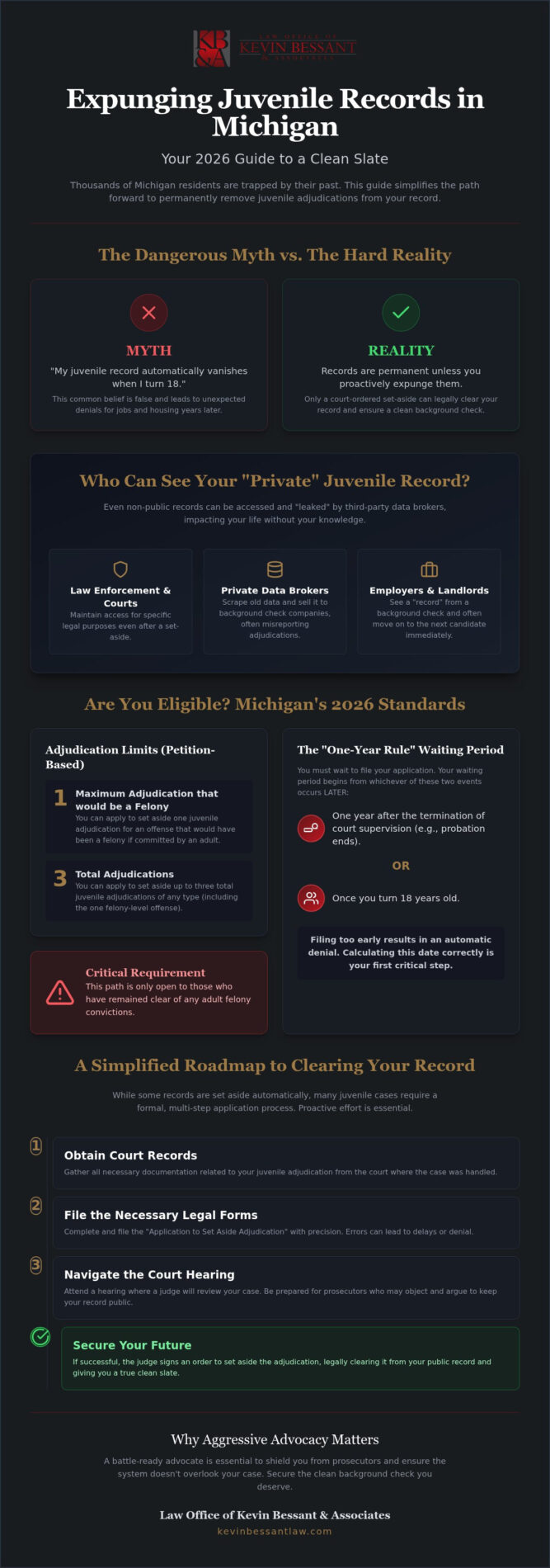
The legal landscape in 2026 offers a powerful second chance, but eligibility is a strict set of gates. While over 1.5 million Michigan residents have benefited from automatic expungements as of April 2026, many juvenile cases still require a manual application to be fully cleared. You cannot simply walk into a courtroom in Warren or Southfield and expect your past to vanish. Michigan law dictates that you can apply to set aside one adjudication that would be a felony if committed by an adult, and up to three total adjudications. However, this path is only open to those who have remained clear of adult felony convictions. If the system is still holding onto your past, you need to know exactly where you stand before the prosecutor finds a reason to deny your request. Expunging juvenile records in Michigan is a high-stakes battle that requires precision and a deep understanding of the current statutes.
Calculating Your Waiting Period
The “One-Year Rule” is the foundation of the application process. Your waiting period begins one year after the termination of court supervision or once you turn 18, whichever occurs later. This is a critical distinction. If you were on probation until age 19, your clock doesn’t start until that supervision officially ends. Filing too early results in an automatic denial, while waiting too long allows your record to continue damaging your reputation. For those seeking a deeper technical breakdown, Michigan Legal Help’s guide to setting aside a juvenile adjudication provides additional statutory context. If your case involved multiple offenses from the same transaction, the court may treat them as a single entry, but you’ll need an aggressive advocate to ensure the judge sees it that way.
Disqualifying Offenses: What Cannot Be Cleared
Not every mistake can be erased. Michigan excludes certain serious offenses from both automatic and application-based set-asides. If the adjudication involved an offense that would carry a life sentence for an adult, the record is permanent. This includes high-stakes violent crimes and specific weapons-related offenses. Additionally, traffic offenses that resulted in death or serious injury are strictly ineligible. The system is designed to be protective of the public record, which means the burden is on you to prove you’ve earned this second chance. Understanding these nuances is the only way to avoid a public and embarrassing rejection in open court. If you’re unsure if your specific charge qualifies for removal, it’s time to discuss your history with a professional who knows how to navigate these 2026 standards.
Automatic Set-Asides vs. Application-Based Expungement
The Michigan Clean Slate laws have fundamentally changed the landscape for young adults, but don’t let the term “automatic” lull you into a false sense of security. As of April 2026, over 1.5 million individuals have seen their records cleared through the state’s automated system. However, this computer-driven process is far from perfect. It primarily targets non-violent, lower-level adjudications and operates on a specific timeline that may not align with your immediate career goals. Relying solely on the state’s database to clear your name is a high-stakes gamble with your future. If the system glitches or miscategorizes your offense, your record remains a public anchor. Expunging juvenile records in Michigan through a proactive legal petition is the only way to guarantee the job is done right.
There’s a critical “gap” in the automation process that leaves thousands of people exposed. While automatic set-asides occur two years after court supervision ends, you can often apply for a manual expungement just one year after discharge. This one-year difference can be the deciding factor in whether you land a high-paying position or get passed over. You shouldn’t wait for a slow-moving government machine to decide when your life can begin. Take control of the narrative. See how our battle-ready advocacy ensures your record is purged on your timeline, not the state’s.
The Reality of Automatic Clean Slate in 2026
The Michigan State Police manage the automated clearing house, but they aren’t your advocates. They process millions of data points, and errors are frequent. Only non-violent adjudications qualify for this hands-off removal. If your past involves a weapon, a serious assault, or any offense excluded by statute, the “Clean Slate” machine will ignore you entirely. “Automatic” does not mean “instant,” and it certainly doesn’t mean “error-free.” You need a professional eye to verify that your public record is truly blank before you submit your next job application.
When You Must File a Formal Application (MC 227)
For more serious adjudications or when you need your record cleared immediately, you must file the Application to Set Aside Adjudication (Form MC 227). This process requires a formal hearing before a judge. While this may sound intimidating, it’s actually a powerful opportunity. A hearing allows you to present a record of rehabilitation and personal growth that a computer algorithm can’t see. An aggressive advocate transforms this from a dry legal filing into a compelling story of your character. We ensure the court sees the person you’ve become, not just the paperwork from your past. This human element is often the only way to overcome a prosecutor’s objection and secure the peace of mind your family deserves.
The Step-by-Step Legal Process to Clear Your Record
Winning your freedom back is a methodical battle. You cannot afford a single clerical error when expunging juvenile records in Michigan. The process is a legal minefield where one missed deadline or improperly served document results in an immediate dismissal. Since the “Clean Slate” laws took effect in April 2021, over 50,000 people have petitioned the courts, but a 2019 University of Michigan study revealed that only 6.5% of eligible individuals successfully navigate this petition-based system within five years. You need to be part of that successful minority. Follow these steps with clinical precision to ensure the system doesn’t swallow your future.
- Step 1: Obtain Your Certified Record: Visit the local court in Detroit, Southfield, or Warren where the adjudication occurred. You must secure a certified copy of your record to prove exactly what you are asking the judge to set aside.
- Step 2: Prepare Form MC 227: This is your formal Application to Set Aside Adjudication. It must be perfect. Any inconsistency with your official record will be used by the prosecutor to challenge your credibility.
- Step 3: Fingerprinting and MSP Check: You must submit your biometric data to the Michigan State Police. This isn’t just a formality; it’s a deep-dive background check to ensure no adult felonies disqualify you.
- Step 4: Service of Process: You are legally required to serve the Attorney General and the local Prosecutor’s office. If you don’t provide proof of service to the court, your hearing will be cancelled before it even begins.
- Step 5: The Discretionary Hearing: This is the final gate. The judge has the power to say no, even if you meet every technical requirement.
Preparing a Bulletproof Application
A successful application requires more than just filling out boxes on a form. You must include an “Affidavit of Rehabilitation” that proves you are a productive member of society. Collect letters of recommendation from employers, community leaders, or educators in your Detroit neighborhood. The #1 mistake applicants make is failing to disclose “other” contact with law enforcement, such as arrests that didn’t lead to charges. If the prosecutor discovers an undisclosed incident, they’ll frame it as a lie to the court. We help you audit your history so your application is an impenetrable shield.
Navigating the Hearing in Wayne or Oakland County
Expect the prosecutor to object. In high-stakes courts like Wayne or Oakland County, the government often fights to keep records public as a matter of “public safety.” You’ll be asked pointed, uncomfortable questions about your past mistakes. The judge isn’t just looking at the law; they’re judging your character and your answers. Kevin Bessant conducts rigorous preparation sessions to ensure you remain composed and persuasive under the intense pressure of a Detroit court hearing. Don’t walk into that courtroom alone. Contact us today to build your defense and secure the second chance you’ve earned.
Why Aggressive Advocacy Matters: Securing Your Future
The courtroom is a battlefield where the prosecutor is your primary opponent. Their job is to maintain the status quo, and they often view your past as a permanent public record. When you are expunging juvenile records in Michigan, you are facing a system that defaults to “no.” Prosecutors frequently argue that the public has an inherent right to access your history, regardless of how much you’ve changed since your teenage years. You cannot afford to walk into this high-stakes environment without a formidable defender. The state has resources and attorneys dedicated to keeping your record public; you need a shield that is just as dedicated to clearing it.
Fighting Prosecutor Objections
Prosecutors frequently deny juvenile expungements by citing “public safety” or the “gravity of the offense.” They rely on the flawed assumption that your teenage mistakes are a reliable predictor of your adult character. Standing alone against these arguments is a dangerous mistake. They will use your own history to frame you as a risk to the community. This is where the “advocate-versus-system” dynamic becomes your greatest asset. You need a voice that refuses to be silenced by bureaucratic objections.
Kevin Bessant acts as a vital shield against this aggressive prosecution. With over 20 years of criminal defense experience in Detroit, Southfield, and Warren courts, he understands how to dismantle these generic arguments. We don’t just ask for mercy; we demand justice. We counter the “right to know” narrative by proving your rehabilitation is a tangible benefit to the Michigan community. You need someone who is not intimidated by the system and who will stand in the gap for you, ensuring the judge sees the person you are today, not the child you were years ago.
Your Future is Non-Negotiable
The economic impact of a clean record is undeniable and life-altering. According to a 2019 University of Michigan study, individuals who successfully seal their records experience a 13% higher chance of employment and a 23% wage increase within just one year. Expunging juvenile records in Michigan is not just about peace of mind; it’s a strategic investment in your earning potential and your family’s stability. A clean background check opens doors to professional licenses, better housing, and higher-tier career opportunities that were previously out of reach.
You are fighting for more than just a piece of paper. You are fighting for the ability to provide for your family and protect your child’s future from the shadow of your past. The system is designed to be difficult, but you don’t have to navigate it without a battle-ready guide. Your reputation is your most valuable asset. Protect it with the same vigor the state uses to attack it. Learn why the Law Office of Kevin Bessant & Associates is the right choice for your defense. Your past does not have to be your permanent identity. Take the decisive step today to clear your name and reclaim your life. Contact Kevin Bessant now for an aggressive shield against your past.
Reclaim Your Reputation and Your Future
Your past should not be a life sentence. We’ve exposed why waiting for the state’s “automatic” system is a high-stakes gamble and how the 2026 eligibility rules require a precise legal strategy. Don’t let a childhood mistake continue to sabotage your career or your family’s peace of mind. Expunging juvenile records in Michigan is the only way to ensure your background check is truly clear. The system is designed to remember your mistakes, but the law finally provides a way to force it to forget.
Kevin Bessant brings over 20 years of criminal defense experience to every case. As an aggressive juvenile crime attorney in Detroit, he has delivered proven results in Michigan set-aside cases by acting as a shield against prosecutors who want to keep your record public. The government won’t help you on its own. You must take the first step to sever the tie to your past and protect your earning potential. Stop looking over your shoulder and start moving forward with the confidence of a clean slate.
Secure Your Future—Schedule a Consultation with Kevin Bessant Today. You’ve earned a second chance, and we are ready to help you make it permanent.
Frequently Asked Questions
How long does it take to expunge a juvenile record in Michigan?
The process typically takes three to six months from the moment you file your application. This timeline depends on the Michigan State Police processing your fingerprints and the specific court’s schedule in Detroit or Warren. You must be patient but persistent. Any delay in serving the Attorney General or the local prosecutor can stall your case for weeks. Don’t let administrative sluggishness derail your second chance.
Can a juvenile felony be expunged in Michigan?
Yes, you can set aside one adjudication that would be a felony if committed by an adult. Michigan law allows for up to three total adjudications to be cleared, provided you meet the strict eligibility standards. However, offenses that would carry a life sentence for an adult are strictly permanent. Expunging juvenile records in Michigan requires a clear understanding of these 2026 exclusions to avoid a wasted application.
What is the difference between expungement and setting aside a record?
In Michigan, these terms describe the same legal outcome. “Setting aside an adjudication” is the technical term used in the statutes, while “expungement” is the common phrase used by the public. When a record is set aside, it is removed from public view and becomes a non-public record. This legal shield prevents employers and landlords from seeing your past mistakes during a routine background check.
Do I need a lawyer for a juvenile expungement hearing?
You are not legally required to have an attorney, but walking into a hearing alone is a massive risk. The judge has total discretion to deny your request even if you meet the technical requirements. Prosecutors often fight to keep records public, using your history against you. You need a battle-ready advocate to present your rehabilitation and shield you from aggressive government questioning.
Will an expunged juvenile record show up on a background check for a job?
A properly set-aside record should not appear on a standard public background check. Once the court orders the expungement, the information is removed from the public database. However, private background check companies sometimes fail to update their files. This is why you need a professional to ensure the court order is properly processed and to handle any “leaked” data that persists in private systems.
Can I expunge a juvenile record if I have adult criminal convictions?
No, you cannot use the application-based process if you have adult felony convictions. Michigan law is very clear that this second chance is reserved for those who have maintained a clean record as an adult. If you have adult convictions, the system views your juvenile history as part of a pattern rather than a one-time mistake. You must audit your entire history before filing any paperwork with the court.
What happens if the prosecutor objects to my juvenile expungement?
If the prosecutor objects, the judge will hold a formal hearing to decide your fate. The prosecutor will argue that the public has a right to know about your past for safety reasons. This is a high-stakes moment where you must prove your rehabilitation through evidence and testimony. Expunging juvenile records in Michigan becomes a fight for your character, and you need a seasoned guide to win.
How much does it cost to file for a juvenile set-aside in Michigan?
There is no state-mandated filing fee for the “Application to Set Aside Adjudication” form itself. However, you will encounter associated costs for fingerprinting and obtaining certified copies of your records from the local court. Some law enforcement agencies charge a small fee for biometric data collection. While the filing is free, the cost of a failed application is much higher than the administrative fees involved.