

What if the firearm found in your home or vehicle wasn’t actually yours in the eyes of the law, even if the police have already processed the charges? You’re likely facing the crushing weight of a five-year prison sentence and the feeling that your Second Amendment rights have been permanently stripped away. It’s a high-stakes crisis that demands an immediate, forceful defense for felon in possession of a firearm Michigan. We understand the fear of returning to a cell and the confusion over whether your rights were ever truly restored under Michigan’s complex MCL 750.224f statutes.
You don’t have to accept a conviction as an inevitability. This article provides a roadmap to dismantling these serious charges using aggressive legal strategies that challenge the prosecution’s evidence at every turn. We’ll explore the vital distinctions between specified and non-specified felonies, the current status of the federal 925(c) restoration program in 2026, and the specific defense tactics that can lead to a full dismissal or a significant reduction of your charges. Your future is on the line, but with the right shield, you can navigate this system and protect your freedom.
Key Takeaways
- Master the complexities of MCL 750.224f to understand exactly how Michigan law defines the “possession” of a firearm.
- Discover how a powerful defense for felon in possession of a firearm Michigan can challenge the state’s theory of “constructive possession” when a weapon isn’t on your person.
- Navigate the critical 3-year and 5-year rules to see if your firearm rights were restored automatically or if you’re eligible to petition the court.
- Learn to weaponize the Fourth Amendment and other aggressive legal strategies to expose illegal searches and dismantle the prosecution’s evidence.
- Position yourself behind a formidable legal shield to fight for a dismissal and protect your future from a five-year prison sentence.
Understanding the Felon in Possession Charge in Michigan (MCL 750.224f)
Michigan law doesn’t play fair when it comes to your Second Amendment rights. If you’ve been convicted of a felony, you’re immediately in the crosshairs of MCL 750.224f. This is the primary statute the state uses to hammer individuals for having a weapon. It isn’t just about being caught with a gun in your waistband. Under this law, “possession” is a broad and dangerous term. It includes using, transporting, selling, or even receiving a firearm. The prosecution only needs to prove you had access to the weapon and the intent to exercise control over it. This legal concept, often referred to as criminal possession of a weapon, allows the state to charge you even if the gun belongs to someone else in your household.
Don’t be misled by the condition of the firearm. The law applies even if the gun is completely unloaded, rusted shut, or locked inside a heavy case. In Michigan, an inoperative weapon is still a weapon in the eyes of the court. As of July 2026, the legal landscape is shifting due to the proposed federal 925(c) program, which aims to create a path for rights restoration. However, you must realize that state-level charges move much faster than federal policy changes. While the federal government debates new rules, Michigan prosecutors are still aggressively pursuing convictions under the existing 3-year and 5-year restoration rules. You need a proactive defense for felon in possession of a firearm Michigan to ensure these complex layers of law don’t bury you.
The Severe Penalties of a Conviction
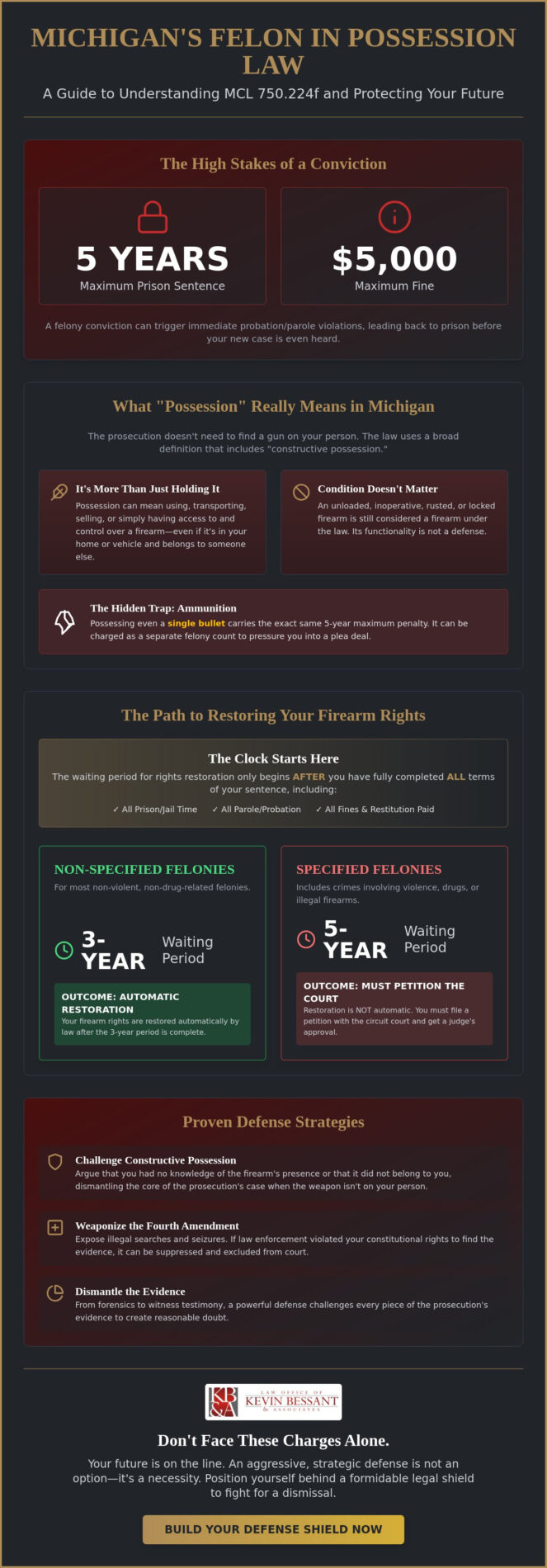
The stakes couldn’t be higher. A conviction for this charge is a felony that carries a maximum penalty of five years in prison and a fine of up to $5,000. It’s a life-altering outcome that often triggers immediate probation or parole violations, sending you back to prison before your new case even reaches trial. If your prior conviction is labeled a “specified felony,” such as a drug offense or a crime involving violence, you face even harsher hurdles. You won’t get your rights back automatically after three years; you’ll have to petition a circuit court after a five-year waiting period. This is a high-pressure situation where you need a battle-ready advocate to stand in the gap. Contact the Law Office of Kevin Bessant & Associates to start building your shield. You can reach us through our contact page to discuss your specific case.
Ammunition Possession: The Hidden Trap
Many people don’t realize that a single bullet can land them in the same amount of trouble as a loaded handgun. Possessing ammunition as a felon carries the exact same five-year maximum penalty. The ammunition doesn’t need to be inside a gun or even in the same room. If a stray round is found in your glove box or a kitchen drawer, the state will treat it as a felony violation. Prosecutors often charge the firearm and the ammunition as separate counts. They do this to increase their leverage and force you into a lopsided plea deal. Don’t let them use these tactics to intimidate you. A strong defense for felon in possession of a firearm Michigan challenges every piece of evidence, from the legality of the search to your actual knowledge of the items found.
Specified vs. Non-Specified Felonies: The 3-Year and 5-Year Rules
Michigan law creates a rigid, two-tier system for firearm rights restoration. Understanding where your prior conviction falls is the bedrock of a successful defense for felon in possession of a firearm Michigan. The state doesn’t treat a retail fraud conviction the same way it treats a drug trafficking charge. If you’re caught with a weapon, the prosecution will immediately look at your record to determine which set of rules applies to you. Under MCL 750.224f, the clock doesn’t even start ticking until you’ve satisfied every single requirement of your sentence. This means all fines are paid, all restitution is settled, and every day of your parole or probation is completed. If you’re even one day short or one dollar behind, the waiting period hasn’t begun.
For most non-specified felonies, Michigan law allows for the “automatic” restoration of firearm rights after a three-year waiting period. It sounds straightforward, but this is where many people fall into a legal trap. The state often argues that a person didn’t actually complete all terms of their sentence, or they misclassify a crime to extend the prohibition. If your case involves a “specified felony,” the rules become significantly more aggressive. You face a five-year waiting period, and your rights are never restored automatically. You must actively petition a circuit court to regain your standing. If you’re unsure where your prior conviction stands, you should reach out to our office to review your record before the system uses it against you.
What Qualifies as a Specified Felony?
The classification of your prior offense is your first line of defense. Michigan law identifies several crimes as “specified felonies” that carry the harsher five-year rule. These include:
- Burglary of an occupied dwelling
- Arson or explosives offenses
- Drug trafficking or the manufacture of controlled substances
- Any felony that involves a “substantial risk of physical force” against another person
That last category is a dangerous catch-all. Prosecutors use it to pull non-violent offenses into the specified category to justify a five-year prison sentence. We fight these classifications by proving your prior offense doesn’t meet the strict legal criteria for a specified felony, potentially dismantling the state’s case before it even reaches a jury.
The Restoration Process in 2026
By 2026, the process of petitioning the circuit court has become even more complex. Even if you’ve waited five years, you must prove to a judge that your record and reputation show you are not a threat to public safety. Relying on “automatic” restoration is a gamble you can’t afford to take. Furthermore, a massive trap exists between state and federal law. While Michigan may restore your rights, federal law under 18 U.S.C. § 922(g) often maintains a lifetime ban. This creates a high-stakes environment where you might be legal under state law but still face a federal indictment. An aggressive defense for felon in possession of a firearm Michigan must account for these conflicting jurisdictions to keep you out of a cell.
Dismantling the Prosecution’s Definition of ‘Possession’
The prosecution wants you to believe that simply being in the same room as a firearm is an automatic ticket back to prison. They rely on your fear and a lack of legal knowledge to secure easy convictions. Our defense for felon in possession of a firearm Michigan turns this strategy on its head. We don’t just accept the police report; we dismantle the very definition of “possession” that the state tries to use against you. In Michigan, possession is a legal conclusion, not a physical fact. To convict you under MCL 750.224f, the prosecutor must prove beyond a reasonable doubt that you had both knowledge of the gun and the specific intent to exercise control over it.
We employ the “Kevin Bessant Shield” to protect our clients from these overreaching tactics. This approach forces the prosecutor to prove your state of mind. It isn’t enough for them to show you were in the same car as a weapon. This is the “Mere Proximity” defense. Being near a gun is not the same as possessing it. If the state cannot prove you knew the gun was there or that you intended to use it, their case falls apart. You need an advocate who knows how to exploit these gaps in the prosecution’s logic. Learn more about why our firm is the formidable choice for high-stakes felony cases.
Constructive Possession: Fighting the ‘House Gun’ Charge
Many of our cases in Detroit and Southfield involve firearms found in shared residences. If a gun is found in a common area like a living room or a shared closet, the police often arrest everyone in the house. This is a standard intimidation tactic. Winning these cases requires proving that the firearm belonged to a spouse, roommate, or family member. We focus on “exclusive control.” If someone else had the key to the safe or the gun was kept in a room you didn’t use, the state’s theory of constructive possession fails. We stand in the gap to ensure the court understands that access does not equal guilt.
Joint Possession vs. Individual Liability
Prosecutors love the theory of joint possession, where they claim multiple people controlled one weapon. We pivot this blame. If there are no fingerprints or DNA linking you to the firearm, we argue that the physical evidence points away from you. The absence of your DNA on a weapon found in a vehicle with three other people is a powerful tool for your defense for felon in possession of a firearm Michigan. We challenge the state to provide more than just guesses and assumptions. Constructive possession is a legal theory that requires concrete proof of your intent to control the weapon, not just evidence that you had access to the area where it was found.
Proven Defense Strategies for Michigan Gun Charges
You shouldn’t wait for the prosecution to make its move. An aggressive defense for felon in possession of a firearm Michigan starts by putting the police on trial. We scrutinize every second of the interaction, from the initial traffic stop to the moment handcuffs were applied. If the police violated your rights, the evidence they found is poisoned fruit. We don’t just ask for leniency; we demand that the court uphold the law. This proactive stance is the only way to protect your freedom in a system designed to secure convictions at any cost.
The legal landscape in 2026 is shifting under the weight of major constitutional challenges. Post-Bruen, the Second Amendment rights of individuals with past convictions are being re-examined in courts across the country. We stay ahead of these trends to build a shield that accounts for the latest federal and state rulings. We also utilize the “Innocent Possession” defense for clients who handled a weapon only briefly for safety purposes. If you moved a firearm to keep it away from a child or handled it momentarily to prevent a crime, that contact shouldn’t cost you five years of your life.
Procedural errors are more common than the state wants to admit. Prosecutors often rely on outdated records or miscalculate the three-year and five-year restoration clocks. If the state charges you before they’ve verified the status of your prior felony, they’ve made a fatal mistake. We dig into the details of your history to find these cracks. If you’re facing a high-stakes charge and need a battle-ready advocate, you should contact our firm immediately to begin your defense.
Suppressing the Evidence: The Motion to Quash
An illegal traffic stop in Detroit or a warrantless search in Warren is often the key to a total dismissal. We file motions to quash the evidence, forcing the judge to throw out the firearm if the police lacked probable cause. Police reports are frequently filled with inconsistencies and “plain view” claims that don’t hold up under pressure. Kevin Bessant & Associates aggressively attacks these documents to expose procedural failures. If the search was illegal, the gun doesn’t exist in the eyes of the court.
Challenging the Prior Conviction
If your underlying felony was expunged or set aside, it cannot serve as the predicate for a 750.224f charge. Learn how expungement can protect your future and prevent the system from using your past against you. Sometimes, the LEIN system contains outdated or flat-out wrong information. If your rights were already restored or the conviction was vacated, the entire charge is invalid. We don’t just take the prosecutor’s word for it; we verify every record to ensure your defense for felon in possession of a firearm Michigan is built on a foundation of truth.
Why You Need an Aggressive Shield: The Law Office of Kevin Bessant & Associates
The Michigan legal system is a machine designed to grind through defendants and secure convictions. If you’re facing a charge under MCL 750.224f, you aren’t just another case number; you’re a target for a five-year prison sentence. You need a defense for felon in possession of a firearm Michigan that doesn’t just react but dominates the courtroom. Kevin Bessant is a battle-ready advocate who refuses to back down from high-stakes felony cases. The system wants you behind bars, but we stand in the gap as your vital shield. With over 20 years of experience in high-stakes criminal litigation, our firm has the seasoned expertise required to navigate these treacherous legal waters.
Our deep roots in Detroit, Southfield, and the surrounding Metro area give us a distinct advantage. We don’t present as a detached corporate entity. We are dedicated protectors who are intimately familiar with the inner workings of the local courts. We understand the gravity of your situation and take it with the utmost seriousness. When the pressure is at its highest, you need a voice that remains confident and unwavering. We provide that voice, ensuring the prosecution knows they’re in for a fight from the moment we take your case.
Aggressive Advocacy in Metro Detroit Courts
Success in the courtroom often depends on knowing the players. We’ve built a formidable reputation in Wayne, Oakland, and Macomb Counties by standing up to prosecutors and challenging the status quo. See why clients trust Kevin Bessant to handle their most critical legal challenges. Unlike many firms that look for the quickest plea deal, we prepare every case for trial. This aggressive preparation gives us the leverage needed to secure dismissals or significant reductions. We know the judges and the specific tendencies of local prosecutors, and we use that specialized knowledge to your benefit.
Secure Your Freedom Today
Don’t wait for the prosecution to build an insurmountable lead against you. Every hour you wait is an hour the state uses to gather evidence and solidify its case. You must act immediately to protect your future. We offer a confidential consultation to discuss the specific facts of your situation and identify the best path forward. This is a moment of crisis, but it’s also the moment to take a decisive step toward your defense. Contact the Law Office of Kevin Bessant & Associates now to secure the aggressive shield you deserve. Your freedom is too valuable to leave to chance.
Take Decisive Action to Protect Your Liberty
Legal Authority: Statute and Case Law
Michigan’s felon-in-possession statute is codified at MCL 750.224f. Federal rights restoration is governed by 18 USC 925(c), which the Department of Justice reopened via a final rule published August 20, 2026, with applications opening September 25, 2026, after more than three decades of dormancy.
- People v Tice, 220 Mich App 47, 52 (1996) — held that MCL 750.224f applies to a person’s record as it exists today, even if the underlying conviction predates the felon-in-possession statute itself.
- United States v Bean, 537 US 71 (2002) — the U.S. Supreme Court held that a federal court could not grant firearm-rights relief under 18 USC 925(c) in place of the agency when no actual administrative decision existed to review, the ruling that left the federal restoration process effectively dormant until the 2026 rule change.
For the current statutory text, see the Michigan Legislature’s MCL database and the Department of Justice’s Federal Firearm Rights Restoration page.
Michigan’s firearm laws are designed to be a maze; one wrong turn can lead back to a prison cell. You now understand that “possession” is a legal theory we can dismantle and that the 3-year or 5-year restoration rules are often misapplied by overzealous prosecutors. Securing a powerful defense for felon in possession of a firearm Michigan is the only way to ensure your side of the story is heard with the force it deserves. We’ve explored how to suppress evidence through Fourth Amendment challenges and how to pivot the blame in joint possession scenarios.
The Law Office of Kevin Bessant & Associates stands ready to act as your formidable shield. We leverage over 20 years of criminal defense experience and a specialized focus on high-stakes weapons offenses to fight for your rights. Our proven track record in Detroit, Southfield, and Warren courts demonstrates that we don’t just manage cases; we win them. We stand in the gap for our clients, providing an unwavering voice against a system that prioritizes convictions over justice.
Your future isn’t written in stone yet. Take the first step toward your freedom and let us stand in the gap for you. You have the power to fight back, and we have the battle-ready expertise to lead the way.
Frequently Asked Questions
Can I be charged with felon in possession if the gun was in a locked safe?
Yes, you can be charged even if the weapon is inside a locked safe. The prosecution will argue “constructive possession” if they can prove you had the key, the combination, or the ability to exercise control over the safe’s contents. This is why a proactive defense for felon in possession of a firearm Michigan is essential; we challenge the state’s assumption that access automatically equals legal possession or the intent to control the weapon.
What is a ‘specified felony’ under Michigan law?
A “specified felony” is a category of serious crimes that triggers harsher firearm restrictions under MCL 750.224f. This list includes arson, explosives offenses, burglary of an occupied dwelling, and drug trafficking. Unlike standard felonies, these offenses require a five-year waiting period after your sentence ends and mandate that you successfully petition a circuit court to restore your rights. If your prior conviction falls here, you are under much higher scrutiny from the state.
How long do I have to wait to own a gun after a felony in Michigan?
The waiting period is either three or five years depending on the nature of your prior offense. This clock only starts once you have finished every requirement of your sentence, including paying all fines and completing parole. For non-specified felonies, restoration is often described as automatic after three years, but you should always verify your status before handling a weapon to avoid a five-year prison trap. Any error in timing can lead to immediate felony charges.
Does an expunged felony still prevent me from owning a firearm?
Generally, an expunged or set-aside felony cannot be used as the predicate for a new firearm charge. Once the court clears your record, that conviction effectively ceases to exist for the purposes of Michigan’s possession laws. However, administrative errors in the LEIN system or federal databases can sometimes lead to wrongful arrests. We aggressively verify your record to ensure the prosecution isn’t using a cleared past to threaten your future liberty.
Can the police search my car for guns if I’m on parole?
Police officers have much broader authority to search your vehicle if you are currently on parole or probation. Most release agreements include a “search waiver” that allows agents to search your person or property without the usual requirement of a warrant. If you are in this high-pressure situation, you must realize that standard Fourth Amendment protections are limited, making the presence of any weapon in your vicinity a direct threat to your freedom.
What happens if I didn’t know there was a gun in the car I was driving?
You cannot be legally convicted if you truly had no knowledge that the firearm was in the vehicle. Knowledge is a mandatory element of the crime that the prosecutor must prove beyond a reasonable doubt. If a passenger left a weapon under a seat without your consent or awareness, we use that lack of knowledge to dismantle the state’s case. We force the prosecutor to provide evidence of your intent rather than just your proximity.
Is a felon in possession charge a federal or state crime in Michigan?
Being a felon in possession is a crime at both the state and federal levels. While Michigan handles cases under MCL 750.224f, the federal government can also bring charges under 18 U.S.C. § 922(g). Federal penalties are often much more severe and do not always recognize state-level rights restoration. This dual jurisdiction creates a dangerous environment where you need a battle-ready advocate who understands how to navigate both legal systems simultaneously.
Can I have my gun rights restored if I was convicted of a violent felony?
Yes, rights restoration is possible for violent felonies, but the process is far more rigorous. Most violent crimes are categorized as specified felonies, meaning you must wait five years after completing your entire sentence before you can take action. You then bear the burden of proving to a circuit court judge that you are no longer a risk to public safety. This requires a methodical, evidence-based defense for felon in possession of a firearm Michigan to be successful.