

The system is not your friend, and it won’t help you move on unless you force it to. Your DUI conviction is a predatory weight that never stops pulling at your professional future. Despite the hype surrounding Michigan’s “Clean Slate” laws, the state does not automatically wipe away an OWI. If you’re tired of losing job offers to a background check or living with the social stigma of a permanent criminal record, you must take a stand. You’ve carried this burden long enough, but you can finally expunge DUI Michigan records if you know how to navigate the court’s strict requirements.
This guide reveals the aggressive legal maneuvers required to clear your name and restore your reputation. We’ll break down the mandatory five-year waiting period that starts only after your probation and sentencing terms are fully complete. You’ll learn the specific eligibility rules for first-offense High BAC cases and the vital evidence needed to prove your rehabilitation to a skeptical judge. Don’t let a single mistake define the rest of your life. Understand the path to a clean slate today and prepare to defend your future against a complex legal landscape.
Key Takeaways
- Michigan’s Clean Slate laws finally provide a path to clear a first-time OWI, but this is a high-stakes, one-time opportunity that requires strict adherence to eligibility rules.
- The clock on your mandatory five-year waiting period doesn’t start at conviction. It begins only after you’ve successfully completed every term of your probation and sentencing.
- Stop waiting for an automatic fix; you must proactively petition the court to expunge DUI Michigan records, as OWI offenses are specifically excluded from automatic clearing.
- Prepare to meet the heavy burden of proof by documenting your rehabilitation and proving to the court that your past record no longer reflects your current character.
- Don’t walk into a discretionary hearing alone. Aggressive legal advocacy is your vital shield against prosecutor objections and the “one-shot” risk of a denied petition.
Michigan’s Clean Slate Law: Can You Actually Expunge a DUI?
For decades, the State of Michigan treated a single Operating While Intoxicated (OWI) conviction like a life sentence. No matter how much you changed or how hard you worked, that record remained a permanent stain on your background. That changed in February 2022. Under the expanded Clean Slate legislation, the door finally opened to expunge DUI Michigan convictions. This wasn’t just a minor tweak; it was a total overhaul of how the state views rehabilitated drivers who have proven they no longer pose a threat to public safety.
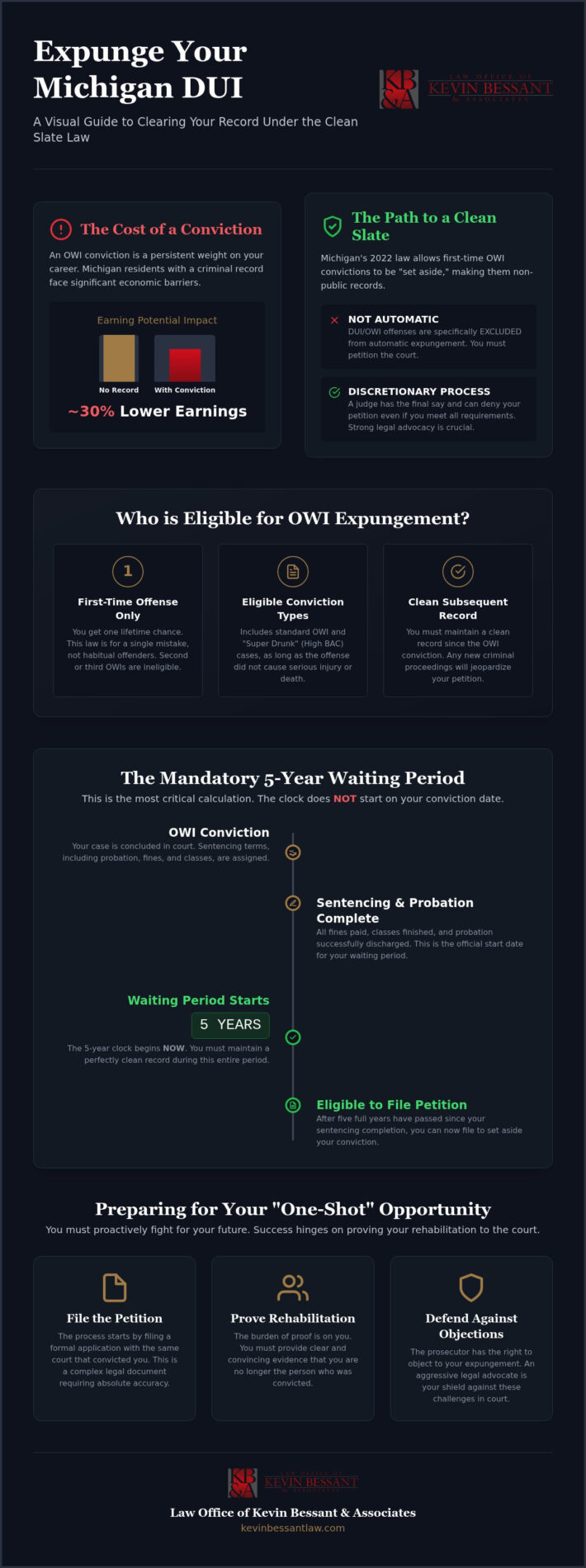
In legal terms, Expungement refers to the process of clearing a criminal record so it no longer appears on public background checks. However, Michigan law specifically uses the phrase “setting aside a conviction.” While the result is the same for your reputation, the process is anything but simple. The state previously barred OWI expungements because of a “tough on crime” stance that ignored the reality of human error. Today, the law recognizes that a single mistake shouldn’t destroy your earning potential for life. Since prime-age adults with a conviction earn roughly 30% less than those without a record, this change is a vital economic lifeline for thousands of Michigan residents.
The 2022 OWI Expungement Expansion
The passage of House Bills 4219 and 4220 marked a historic victory for Michigan residents. Before these bills went into effect, an OWI was a permanent mark that followed you to every job interview. Now, first-time offenders have a fighting chance. This expansion was specifically designed to help those who made an isolated mistake, not habitual offenders. The Michigan Attorney General’s office supported this initiative to reduce barriers to employment and housing, acknowledging that the system was holding back capable people over a one-time lapse in judgment.
Expungement vs. Setting Aside a Conviction
When you successfully expunge DUI Michigan records, the conviction isn’t deleted from existence. Instead, it is “set aside.” This means it becomes a non-public record. It vanishes from the view of landlords, most employers, and the general public. However, it remains visible to law enforcement, the courts, and the Secretary of State. If you’re ever charged with another OWI, the court will see the set-aside conviction and use it to enhance your sentencing. It is a shield for your professional reputation, but it doesn’t grant you a “free pass” for future offenses.
You must understand the catch. While Michigan now offers automatic expungement for certain minor misdemeanors, DUIs are strictly excluded from that process. You’ll never wake up to a clean record by accident. To clear an OWI, you must proactively file a petition and face a judge in the court where you were convicted. It is a discretionary process, meaning the judge has the absolute power to say “no” even if you meet the basic criteria. You’re entering a legal battleground where the prosecutor may still object to your freedom, and you need to be prepared to fight back.
Eligibility Requirements: Who Qualifies for OWI Expungement?
The state isn’t handing out favors. You only get one chance in your lifetime to expunge DUI Michigan convictions. The law is designed for individuals who made a single, isolated mistake, not for habitual offenders. If you have a second or third OWI on your record, you remain ineligible under current statutes. This “one-shot” rule applies to standard Operating While Intoxicated charges and “Super Drunk” (High BAC) convictions, provided your actions didn’t cause physical harm to others. If you’ve already set aside a different OWI in the past, the door is closed.
Eligibility is a rigid legal threshold. You must prove you meet every criteria before a judge will even consider your character. This includes having a clean record since your conviction and ensuring no other criminal proceedings are pending against you. The court looks for a pattern of stability. If you’ve struggled with new legal issues, the prosecution will use them as a weapon to block your petition. Success requires a flawless presentation of your history since the day of your arrest.
The 5-Year Waiting Period Decoded
The waiting period is the mandatory time between the end of all sentencing requirements and the filing of your petition. Don’t miscalculate this date. The five-year clock does not start on your conviction date. It begins the moment you are fully discharged from probation, released from jail, or finish paying all court-ordered fines, whichever happened last. If you were on probation for two years, your total wait time is effectively seven years from the date of the incident. You can cross-reference these strict timelines through Michigan’s Clean Slate Law resources provided by the Attorney General. Any new criminal conviction during this period can reset the clock or disqualify you entirely.
Crimes That Do Not Qualify
Some records are permanent. If your OWI resulted in the death of another person or caused “serious impairment of a body function,” you are disqualified for life. The law defines serious impairment as any injury that causes a visible disfigurement or permanently alters a person’s ability to lead a normal life. Commercial drivers face even steeper hills. If you were operating a commercial vehicle with a CDL at the time of the offense, federal regulations often prevent expungement from restoring your driving privileges, even if the criminal conviction is set aside. These federal barriers are notoriously difficult to bypass.
A single mistake shouldn’t be a life sentence, but the path to freedom is narrow. If you are unsure whether your specific conviction meets these high standards, you should reach out for a professional case review to ensure you don’t waste your one opportunity on a flawed application.
The DUI Expungement Process: Why It’s Not Automatic
Don’t fall for the “Clean Slate” marketing. While millions of criminal records have been cleared automatically since the law changed, OWI convictions were intentionally left behind. To expunge DUI Michigan records, you must initiate a manual, adversarial legal process. This isn’t a clerical update. It’s a formal request to a judge to overwrite a past judgment. If you don’t take the first step, the record stays on your background check forever. The system isn’t going to fix this for you.
The timeline is often grueling. Expect the process to take anywhere from 4 to 9 months depending on the backlog of the court where you were convicted. This delay occurs because multiple state agencies must verify your history before a hearing is even scheduled. You are also up against the prosecutor’s office. They have a legal right to object to your petition. They often do. Prosecutors are trained to find reasons to keep convictions on the books, and they will scrutinize your behavior since the arrest to build a case against your freedom.
The Petition for Set Aside (MC 227)
Filing the correct paperwork is the first major hurdle. You must use form MC 227, the Application to Set Aside Conviction. In high-volume courts like those in Wayne or Oakland County, the clerks will reject your filing for a single typo or a missing signature. There is no room for error. Because you only get one shot at this, consulting a Detroit DUI Defense Lawyer is the best way to ensure your petition is bulletproof before it hits the judge’s desk. You are also required to pay a $50 filing fee to the State of Michigan to process the application.
The Fingerprinting and Background Check Phase
Before you file, you must verify your record. Use the Internet Criminal History Access Tool (ICHAT) to ensure you don’t have hidden disqualifiers that could sabotage your case. Once the petition is filed, you are required to undergo a new fingerprinting session through local law enforcement or the Michigan State Police. These prints are sent to the FBI and the State Police to confirm your 5-year waiting period has been clean. The Attorney General’s office then reviews this data to decide if they will support or oppose your petition. Only after these state agencies have their say will a judge finally schedule your hearing.
Preparing Your Petition: Evidence, Hearings, and Objections
Meeting the eligibility criteria is just the entry fee. To successfully expunge DUI Michigan records, you must carry the heavy burden of proof. The law requires you to demonstrate that your behavior since the conviction has been “consistent with the circumstances of the offense and the public welfare.” This is a high bar. You aren’t just filing papers; you’re convincing a judge that you are no longer a risk to the community. If you don’t present a compelling case, the court will default to keeping the conviction on your record.
Success depends on how you frame your life since the arrest. You are entering a discretionary environment where the judge’s personal views on public safety can influence the outcome. You need to be proactive. Waiting for the hearing to explain yourself is a recipe for failure. You must build a wall of evidence that makes a denial difficult for the judge to justify.
Proving Your Rehabilitation
Judges in strict courts like Royal Oak or Southfield look for concrete, documented proof of a changed life. They don’t want to hear excuses about the night of the arrest. They want to see AA attendance logs, certificates from intensive counseling programs, and consistent employment records. Character letters from community leaders or employers can also be powerful, provided they are specific and attest to your current sobriety and integrity. It’s vital to remember that the judge has full discretion to deny a petition based on the “circumstances of the offense,” meaning if your original arrest involved high speeds or extreme danger, they may still refuse to clear it despite your recent progress.
Navigating the Courtroom Hearing
The hearing is where your future is decided. It follows a formal, high-pressure structure: opening statements, the presentation of your evidence, and often, a pointed cross-examination by the prosecutor. Expect the judge to ask direct questions about your relationship with alcohol and what has changed in your life since the police pulled you over. Prosecutors frequently object to OWI expungements, arguing that the public needs to know about your driving history for safety reasons. You must be prepared to counter these arguments with a focused, vigorous defense that prioritizes your right to move forward.
The stakes are absolute. If the judge denies your application, you’re barred from re-applying for three years. You can’t afford to waste your “one shot” on a weak presentation or a lack of evidence. To protect your reputation and ensure your petition is handled with the seriousness it deserves, you should contact an experienced advocate to build a winning strategy before your hearing date is set.
Why You Need an Aggressive Detroit DUI Expungement Lawyer
The system is built to remember your mistakes. It isn’t designed to forgive them. When you attempt to expunge DUI Michigan records, you’re walking into a courtroom where the default setting is skepticism. The “One Shot” rule creates a high-pressure environment where a single procedural error or a weak argument results in a three-year ban on re-applying. You can’t afford to treat this like a DIY project. You need an advocate who acts as a vital shield, standing between you and a legal system that would prefer to keep your record permanent.
Local knowledge is your greatest asset in this struggle. The legal landscape in Southeast Michigan isn’t uniform. A petition filed in Detroit’s 36th District Court requires a different strategic approach than one filed in Warren or Troy. Judges in these jurisdictions have specific tendencies and unique expectations for what constitutes “rehabilitation.” We understand these nuances because we’ve spent over 20 years navigating these specific courtrooms. We don’t just file forms; we prepare for a battle, ensuring every potential prosecutor objection is anticipated and neutralized before the hearing even begins.
Aggressive Advocacy for High-Stakes Cases
Our firm treats your expungement with the same urgency as a high-stakes felony defense. We don’t wait for the prosecutor to attack your character. We proactively build a narrative of growth and professional success that makes their objections look hollow. By the time you stand before the judge, we’ve already laid the groundwork to prove that your past OWI is an anomaly, not a pattern. Learn more about Why Us and how our battle-ready approach has helped Detroit families reclaim their lives from the weight of a criminal record.
Secure Your Future Today
Think of this process as a high-yield investment in your own freedom. Clearing your record removes the 30% “conviction tax” that many employers silently apply during background checks. It restores your professional reputation and opens doors to housing and career opportunities that were previously locked. You’ve served your time and finished your probation. Now, it’s time to stop paying for the same mistake every time you apply for a job. Take the first step toward a clean criminal background check by securing the representation you deserve. Contact the Law Office of Kevin Bessant & Associates today to start the process to expunge DUI Michigan convictions and finally move forward with your life.
Take Control of Your Criminal Record Today
Your future is too valuable to leave in the hands of a disinterested bureaucracy. Michigan’s Clean Slate laws provide the opportunity, but they don’t provide the result. You must proactively petition the court to expunge DUI Michigan convictions, and you must do it with a strategy that anticipates prosecutor pushback. The five-year waiting period is only the first hurdle; the real challenge is surviving the discretionary hearing where a judge decides if you’ve truly earned your freedom.
Kevin Bessant acts as your vital shield in the courtroom, bringing over 20 years of criminal defense experience to your case. As an aggressive advocate in Wayne, Oakland, and Macomb counties, he has a proven track record of success in high-stakes felony and OWI matters. You don’t have to face a skeptical judge alone. Stop letting a past mistake dictate your future earnings and social standing. Your clean slate is within reach if you take decisive action now.
Clear Your Record – Schedule Your Consultation with Kevin Bessant. Restoration is possible, and our firm is ready to stand in the gap for you. Take the first step toward a total professional recovery today.
Frequently Asked Questions
Can I expunge a DUI in Michigan if I have more than one conviction?
No, you cannot set aside more than one OWI conviction in your lifetime. Current Michigan law limits eligibility strictly to first-offense convictions. If you have a second or third offense on your record, those convictions remain permanent. This rule ensures that the law only benefits those with an isolated lapse in judgment rather than habitual offenders. If you’ve already had a DUI set aside, you don’t get another chance.
How long do I have to wait to expunge a DUI in Michigan?
You must wait exactly five years before you can apply to expunge DUI Michigan records. This clock doesn’t start on the day of your conviction. It begins only after you’ve successfully completed every term of your sentence. This includes finishing probation, completing any jail time, and paying all court-ordered fines. If you miscalculate this date and file early, the court will reject your application immediately, wasting your time and resources.
Is a Michigan DUI expungement automatic under the Clean Slate law?
No, DUI expungements are never automatic. While the Clean Slate law introduced automatic clearing for some minor misdemeanors, OWI offenses were specifically excluded from that process. You’re required to file a formal petition and attend a discretionary hearing. The burden is entirely on you to prove your rehabilitation to a judge. The state won’t act on your behalf, and the record stays public until you force a change.
Will my DUI expungement restore my driving privileges?
No, a successful expungement doesn’t restore your driving privileges or remove the OWI from your driving record. The set-aside process only clears your public criminal history. Your driving record is maintained separately by the Secretary of State. Any license sanctions, points, or revocations resulting from the original conviction will remain in effect. Expungement is a tool for employment and housing, not for fixing a revoked driver’s license.
What happens if my DUI expungement petition is denied?
If your petition is denied, you’re legally barred from re-filing for three years. This mandatory waiting period makes it critical to get the process right the first time. A denial often happens because a judge wasn’t convinced of your rehabilitation or a prosecutor successfully argued that your record should remain public for safety reasons. You only get one shot to make a first impression, so don’t walk in unprepared.
Does a DUI expungement clear my record with the Secretary of State?
No, it doesn’t. A DUI expungement clears the conviction from your criminal background check, but the Secretary of State still maintains the OWI on your driving history. This means auto insurance companies and the Department of State will still see the offense. The expungement is designed to help you pass background checks for jobs and housing. It won’t hide your driving history from state regulators or insurance providers.
Do I need to go to court for a DUI expungement in Michigan?
Yes, you must attend a formal hearing in the court where you were originally convicted. This is a discretionary proceeding where you must present evidence of your rehabilitation. The judge will ask direct questions about your lifestyle and your history since the arrest. It’s an adversarial process where the prosecutor has the right to object to your request. You need a vigorous defense to counter any opposition from the state.
How much does it cost to expunge a DUI in Michigan?
You’re responsible for a state-mandated filing fee payable to the State of Michigan to process your application. You’ll also face costs for mandatory fingerprinting through local law enforcement or the Michigan State Police. While these administrative costs are fixed, the real price of failure is much higher. If you are researching costs for expert counsel, you can explore Legal Representation Fees to see how specialized firms structure their defense services. If you try to expunge DUI Michigan records without professional help and lose, you’re locked out of the system for three years.