

The moment handcuffs click around your wrists, the clock starts. Every word you say, every instinct you follow, every decision you make in those first frantic hours can either protect your future or hand prosecutors exactly what they need to destroy it. Knowing what to do when arrested in Michigan isn’t just useful information; it’s the difference between walking free and facing years of consequences you never saw coming.
You already know that gut-sinking panic. The racing thoughts. The desperate urge to explain yourself, to cooperate your way out of the situation. That instinct feels natural, but in a Michigan interrogation room, it’s one of the most dangerous things you can do.
This guide gives you a clear, step-by-step legal shield for the critical 24 hours following an arrest in Michigan. You’ll learn exactly when to stay silent, how the arraignment process works, what drives bond decisions, and how to secure aggressive legal representation before your case gains momentum against you. From the backseat of a police cruiser to your first court appearance, you’ll know your next move before you even have to think about it.
Key Takeaways
- Knowing exactly what to do when arrested in Michigan — including the precise phrase to invoke your right to silence — can prevent you from handing prosecutors the evidence they need to convict you.
- Michigan law requires a prompt arraignment within 24 hours of arrest, and understanding this timeline gives you a critical window to build your defense before the system gains momentum against you.
- Your bond hearing is your first real shot at freedom — and the factors a Michigan judge weighs can be strategically addressed with the right legal advocate in your corner.
- High-stakes charges like OWI, weapons possession in Detroit, and felony assault carry consequences that begin the moment of arrest, making immediate legal intervention essential — not optional.
- An aggressive, locally experienced Michigan criminal defense attorney isn’t just an advantage; it’s the shield standing between you and life-altering consequences.
The First 10 Minutes: Invoking Your Michigan Constitutional Rights
Those first ten minutes after an arrest aren’t chaos. They’re a carefully engineered opportunity for law enforcement to collect evidence against you. Michigan police officers are trained in conversational interrogation techniques designed to keep you talking before you even realize you’re being questioned. The casual “so what happened tonight?” from the officer driving you to the precinct isn’t small talk. It’s strategy.
Understanding what to do when arrested in Michigan starts with one unbreakable rule: stop talking. Not after you’ve given a brief explanation. Not after you’ve “cleared up the misunderstanding.” Immediately. Completely. The Miranda warning rights you’ve heard recited on television are a real constitutional shield, but that shield only works if you actively raise it.
The Right to Remain Silent is Absolute
“Anything you say can and will be used against you” isn’t a Hollywood formality. It’s a prosecutorial promise. Inside Detroit precincts and Wayne County holding facilities, the single most common mistake arrested individuals make is believing they can talk their way out of the situation. They explain. They contextualize. They apologize. Every word becomes potential evidence that prosecutors will dissect, reframe, and weaponize at trial.
Silence doesn’t imply guilt. It denies the prosecution a foundation to build on before your attorney even enters the picture. Use this exact phrase, stated clearly and calmly:
- “I am invoking my right to remain silent. I want an attorney.”
Say it once. Then stop. Legally, that statement obligates officers to halt questioning. Anything they elicit after that point becomes constitutionally vulnerable evidence.
Refusing Consent to Searches
There’s a critical legal distinction between a lawful pat-down for officer safety and a full search of your vehicle, phone, or personal property. A pat-down is permitted under Michigan law when an officer has reasonable suspicion you’re armed. A full search of your car or device requires either a warrant or your voluntary consent.
Never give that consent. The moment you say “go ahead,” you’ve surrendered Fourth Amendment protections that no attorney can restore after the fact. Michigan courts consistently uphold evidence obtained through voluntary consent, regardless of what you believed you were agreeing to.
If officers search your property without consent and without a warrant, do not resist physically. Stay calm, stay quiet, and mentally note every detail: the officer’s name, badge number, time, location, and exactly what was searched. Document everything the moment you’re able. That documentation becomes ammunition for your defense attorney to challenge the search’s legality and potentially suppress whatever they found.
Knowing what to do when arrested in Michigan means understanding that your rights aren’t passive. They require active, immediate assertion. Every second you delay is a second the system uses against you.
Inside the Precinct: Surviving Booking and the Arraignment Process
You’ve invoked your rights. You’ve stayed silent. Now you’re being walked through the precinct doors, and a different kind of pressure begins. Booking feels administrative, almost routine. That’s exactly what makes it dangerous. The procedural calm of fingerprinting and paperwork can lull you into lowering the guard you’ve just fought to establish.
The Booking Phase Logistics
Booking is the system cataloguing you: photographs, fingerprints, personal information, and the collection of your property. Officers will log everything you’re carrying, issue a receipt, and place your belongings in storage. You’re entitled to make a phone call, and that call should go directly to a criminal defense attorney, not a family member who will then spend precious time trying to find one.
One rule applies to every document placed in front of you during this process: do not sign anything beyond a basic booking receipt without your attorney present. Statements, consent forms, and “voluntary” agreements can all have legal consequences you won’t recognize in the moment. Politely decline. State that you want your attorney to review anything requiring your signature.
The friendlier the officer during processing, the more alert you should be. Detroit and Southfield precincts operate in environments where casual conversation is a practiced technique. An officer asking about your family, your night, or your job isn’t making small talk. Stay courteous, stay composed, and stay quiet about your case. That shield you raised at arrest? Keep it up through every minute of booking.
There’s another threat inside the holding area that most generic legal guides completely overlook: other inmates. Never discuss your charges, your version of events, or anything about your case with anyone in that cell. Jailhouse informants are a documented prosecutorial tool. A cellmate who seems sympathetic today can become a witness against you tomorrow.
Your First Court Appearance: The Arraignment
Michigan law mandates that an arrested individual be brought before a judge or magistrate for arraignment without unnecessary delay, generally within 24 hours of arrest. This isn’t a trial. It’s the formal reading of charges, the entry of an initial plea, and the first bond determination. It moves fast, and what happens here shapes everything that follows.
You have two options at arraignment: enter a “Not Guilty” plea or stand mute, which the court automatically records as Not Guilty. Both preserve your defense options. What you should never do is plead guilty at arraignment, regardless of the circumstances. That plea closes doors your attorney hasn’t even had a chance to open yet.
This is precisely why knowing what to do when arrested in Michigan includes understanding that arraignment isn’t a formality. The charges the prosecution presents, the language used to frame them, and the bond arguments made in that room all set the trajectory of your case. An aggressive criminal defense attorney in Detroit who is present at arraignment can challenge overreaching charges, argue aggressively for reasonable bond, and signal to the prosecution from minute one that you are not an easy target.
Twenty-four hours sounds like enough time. It isn’t. Every minute you wait to secure representation is a minute the system spends building momentum against you. Reach out to Kevin Bessant’s defense team the moment you’re able, so someone is already fighting for you before you ever set foot in that courtroom.
The Bond Hearing: Your Best Chance at Immediate Freedom
Most people walk into a bond hearing blind, treating it like a bureaucratic checkpoint they have to survive rather than a winnable battle they can fight. That’s a critical mistake. The bond hearing is your first real opportunity to reclaim your freedom, and an aggressive defense attorney can turn it into a strategic advantage before your case even gains traction.
Bond exists for one legal purpose: to guarantee your return to court. It is not punishment. Michigan law does not permit a judge to set an impossibly high bond simply because the charge is serious. That distinction matters, and a skilled attorney will force the court to honor it.
When determining bond, Michigan judges weigh several factors:
- Flight risk: Do you have ties that anchor you to the community, or reasons to disappear?
- Public safety: Does the nature of the charge suggest a risk to others if you’re released?
- Charge severity: Felonies carry more weight than misdemeanors, though neither automatically justifies excessive bond.
- Criminal history: Prior failures to appear or prior convictions work against you.
- Employment and family stability: These actively work in your favor when properly presented.
Understanding what to do when arrested in Michigan includes recognizing that bond hearings aren’t passive. They’re arguments. Your attorney isn’t just showing up; they’re building a case for your release in real time.
Michigan courts recognize two primary release structures. A Personal Recognizance (PR) Bond requires no money upfront; you’re released on your promise to appear. A Cash or Surety Bond requires payment, either directly to the court or through a bail bondsman who posts it on your behalf for a non-refundable fee. The difference between these outcomes often comes down entirely to how effectively your attorney argues your circumstances to the judge.
Securing Your Release in Detroit and Southfield
Bond trends vary significantly across Michigan’s counties. Wayne County courts, which handle Detroit’s high-volume caseload, tend toward higher bond amounts on felony charges. Oakland County judges often respond strongly to documented community ties. Macomb County courts weigh employment stability heavily in their assessments.
Preparation is everything. Before your hearing, your attorney should be gathering concrete evidence of your community roots: employer verification letters, proof of residence, documentation of family dependents, and any records of consistent court compliance from prior matters. These aren’t soft character appeals; they’re direct responses to the flight risk calculation every judge is running.
Don’t walk into that courtroom without a fighter in your corner. Learn more about how Kevin Bessant’s team approaches these critical moments through our bond hearing lawyer Detroit services, built specifically around aggressive advocacy for immediate release.
Common Bond Conditions You Must Follow
Release isn’t unconditional. Michigan judges routinely attach requirements that carry serious consequences if violated. Typical conditions include:
- Travel restrictions: You may be prohibited from leaving the county or state without prior court approval.
- Drug and alcohol testing: Random testing is common, particularly in OWI or drug-related cases.
- No-contact orders: If the charge involves another person, contact with that individual is typically prohibited entirely.
- Check-in requirements: Regular reporting to a pretrial services officer may be mandated.
Violate any of these conditions and the consequences are immediate: arrest, bond forfeiture, and a judge who now views you as a flight risk going forward. There’s no grace period. There’s no warning.
Some bond conditions are also disproportionately restrictive given the actual circumstances of your case. That’s not something you have to accept permanently. Knowing what to do when arrested in Michigan means understanding that an attorney can file a motion to modify overly burdensome conditions, whether that’s lifting a travel restriction that prevents you from working or challenging a no-contact order that disrupts your family situation. Your Shield doesn’t stop fighting after you walk out of that hearing.
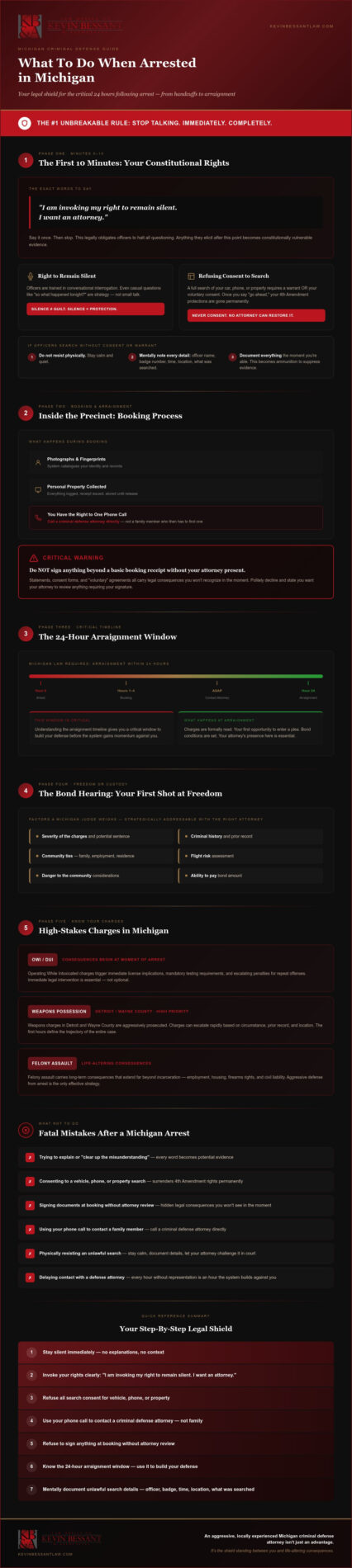
Navigating High-Stakes Charges: DUI, Weapons, and Felony Assault
Not all arrests carry equal weight. A misdemeanor charge and a felony weapons offense both begin with handcuffs, but they diverge dramatically the moment booking ends. Certain charges trigger automatic consequences that run parallel to your criminal case, attacking your license, your rights, and your freedom on separate tracks simultaneously. Knowing what to do when arrested in Michigan means recognizing which track you’re on before the system locks you into a trajectory you can’t reverse.
DUI Defense and License Protection
An OWI arrest in Michigan doesn’t just threaten your freedom. It launches an immediate, separate attack on your driver’s license through the implied consent law. The moment you’re arrested for OWI, a 14-day countdown begins. You have exactly 14 days to request a hearing with the Michigan Secretary of State and challenge the automatic license suspension. Miss that window and your license is gone, regardless of what happens to your criminal case.
That timeline is unforgiving. Most people don’t know it exists until it’s already expired.
Breathalyzer and blood test results aren’t bulletproof evidence either, despite how prosecutors present them. Breathalyzer devices require proper calibration and maintenance documentation. Blood samples must follow strict chain-of-custody protocols from collection through laboratory analysis. A single break in that chain, an improperly maintained device, a technician who deviated from procedure, creates grounds to challenge the result entirely. An DUI defense lawyer Detroit residents trust knows exactly where these vulnerabilities hide and how to expose them before trial.
Weapons and Felony Assault Tactics
Gun charges in Detroit carry consequences that shock people who underestimate them. Michigan law imposes mandatory minimum prison sentences on certain weapons offenses, which means a judge has limited discretion to show leniency even when circumstances warrant it. “Possession” sounds minor. It isn’t. Depending on your prior record, the location of the alleged offense, and whether the firearm was concealed, you could be looking at years of mandatory incarceration before any discretionary sentencing even begins.
Defending a gun charge lawyer Detroit clients face requires a two-front attack: challenging the constitutionality of the stop and search that produced the weapon, and dismantling the prosecution’s evidence chain. If officers lacked reasonable suspicion or probable cause, everything they found afterward becomes suppressible. No weapon in evidence means no charge to prosecute.
Felony assault accusations demand the same aggressive posture. Michigan’s self-defense law and “Stand Your Ground” provisions create legitimate defense pathways, but they require precise, strategic application. Self-defense claims don’t succeed on instinct alone; they succeed when an attorney methodically reconstructs the sequence of events, challenges witness credibility, and frames the evidence within the legal standard the prosecution must overcome.
Across all three charge categories, the “aggressive defense” framework starts in the same place: the police report. Officers make procedural errors. They document stops inaccurately. They omit details that undercut their probable cause narrative. A battle-ready defense attorney tears that report apart line by line, hunting for the constitutional violation that changes everything.
These charges don’t wait for you to get organized. Neither should your defense. Contact Kevin Bessant’s team today and put an aggressive shield between you and the consequences bearing down on you right now.
Why an Aggressive Shield Matters: Securing a Detroit Criminal Defense Expert
The system doesn’t pause while you decide what to do. Prosecutors build cases in real time. Evidence gets catalogued, witnesses get interviewed, and narratives get locked in before most people have even thought about picking up the phone. Knowing what to do when arrested in Michigan means nothing if you don’t act on it immediately, and the single most consequential action you can take is putting a battle-tested advocate between you and the machinery moving against you.
The Law Office of Kevin Bessant & Associates brings more than 20 years of high-stakes criminal defense litigation to Michigan’s toughest courtrooms. That’s not a credential to skim past. That’s two decades of reading Wayne County prosecutors, anticipating Oakland County judicial tendencies, and knowing exactly which arguments land in Macomb County bond hearings versus which ones fall flat. That local intelligence isn’t something you can download. It’s built in the room, case by case.
A Dedicated Protector in Your Corner
High-volume settlement firms process cases like assembly lines. You become a file number, your circumstances become a checkbox, and your defense becomes whatever formula moves the docket forward fastest. That approach might work for minor infractions. It fails catastrophically when you’re facing a felony assault charge in Detroit or a weapons offense that carries mandatory minimums.
Kevin Bessant’s approach is different by design. Every homicide defense, every drug charge, every retail fraud case gets personalized, aggressive attention. The firm’s deep familiarity with Detroit, Southfield, and Warren courtrooms means your attorney walks in knowing the terrain, not learning it at your expense. That local advantage translates directly into sharper cross-examinations, more targeted suppression motions, and bond arguments built around what actually moves the specific judge sitting on your case.
The Cost of Waiting
Hesitation is expensive. Witnesses’ memories shift. Surveillance footage gets overwritten. The prosecution’s version of events hardens into the accepted narrative while you’re still trying to figure out your next move. Every hour without representation is an hour the other side spends working unchallenged.
There’s also a longer horizon to consider. How you defend yourself today directly shapes your options years from now. A conviction that might have been avoided, or a charge that could have been reduced, can close the door on future relief. Michigan’s Clean Slate laws offer real pathways to clearing your record, but those pathways narrow significantly depending on the outcome of your underlying case. Working with an expungement attorney Michigan residents trust starts with the defense decisions made right now, not after the damage is done.
Don’t gamble with your future waiting for a better moment to act. That moment doesn’t come. Secure your aggressive criminal defense today and put a proven shield between you and the consequences bearing down on you. Don’t stand alone against the system. You don’t have to.
Your Next Move Determines Everything
Knowing what to do when arrested in Michigan is only half the battle. The other half is acting on that knowledge before the system builds momentum you can’t reverse. Stay silent. Invoke your rights immediately. Refuse consent to searches. And get a battle-tested attorney into your corner before that arraignment clock runs out.
Three realities from this guide don’t change regardless of your charge: evidence gets locked in fast, prosecutors work unchallenged when you’re unrepresented, and the decisions made in those first 24 hours follow you for years. You don’t have to face that alone.
The Law Office of Kevin Bessant & Associates brings 20+ years of aggressive criminal defense to Detroit’s toughest courtrooms, with proven results in bond hearings, felony litigation, and DUI defense. That experience is your shield right now, when it counts most.
Don’t let another hour pass without a fighter in your corner. Don’t Gamble With Your Freedom. Contact the Law Office of Kevin Bessant & Associates Now. Your future is worth defending.
Frequently Asked Questions About What to Do When Arrested in Michigan
What is the first thing I should do if I am arrested in Michigan?
Invoke your rights immediately. State clearly: “I am invoking my right to remain silent. I want an attorney.” Say it once, then stop talking entirely. Don’t explain, apologize, or try to clarify the situation. Your second move is to use your phone call to contact a criminal defense attorney directly, not a family member who then has to locate one for you. Every minute without representation is a minute the prosecution works unchallenged.
Can Michigan police search my car without a warrant after an arrest?
Not without your consent or a recognized legal exception. Michigan and federal law permit officers to search the area immediately within your reach at the time of arrest for safety reasons, but a full vehicle search generally requires a warrant, your voluntary consent, or circumstances like plainly visible contraband. Never give consent. If officers search anyway, don’t physically resist; stay calm, note every detail you can, and report everything to your attorney so the search can be challenged later.
How long can the police hold me in jail before I see a judge?
Michigan law requires arraignment without unnecessary delay, which courts interpret as generally within 24 hours of arrest. This timeline applies to most arrests, though weekends and holidays can create practical complications in how quickly a magistrate becomes available. That 24-hour window is exactly why knowing what to do when arrested in Michigan includes securing legal representation before arraignment, not after. An attorney present at that first hearing can challenge charges and fight for reasonable bond from the opening moment.
What happens if I cannot afford to pay my bond in Detroit?
You have options. First, your attorney can argue for a Personal Recognizance bond, which requires no money upfront and releases you on your promise to appear. If a cash bond is set, a bail bondsman can post it on your behalf for a non-refundable fee, typically a percentage of the total amount. If bond remains unaffordable, your attorney can file a motion to reduce it, presenting evidence of community ties, employment, and family stability that the initial hearing may not have fully addressed.
Will I lose my driver’s license immediately after a Michigan DUI arrest?
Not automatically, but you’re on a tight deadline. Michigan’s implied consent law triggers a 14-day window from the date of your OWI arrest to request a hearing with the Secretary of State and contest the automatic suspension. Miss that deadline and your license is suspended regardless of what happens to your criminal case. The suspension and the criminal charge run on completely separate tracks, which means you need an attorney addressing both simultaneously, not sequentially.
Can a felony arrest be removed from my record later?
Michigan’s Clean Slate laws do create pathways for expungement of certain felony convictions, but eligibility depends heavily on the specific offense, the number of prior convictions, and how much time has passed since sentencing. Some serious offenses, including certain violent crimes and major traffic offenses, are excluded entirely. The outcome of your underlying case matters enormously here: a charge reduced through aggressive defense today may be expungeable years from now, while a conviction that could have been avoided closes that door permanently.
What is the difference between a felony and a misdemeanor in Michigan?
Michigan misdemeanors carry maximum penalties of up to one year in county jail and are typically handled in district court. Felonies carry potential sentences exceeding one year and are served in state prison, not county jail. The distinction goes beyond sentencing: felony convictions trigger the loss of voting rights while incarcerated, firearm possession rights, and certain professional licenses. Some Michigan felonies also carry mandatory minimum sentences, meaning a judge has limited ability to show leniency even when circumstances might otherwise warrant it.
Do I have to answer questions if the police say they just want to “clear things up”?
No. That phrase is one of the most common interrogation setups you’ll encounter. “Clearing things up” is not a legal category; it’s a technique designed to get you talking before you’ve had a chance to think carefully or consult an attorney. You have the absolute right to remain silent whether you’re under formal arrest or being questioned voluntarily. Politely but firmly state that you want an attorney present before answering any questions. That request legally obligates officers to stop questioning you.