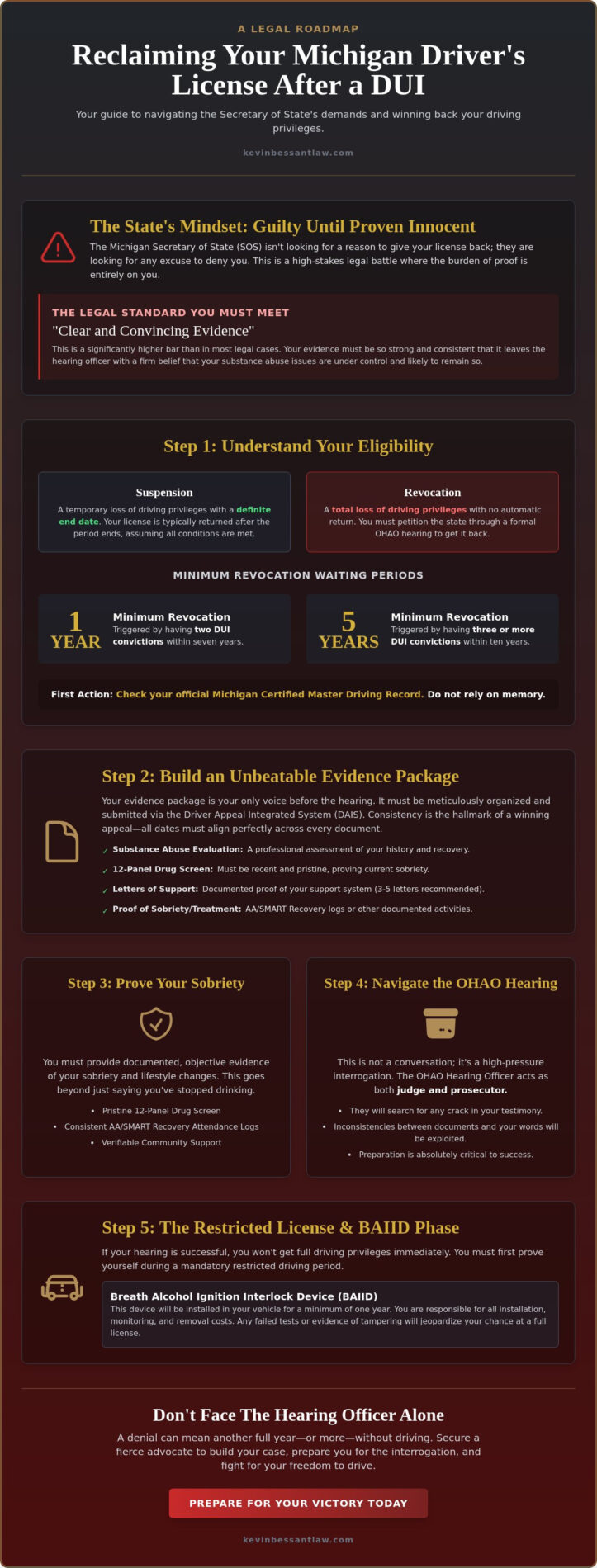
The Michigan Secretary of State isn’t looking for a reason to give your license back; they are looking for any excuse to keep you off the road. When you walk into an Office of Hearings and Administrative Oversight (OHAO) hearing, you aren’t just filling out paperwork. You are entering a high-stakes legal battle where the burden of proof rests entirely on your shoulders. Whether you’re stuck in a one-year or five-year eligibility window, you must understand exactly how to get license back after DUI Michigan before you risk a permanent denial that destroys your employment and family life.
We know the fear of a hearing officer’s interrogation is real, but you don’t have to face the system alone. You deserve a fierce advocate and a clear path to freedom. This guide provides the exact legal roadmap to navigate the Secretary of State’s demands and reclaim your driving privileges. We will detail the $125 reinstatement fee, the mandatory 12-panel drug screen, and the specific evidence required to prove your sobriety is “clear and convincing” to the state. Stop guessing and start preparing for your victory today.
Key Takeaways
- Identify your specific eligibility window and the legal distinctions between a license suspension and a full revocation under Michigan law.
- Discover the exact process of how to get license back after DUI Michigan by assembling a comprehensive evidence package that withstands the state’s scrutiny.
- Learn how to provide “clear and convincing” proof of sobriety through 12-panel drug screens and documented support systems like AA or SMART Recovery.
- Prepare for the OHAO hearing by understanding the hearing officer’s role and how to navigate their high-pressure interrogation effectively.
- Understand the requirements of the restricted license phase, including the costs and reporting mandates of the Breath Alcohol Ignition Interlock Device (BAIID).
Understanding Your Eligibility for Michigan License Restoration
The Michigan Secretary of State operates with a single objective: keeping habitual offenders off the road. If you are wondering how to get license back after DUI Michigan, you must first accept that the state views you as a risk until you prove otherwise. This isn’t a simple administrative task. It is a legal battle where the burden of proof rests entirely on your shoulders. You’re fighting against a system designed to say “no.” While DUI laws in the United States vary by jurisdiction, Michigan remains one of the strictest when it comes to license restoration. You aren’t just asking for a favor; you are challenging a formal revocation that the state intends to keep in place.
The standard you must meet is “Clear and Convincing Evidence.” This is a significantly higher bar than a simple “Preponderance of Evidence.” It means your evidence must be so strong and consistent that it leaves the hearing officer with a firm belief that your substance abuse problems are under control and likely to remain so. Most people fail because they treat the hearing like a casual conversation. In reality, the OHAO hearing officer acts as both judge and prosecutor. If your testimony has one crack, they will find it. This is why checking your official Michigan Certified Master Driving Record is the non-negotiable first step. Don’t rely on your memory; the state won’t. If you miscalculate your eligibility date by even one day, the OHAO will reject your application instantly.
Revocation vs. Suspension: Why It Matters
A suspension has a definite end date. A revocation is a total loss of driving privileges with no automatic return. The Secretary of State won’t just mail your plastic back to you when the time is up. In Michigan, multiple OWI convictions trigger “habitual offender” status. This means the state legally presumes you have a chronic alcohol problem. Your license is gone indefinitely until you successfully petition the Office of Hearings and Administrative Oversight (OHAO). You are essentially considered guilty of being an unsafe driver until you prove your sobriety through a rigorous legal process. You can learn more about why our firm is the right choice to lead this defense.
Calculating Your Minimum Waiting Period
Your “eligible to apply” date depends on your specific conviction history. If you have two DUIs within seven years, you face a minimum one-year revocation. If you have three or more DUIs within ten years, that window jumps to five years. Check your record for “Driving While License Suspended” (DWLS) charges. These are clock-killers. Every time you’re caught driving without a license, the state can reset your waiting period. We recommend starting your preparation at least three to six months before your eligibility date hits. You need this lead time to gather support letters, complete your professional evaluation, and ensure your 12-panel drug screen is pristine. Don’t wait until the last minute to start building your shield.
Building an Unbeatable Evidence Package for the SOS
Submitting a half-baked application to the Secretary of State is a guaranteed way to stay sidelined for another year. If you want to know how to get license back after DUI Michigan, you must realize that your evidence package is your only voice before the hearing even begins. The Office of Hearings and Administrative Oversight (OHAO) expects a meticulously organized submission through the Driver Appeal Integrated System (DAIS). “Good enough” evidence doesn’t exist in this arena. If your documents are inconsistent or lack the required legal depth, the hearing officer will issue an automatic denial without hesitation. You are building a case to prove you are no longer a threat to the public; every single page must reinforce that narrative.
Your timeline is your greatest asset or your biggest liability. Dates must align perfectly across every document in your packet. If your Substance Abuse Evaluation was completed on one date, but your 12-panel drug screen was taken three weeks later, you’ve already created a gap that a hearing officer will exploit. Consistency is the hallmark of a winning appeal. To start on the right foot, you should download and review the official license restoration hearing forms to understand the baseline requirements. However, simply filling out these forms isn’t enough to win. You need a strategy that anticipates the state’s skepticism.
The Substance Abuse Evaluation (SAE)
The SAE is the most critical document in your entire appeal. It isn’t a standard medical checkup; it’s a forensic legal document that must be completed by a state-certified evaluator. Whether you find an evaluator in Detroit, Southfield, or elsewhere in the state, they must understand OHAO’s specific demands. The “diagnosis” and “prognosis” sections are where most cases are won or lost. If your evaluator lists your prognosis as anything less than “excellent,” your appeal is likely dead on arrival. The state needs to see a lifetime commitment to sobriety, backed by professional clinical data. Before you submit a single document, it’s vital to have a professional eye review your packet to ensure no hidden errors exist. You can reach out to our firm for a comprehensive strategy session.
Letters of Community Support: Quality Over Quantity
You need three to six notarized letters from people who see you in different social circles, such as family, work, and recovery groups. These aren’t character references; they are sobriety testimonials. They must state exactly how long the writer has known you, when they last saw you drink, and their knowledge of your recovery program. Avoid “poison pills” in these letters. A writer who says, “I haven’t seen them drink much lately,” has just sunk your case. The state demands proof of total abstinence, not “controlled” use. Every letter must be a forceful endorsement of your sober lifestyle.
Proving Sobriety: The 12-Panel Drug Screen and AA Logs
The Hearing Officer is waiting for you to trip over your own history. One of the most common ways a petition fails is the “Sobriety Date” trap. If your substance abuse evaluation lists your last drink as occurring on January 1st, but your testimony or a support letter suggests it was actually in February, your credibility is destroyed. The state will view this discrepancy as an attempt to deceive the Office of Hearings and Administrative Oversight (OHAO). When you are learning how to get license back after DUI Michigan, you must realize that consistency is more than a suggestion; it’s a requirement for survival. Your sobriety date must be a fixed, immovable point across every document and every sentence you utter during the hearing.
Relapse is a reality for many, but it doesn’t have to be a death sentence for your appeal. The key is how you frame it. You must demonstrate that your current period of abstinence, which must be at least one full year, is different from previous attempts. You need to show the hearing officer that you’ve identified your triggers and built a fortress around your sobriety that didn’t exist before. This is where your physical and social evidence must do the heavy lifting to prove your life has fundamentally changed.
The 12-Panel Drug Test Requirements
A standard employment drug test is useless here. The Secretary of State requires a 12-panel drug screen that specifically includes “integrity variables.” These variables measure creatinine and pH levels to ensure the sample hasn’t been diluted or tampered with. If your lab report doesn’t include these specific data points, the OHAO will reject your entire evidence package. You should expect to pay around $60 for this specialized screen. Timing is equally critical. Your drug screen results must be dated within 90 days of the date you submit your hearing request. If you miss this window by even a single day, you’re handing the state a reason to deny you.
Proving a Support System Exists
The OHAO Hearing: Navigating the Confrontation
The moment you log into your virtual hearing room, the environment shifts from preparation to high-stakes confrontation. The Office of Hearings and Administrative Oversight (OHAO) hearing isn’t a friendly chat or a simple interview. It’s a formal legal proceeding where the Hearing Officer acts as both the judge and the prosecutor. They’re trained to find the slightest inconsistency in your story. If you’ve been searching for how to get license back after DUI Michigan, you must realize that a single slip-up during this interrogation results in an immediate denial. Losing doesn’t just mean you can’t drive. It means you’re legally barred from appealing again for another full year. The state is not your friend in this room.
The hearing officer will probe your history with surgical precision. They’ll ask trick questions about your last use of controlled substances or your social circle’s drinking habits. They want to see if you’ll admit to “moderate” drinking or if you’ll contradict the evidence package you submitted weeks ago. This is where an aggressive DUI defense lawyer becomes your only shield. You need someone who can object to improper questioning and ensure the record reflects your true commitment to sobriety. Without a battle-ready advocate, you’re left to navigate a system that’s designed to keep you off the road.
Virtual Hearings vs. In-Person
Most Michigan restoration hearings now take place via Microsoft Teams. While you might be in your home in Detroit or Warren, you must treat this as a formal courtroom. Technical failures, like a dropping Wi-Fi signal or poor audio, can derail your testimony and make you appear unprepared. You must project credibility and genuine remorse through a webcam. This means maintaining eye contact with the lens, dressing professionally, and ensuring your environment is silent. The hearing officer is judging your demeanor as much as your words. If you look distracted, they’ll assume you aren’t taking your sobriety seriously.
Mastering the Direct and Cross-Examination
Your testimony begins with a direct examination, usually led by your attorney. This is your chance to set the tone and present your “Relapse Plan.” The hearing officer will inevitably ask: “What will you do when life gets hard?” If your answer is a vague “I just won’t drink,” you’ve already lost. You must provide a concrete, step-by-step strategy involving your support system, your sponsor, and your specific coping mechanisms. Attorney Kevin Bessant prepares you for this cross-examination by identifying the state’s likely attack vectors before the hearing starts. We shield you from procedural bullying and ensure your voice is heard without being twisted by the state’s interrogation tactics.
Don’t risk a one-year denial by walking into a confrontation unprepared. Schedule your strategy session with our firm today to secure your future and get back on the road.
Restricted Licenses and the Ignition Interlock Phase
Winning your OHAO hearing is a massive victory, but it is a conditional one. The Secretary of State won’t just hand over a full license immediately. Instead, you’ll receive a restricted license order, often called the “Green Light,” which comes with a mandatory Breath Alcohol Ignition Interlock Device (BAIID) requirement. If you want to know how to get license back after DUI Michigan, you must understand that this phase is a one-year test of your sobriety. The state is effectively putting you on probation behind the wheel. Any mistake during this period, from a missed rolling re-test to a power failure in your car’s battery, can trigger a new license revocation and send you back to square one.
The financial burden of this phase is significant. You’ll be responsible for the $125 reinstatement fee along with the ongoing costs of the interlock device. For example, providers like Intoxalock may require a $107.99 deposit and a $29.99 setup fee, with monthly leasing costs reaching approximately $127.99. Other providers like Smart Start offer daily rates starting around $1.99. Installation fees typically range from $100 to $200. These costs are the price of your freedom, but they also buy you a year of intense state surveillance. Every time you blow into that device, the data is recorded and sent directly to the Secretary of State.
Living with the BAIID Device
Success during the restricted phase requires absolute vigilance. You must choose a reputable interlock provider in the Detroit metro area and adhere to a strict reporting schedule. The SOS monitors your driving data for “violations,” which include high-alcohol startups, missed rolling re-tests, or evidence of tampering. False positives are a constant threat. Something as simple as using mouthwash or eating certain yeasty foods can trigger a warning. If your device records a failure, you have a very narrow window to prove it was a false positive. We help clients fight “tamper” or “power loss” accusations that threaten to reset their revocation period. Don’t let a technical glitch destroy a year of hard-earned progress.
The Path to Full Reinstatement
You must remain on a restricted license for at least 12 months before you are eligible to petition for full, unrestricted driving privileges. This isn’t an automatic upgrade. You’ll have to return to the OHAO for a final hearing to prove you have mastered the interlock phase without a single violation. The hearing officer will review your BAIID reports with a magnifying glass. If your record is clean and your testimony remains consistent with your initial appeal, you can finally leave the interlock device behind. This is the final hurdle in the roadmap of how to get license back after DUI Michigan, and it requires the same level of aggressive preparation as your first hearing.
The system is designed to be difficult, but you don’t have to navigate it alone. We are ready to act as your shield and guide you through every step of this high-stakes process. Ready to get back on the road? Contact the Law Office of Kevin Bessant & Associates today.
Take the First Step Toward Reclaiming Your Road Freedom
Legal Authority: Statute and Administrative Rule
Michigan license revocation and restoration procedures are codified at MCL 257.303, with the substantive hearing standards set out in Michigan Administrative Rule 257.313 (“Rule 13”), which requires an applicant to prove by clear and convincing evidence that their alcohol or substance abuse problem is under control and likely to remain under control.
For the current statutory and rule text, see the Michigan Legislature’s MCL database.
The path to restoration is a minefield of legal technicalities and state-sponsored skepticism. You’ve learned that winning requires more than just waiting out your revocation period; it demands a flawless evidence package and a battle-ready performance at your OHAO hearing. From securing the right 12-panel drug screen to surviving the hearing officer’s interrogation, every detail counts. Understanding how to get license back after DUI Michigan is the difference between driving to work and facing another year of isolation. The state’s goal is to keep you off the road, but our goal is to put you back on it.
You don’t have to stand against the Secretary of State alone. With 20+ years of aggressive criminal defense experience and specialized expertise in Detroit OHAO hearings, Attorney Kevin Bessant provides the vigorous advocacy you need to shield yourself from the state’s bullying tactics. We don’t just fill out forms; we build a fortress around your case to ensure your sobriety is seen as clear and convincing. Your future and your livelihood are too important to leave to chance.
Secure Your Driver’s License Shield – Contact Kevin Bessant Now. Your future is waiting. Let’s get you back behind the wheel with the confidence and legal protection you deserve.
Frequently Asked Questions
How much does it cost to get your license back after a DUI in Michigan?
Reclaiming your road freedom requires navigating several mandatory fees. You must pay a $125 reinstatement fee to the state once your appeal is granted. Additionally, expect to pay approximately $250 to $300 for a professional substance abuse evaluation and about $60 for the required 12-panel drug screen. If you’re granted a restricted license, ignition interlock providers like Intoxalock charge a $107.99 deposit and $127.99 monthly leasing fees. These costs are the non-negotiable hurdles the state places in your path.
Can I get a restricted license before my OHAO hearing?
No, you cannot obtain a restricted license for a revoked driving privilege without first winning an OHAO hearing. The Secretary of State does not grant “hardship” or “work” licenses automatically for habitual offenders. You must prove your sobriety through the formal appeal process described in this guide. Don’t waste time looking for shortcuts; the only way forward is through a successful legal petition that meets the state’s rigorous standards.
What happens if I lose my Michigan driver’s license restoration hearing?
If you lose your hearing, you are legally barred from filing another appeal for one full year. This is the primary danger of submitting a poorly prepared case. The Hearing Officer’s denial is final for 12 months, meaning you remain without a license regardless of your employment or family needs. You must treat your first attempt as your only chance to avoid a devastating 365-day delay in your restoration journey.
Do I really need a lawyer for a Secretary of State hearing?
While you aren’t legally required to have representation, walking into an OHAO hearing alone is a massive risk. The state acts as both judge and prosecutor, looking for any inconsistency to deny your request. An aggressive advocate shields you from procedural bullying and ensures your evidence meets the “clear and convincing” standard. Most people who represent themselves fail because they don’t understand how to get license back after DUI Michigan through the state’s complex legal framework.
How long does the entire license restoration process take in Michigan?
The entire process typically takes four to six months from the moment you begin gathering evidence. You should start preparing your packet three to six months before your eligibility date. Once you submit your request through the Driver Appeal Integrated System (DAIS), it can take several weeks to receive a hearing date. After the hearing, a written decision is usually mailed within a few weeks. Every day you wait to start is another day you remain off the road.
Can out-of-state residents get their Michigan license hold cleared?
Yes, out-of-state residents can clear a Michigan hold through an administrative review or a virtual hearing. If you now live outside of Michigan but cannot get a license in your new state due to a Michigan revocation, you must still prove your sobriety to the OHAO. We help out-of-state petitioners navigate this process remotely to ensure their Michigan record is cleared and their driving privileges are restored in their home state.
What is the ‘Clean Slate’ law and does it apply to DUI license restoration?
Michigan’s “Clean Slate” law allows for the expungement of certain criminal convictions, but it does not automatically restore a revoked driver’s license. Even if your underlying OWI conviction is set aside, your driving record remains separate. You must still go through the formal OHAO hearing process to reclaim your driving privileges. Don’t confuse criminal expungement with the administrative restoration of your license; they are two distinct legal battles requiring different strategies.
What if my DUI happened 10 or 20 years ago?
The age of your conviction does not matter; a revocation is indefinite until you take action. Even if your last DUI was 20 years ago, the Secretary of State will not give your license back without a formal hearing. You must still provide a substance abuse evaluation and prove you have maintained total abstinence. The state views an old revocation with the same skepticism as a new one, so you must prepare your evidence with total precision.