

A single bagel or a splash of mouthwash shouldn’t cost you your driver’s license, but in the eyes of the Secretary of State, a technical glitch is often treated as a criminal violation. You’ve fought hard to regain your restricted driving privileges, yet you’re now tethered to a machine that records your every breath and captures your image during random retests. Understanding the specific ignition interlock device rules Michigan enforces is the only way to shield yourself from a system that is often more interested in compliance than common sense.
It’s understandable to feel anxious about the high cost of monthly rentals or the fear of a “false positive” triggering a permanent revocation. You deserve a clear path to full license restoration without being sabotaged by aggressive state monitoring. We’re here to stand in the gap and provide the professional reassurance you need to navigate this high-pressure environment. This article will teach you how to master the complex 2026 BAIID regulations, defend against technical violations, and ensure you successfully complete your monitoring period. We’ll examine the 0.025 BAC threshold, reporting requirements, and the proactive steps you must take to protect your future behind the wheel.
Key Takeaways
- Learn the strict 0.025 BAC threshold and why driving any vehicle without a device is a critical mistake.
- Master the ignition interlock device rules Michigan requires to prevent technical glitches from turning into permanent license revocations.
- Identify “environmental” traps like mouthwash and spicy foods that trigger false positives and threaten your driving privileges.
- Discover how to maintain a bulletproof log of your tests and vehicle repairs to survive aggressive state monitoring.
- Understand the vital role of aggressive legal advocacy in defending your restricted license during Secretary of State show-cause hearings.
What is a BAIID and Why Does Michigan Require It?
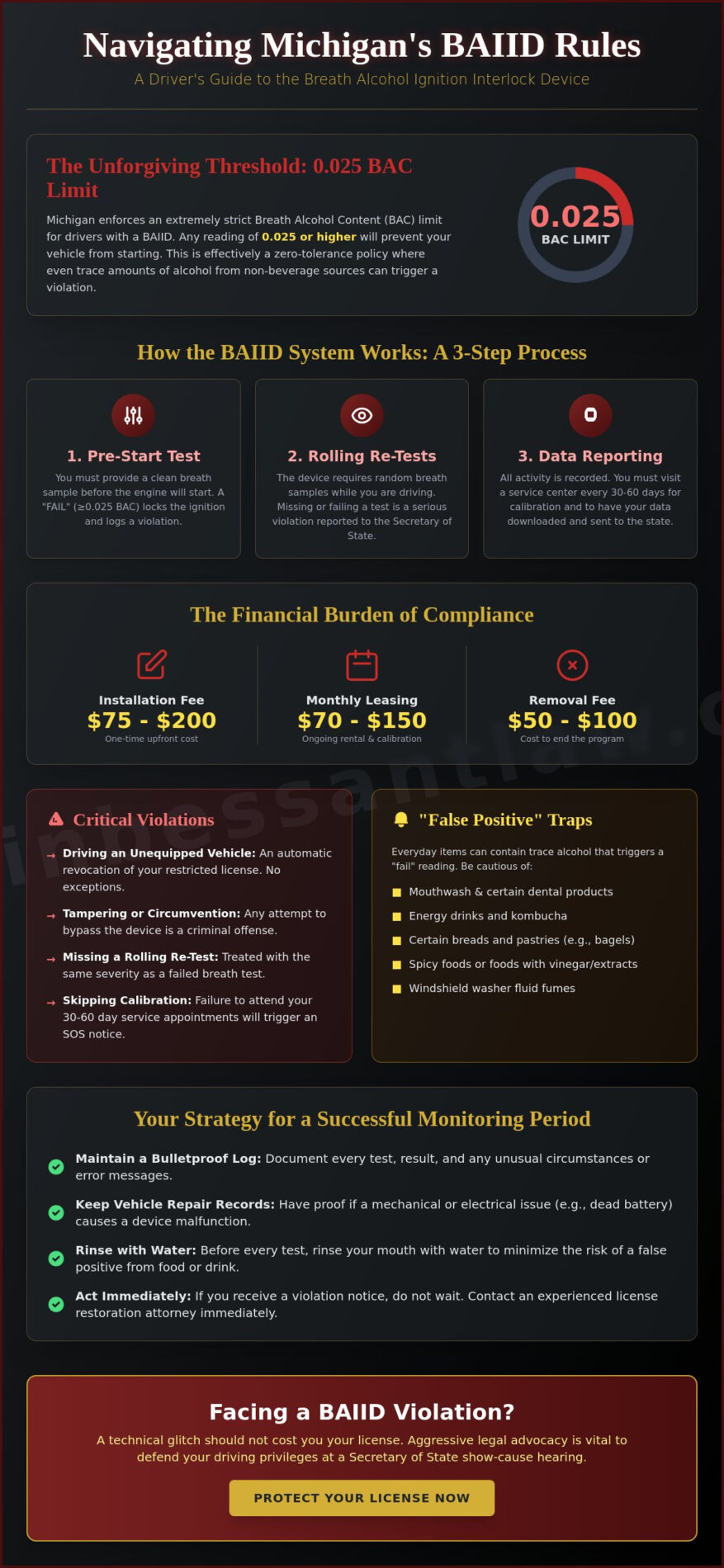
Regaining your driving privileges after multiple OWI convictions in Michigan isn’t just about proving your sobriety at a hearing. It’s about surviving a period of technological probation. A Breath Alcohol Ignition Interlock Device (BAIID) is a sophisticated breathalyzer wired directly into your vehicle’s electrical system. It acts as a digital gatekeeper. If the device detects a Breath Alcohol Content (BAC) of 0.025 or higher, your car simply won’t start. The state doesn’t trust you yet. They’ve outsourced that trust to a machine.
The ignition interlock device rules Michigan enforces are designed to be unforgiving. Once the engine is running, the device doesn’t stop monitoring your breath. It requires random rolling retests at set intervals while the vehicle is in operation. If you miss a test or blow a “fail,” the ignition interlock device logs the event and reports it immediately to the Secretary of State. This is a high-stakes monitoring trap where any technical slip-up can lead to an immediate re-revocation of your license. Don’t let a faulty sensor or a piece of food destroy your progress.
The Role of Rule 13 in License Restoration
Under Michigan’s Administrative Rule 13, the Secretary of State views the BAIID period as a mandatory trial period for your sobriety. If you have two or more DUI convictions within seven years, or three within ten, you can’t jump straight to a full license. The law mandates a minimum of one year on a restricted license with a BAIID. The Office of Hearings and Administrative Oversight (OHAO) uses this time to watch you. They want to see a clean record of data downloads before they even consider granting you full, unrestricted driving privileges. In September 2023, Governor Whitmer signed Senate Bills 134 and 135, which expanded these requirements to specialty courts, including veterans and drug treatment courts. The net is widening, and the monitoring is becoming more aggressive.
Mandatory Installation and Monitoring Costs
You can’t just pick any device from a local shop. You must use a state-approved vendor, and the financial burden falls entirely on your shoulders. While prices fluctuate based on the vendor, expect an installation fee between $75 and $200. The bleeding doesn’t stop there. Monthly leasing fees typically range from $70 to $150, and you’ll pay a removal fee of $50 to $100 at the end. You’re also required to visit the service center every 30 to 60 days for calibration and data downloads. Skipping these appointments is a major violation that will trigger an SOS notice. You are paying for the privilege of being monitored by a system that is looking for a reason to take your license back. If you receive a notice of a violation, contact Kevin Bessant immediately to protect your driving future.
Critical Ignition Interlock Device Rules in Michigan
Don’t treat your restricted license like a standard operator’s permit. It’s a high-stakes privilege with a very short leash. The ignition interlock device rules Michigan mandates require you to drive only the vehicle equipped with the BAIID. If you’re caught behind the wheel of a car without one, your restricted license will be revoked immediately. There are no exceptions for emergencies or borrowing a spouse’s vehicle. You must also maintain a Breath Alcohol Content (BAC) below 0.025 grams per 210 liters of breath to start your vehicle. This is effectively a zero-tolerance policy. One mistake with a morning bagel or mouthwash can trigger a report that threatens your freedom.
Once you’re on the road, the monitoring doesn’t stop. The device will prompt you for random rolling retests at various intervals. These tests are designed to ensure you didn’t have someone else blow into the device to start the car. You have a limited window to provide a clean sample while the vehicle is in motion. Missing a rolling retest is treated with the same severity as a failed breath test. According to the Michigan Vehicle Code on ignition interlock devices, any attempt to tamper with or circumvent the device is a criminal offense. All of this data is stored and uploaded to the Secretary of State during your mandatory monthly calibration appointment. If you’re facing a potential violation, it’s vital to speak with a license restoration expert before the SOS takes action.
Restricted Driving Boundaries
Your restricted license isn’t a “go anywhere” pass. You are legally confined to specific locations and times, typically limited to work, school, support groups, or court-ordered treatments. You must carry your original SOS Order of Action at all times. If a police officer pulls you over and you’re outside your permitted hours or traveling to an unauthorized location, you face immediate arrest and license revocation. The SOS doesn’t accept excuses for “quick errands” or “driving a friend home.” Stick to the script or lose your seat behind the wheel.
The 48-Hour Service Window
Technical glitches or failed tests can send your device into “lockout mode.” When this happens, you have a critical 48-hour window to get your vehicle to a state-approved service center. If you fail to meet this deadline, the device may permanently disable your ignition, requiring a costly tow and an automatic report to the SOS. A lockout report triggers an immediate review of your driving record. The state will assume you’ve been drinking unless you can prove otherwise. This is a moment of crisis that requires a decisive, professional response to prevent a permanent revocation.
Common BAIID Violations and the False Positive Trap
The machine in your dashboard is not your friend. It is a biological sensor that lacks the ability to distinguish between a shot of whiskey and the ethanol found in common household products. The ignition interlock device rules Michigan enforces create a zero-tolerance environment where “environmental” alcohol becomes a legal minefield. While advocacy groups like Mothers Against Drunk Driving highlight the safety benefits of these tools, they rarely mention the technical glitches that can ruin an innocent person’s life. A failed start-up test caused by spicy food, yeast in bread, or alcohol-based hand sanitizer is recorded as a violation regardless of your actual sobriety. You are guilty until you prove yourself innocent.
Tampering and circumvention are the most serious accusations you can face. Michigan law treats “blowing for a friend” or asking someone else to provide a sample as a felony-level mistake. Even innocent actions can look like tampering to the Secretary of State. A dead car battery or a mechanic disconnecting power to perform repairs is often flagged as an intentional power interruption. The SOS assumes you were trying to bypass the device. If your battery dies, you must have a paper trail of receipts and service records to explain the power loss. Without documentation, the state will move to revoke your license immediately. If you’ve been flagged for a technical glitch, contact Kevin Bessant immediately to stop the revocation process.
Defending Against False Positives
The High Stakes of a “Major Violation”
Michigan separates infractions into minor and major violations. A minor violation includes failing a start-up test or missing a rolling retest. However, three minor violations within one monitoring period or a single “major” event, such as tampering or a failed rolling retest, will trigger a catastrophe. A major violation results in the automatic reinstatement of your original license revocation. This is the “re-revocation” nightmare where you lose your driving privileges for at least another full year. You won’t just get a warning; you’ll get a notice in the mail telling you that your license is gone. You must act decisively to request a show-cause hearing and defend your future.
Managing Your BAIID Period: A Strategy for Success
Installing the device was the first step, but surviving the monitoring period requires a proactive defense strategy. The ignition interlock device rules Michigan enforces are designed to catch you in a mistake. You must treat every day as if you are already standing before a hearing officer. Success isn’t passive. It’s about creating a wall of evidence that proves your sobriety and your commitment to the law. The Secretary of State is not looking for excuses; they are looking for a perfect data set. If you don’t provide it, they’ll take your license back without hesitation.
One of the most dangerous mistakes you can make is letting someone else drive your vehicle. If a friend or family member fails a breath test or misses a rolling retest while behind your wheel, the violation is yours. The SOS holds the permit holder responsible for the vehicle, not the person who provided the sample. Similarly, you must protect your vehicle’s electrical integrity. If a mechanic needs to disconnect the battery, you must obtain a formal receipt and a signed statement on shop letterhead detailing the exact time and reason for the power loss. Without this paper trail, the state will assume you were attempting to bypass the system. If you’ve already experienced a power interruption, contact Kevin Bessant immediately to document the event before a notice of revocation arrives.
The Importance of the Written Maintenance Log
Hearing officers in 2026 are increasingly skeptical of digital data alone. They want to see a meticulous written log that matches the device’s records. Your log should document every trip, every startup failure, and every cleared retest. If you blow a 0.026 because of a morning bagel, your log must reflect the “rinse and retest” protocol we discussed. Write down the time of the failure, the reason (e.g., “consumed food”), and the time of the subsequent passing test. This level of transparency proves you aren’t hiding a pattern of consumption. It turns a potential violation into a documented technical anomaly.
Preparing for Your Final Restoration Hearing
Your final restoration hearing is the culmination of your monitoring period. The hearing officer will review your “Annual Report,” which is a summary of every breath sample you’ve provided over the last year. This report is the most influential piece of evidence in your case. It can either be your greatest shield or your downfall. A seasoned DUI defense lawyer Detroit is essential for interpreting these technical reports. We know how to identify and explain “false positives” or missed tests that might look like violations to an untrained eye. We prepare you for the aggressive questioning of the OHAO, ensuring your year of compliance leads to a full, unrestricted license. Don’t risk a permanent revocation by walking into your final hearing unprepared; schedule your strategy session today to secure your driving future.
Why You Need Kevin Bessant as Your License Shield
The Secretary of State is not your ally. They operate a system designed to flag, monitor, and ultimately revoke. When you’re caught in the crosshairs of the ignition interlock device rules Michigan enforces, you need more than a consultation. You need a battle-ready advocate who understands that a technical glitch is not a moral failure. Kevin Bessant stands as your vital shield, positioning our firm between you and a legal system that often prioritizes automated reports over human reality. We don’t just handle cases. We dismantle the state’s assumptions and fight to keep you on the road. Your restricted driving privileges are too valuable to lose to a machine’s error.
Our proactive approach focuses on correcting technical BAIID errors before they result in a permanent revocation. We understand the inner workings of the Office of Hearings and Administrative Oversight (OHAO) and how to present a defense that hearing officers respect. A re-revocation is a catastrophic event that can derail your career and destroy your personal freedom. We act as your seasoned guide through this treacherous territory, projecting a persona that is both experienced and intensely focused on achieving favorable outcomes. Don’t stand alone against a system that is rigged to see you fail.
When the SOS Sends a Violation Notice
The clock starts ticking the second a violation is logged. You have a strict 14-day window to request a hearing once the Secretary of State issues a notice of license revocation. Do not wait for the state to make the first move. Act immediately. We challenge the reliability of the BAIID data by exposing the environmental factors and technical malfunctions that lead to false accusations. We’ve seen how aggressive advocacy can secure a release from the monitoring trap. We force the OHAO to look beyond the digital readout and consider the physical evidence and maintenance logs we’ve meticulously prepared. We stand in the gap for you, offering a confident and unwavering voice in the face of serious personal challenges.
Secure Your Future with an Expert Advocate
A general practice lawyer might understand the basics, but they lack the specialized vigor required for a high-stakes license restoration case. Successfully navigating the ignition interlock device rules Michigan requires a deep familiarity with the specific expectations of hearing officers in Detroit and Southfield. Our local knowledge is your greatest advantage. We know how to frame your compliance and your character in a way that resonates with the court. Your ability to provide for your family depends on your license. It’s time to take your situation with the utmost seriousness. Contact the Law Office of Kevin Bessant & Associates today for a high-stakes defense that puts you back in control of your future.
Take Control of Your Driving Future Today
Legal Authority: Statute
Michigan’s ignition interlock requirements are codified at MCL 257.625l, with the Specialty Court Interlock Program at MCL 600.1084 and MCL 600.1091, expanded by 2023 PA 124 and 125 (Senate Bills 134 and 135), signed into law September 18, 2023, to extend BAIID eligibility to drug treatment, mental health, and veterans treatment courts.
For the current statutory text, see the Michigan Legislature’s MCL database.
You’ve worked too hard to let a technical glitch or a misunderstood regulation strip away your independence. Surviving the monitoring period requires more than just luck; it demands a meticulous maintenance log and a proactive defense against false positives. The ignition interlock device rules Michigan enforces are strict, but they aren’t insurmountable when you have a seasoned advocate standing in the gap for you. We don’t just consultative; we provide a vigorous defense to ensure you reach the finish line of full licensure.
Kevin Bessant brings over 20 years of aggressive criminal defense experience to your case. With a specialized focus on Michigan license restoration and deep local expertise in Detroit and Southfield courts, we know exactly how to challenge the state’s data and win. We are not a detached corporate entity; we are battle-ready defenders dedicated to your success. We fight to ensure your monitoring period ends with a full, unrestricted license rather than a permanent revocation. You deserve a future where you’re back in the driver’s seat for good.
Don’t Let a BAIID Violation Revoke Your Life. Call Kevin Bessant Now. We are ready to help you secure your freedom and protect your career. Reach out today for the professional reassurance and aggressive advocacy you need.
Frequently Asked Questions
How much does an ignition interlock device cost in Michigan?
Installation fees typically range from $75 to $200, while monthly leasing costs fall between $70 and $150. You’re also responsible for a removal fee of $50 to $100. These costs are non-negotiable and entirely your responsibility. Every service visit for calibration adds to the financial burden of the ignition interlock device rules Michigan mandates. Budget carefully to ensure you never miss a required appointment.
Can I drive any car if I have a restricted license and a BAIID?
You are strictly prohibited from driving any vehicle that is not equipped with a state-approved BAIID. There are no exceptions for emergencies, work vehicles, or borrowing a friend’s car. If you’re caught operating a vehicle without the device, your restricted license will be revoked immediately. This is a non-negotiable requirement of your Order of Action. Stick to your designated vehicle or prepare to lose your driving privileges permanently.
What happens if I fail a rolling retest in Michigan?
Failing a rolling retest is classified as a major violation that triggers an immediate report to the Secretary of State. The device will log the failure and may enter a 48-hour lockout mode. This event often results in the automatic reinstatement of your original license revocation. You must act decisively to request a show-cause hearing. Don’t wait for the state to take your license; contact a dedicated advocate to challenge the data before it’s too late.
Can mouthwash cause a false positive on my Michigan BAIID?
Alcohol-based mouthwash contains ethanol that will trigger a failed test on your Michigan BAIID. If this happens, you must follow the “rinse and retest” protocol immediately. Rinse your mouth with water and blow again within five minutes to prove the alcohol was environmental rather than consumed. A second passing test is your strongest defense against an aggressive SOS review. Document the incident in your written maintenance log to protect your driving record.
How long do I have to keep the ignition interlock in my car?
Most habitual offenders must maintain the device for a minimum of one continuous year before they can petition for full restoration. This period acts as a trial period to prove your sobriety to the Office of Hearings and Administrative Oversight. Any violation during this time can reset the clock or lead to a re-revocation. You must demonstrate perfect compliance with all ignition interlock device rules Michigan requires to successfully move toward an unrestricted license.
What should I do if my car battery dies with a BAIID installed?
A dead battery is often flagged as an intentional tampering event or power interruption by the Secretary of State. If your battery dies, you must obtain a formal receipt or a signed statement on shop letterhead detailing the exact time and reason for the power loss. Keep these records meticulously. Without a paper trail, the SOS will assume you were trying to bypass the device. Act within the 48-hour service window to resolve any technical lockouts.
Can someone else blow into my ignition interlock for me?
Asking someone else to blow into your device is a felony-level mistake that results in immediate license revocation and potential criminal charges. The device captures a digital image of the person providing the breath sample during every test. If the image doesn’t match your record, the SOS will identify the circumvention immediately. Never risk your entire future by trying to bypass the system. The monitoring is aggressive and designed to detect exactly this type of tampering.
How do I get the ignition interlock removed after my restricted period?
You must never remove the BAIID until you receive a formal Order from the Secretary of State granting full license restoration. Removing the device prematurely is treated as a major violation and will result in an immediate re-revocation. Once you win your final restoration hearing, you will receive the necessary paperwork to take to your service center. Follow the legal process to the letter to ensure your transition to an unrestricted license is permanent and successful.