

The moment those red and blue lights appeared in your rearview mirror, the state of Michigan began building a case to strip away your driving privileges and your liberty. Most drivers assume that a Wayne County OWI charge is an unbeatable dead end where the prosecutor holds every advantage. They are wrong. It is natural to feel overwhelmed by the crushing pressure to plead guilty, especially when the threat of immediate license suspension and jail time looms over your head. You deserve a defense that does not just manage your case but actively fights to win it.
Mastering the Wayne County DUI court process requires more than just showing up; it demands a tactical understanding of local judges and the specific pressure points where a case can be broken. This guide provides the strategic roadmap you need to navigate every stage of your legal battle. We will detail how aggressive legal intervention can protect your freedom, help you retain your license, and ensure you never face the system alone. From your first arraignment to the final resolution, you will learn how to turn the tables on the prosecution and secure the outcome you need to move forward with your life.
Key Takeaways
- Learn how to navigate the Wayne County DUI court process starting from the arraignment, your first critical opportunity to challenge the state’s case.
- Identify the tactical pressure points in the pre-trial phase where analyzing dashcam footage and breathalyzer logs can break the prosecution’s momentum.
- Understand how specific local jurisdictions, like the 36th District Court in Detroit, influence the strategy and eventual outcome of your OWI defense.
- Master the art of the plea bargain by learning how to target specific charge reductions, such as OWVI, to safeguard your driving privileges.
- Prepare for the Pre-Sentence Investigation with a proactive plan designed to minimize long-term consequences and keep you out of jail.
The Initial Crisis: Arrest and the Wayne County Arraignment
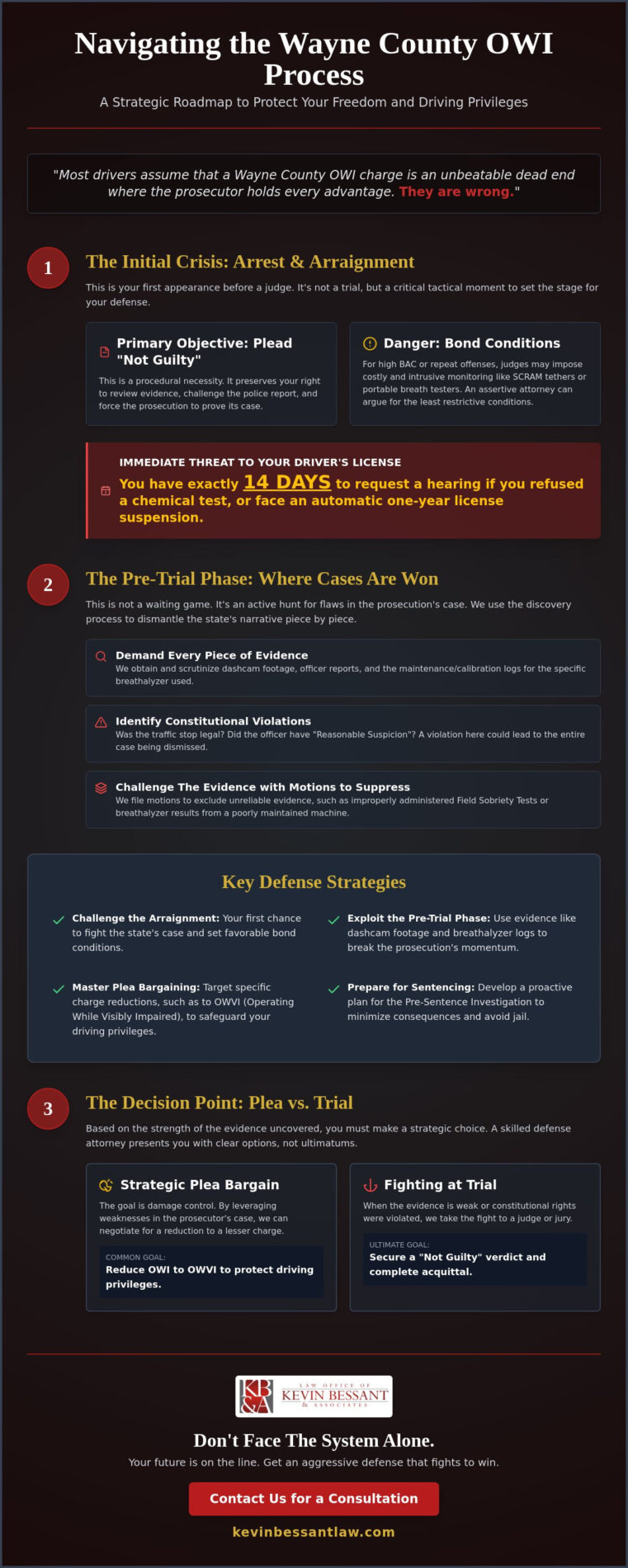
The transition from the back of a police cruiser to the formal courtroom is jarring. Once you’re processed and released from custody, you enter the formal Wayne County DUI court process. The arraignment is the first time you face a judge or magistrate, and it’s where the state’s machinery starts to grind against you. This isn’t a trial, but it is a critical tactical moment. You must understand that the judge is there to read your charges and set the terms of your freedom. You have one primary objective during this hearing: plead not guilty. This isn’t about whether you “did it” or not. It’s a procedural necessity that preserves your right to review the evidence, challenge the police report, and force the prosecution to prove every element of the crime.
Securing Your Release and Bond Conditions
Freedom in Michigan isn’t always free. During the arraignment, the court decides if you can remain out of jail while your case is pending. You might be released on a “personal recognizance” bond, which costs nothing upfront, or the judge may demand a cash bond. The real danger lies in the bond conditions. For High BAC offenses (0.17% or higher) or repeat offenses, judges often impose strict alcohol monitoring. This could mean wearing a SCRAM tether or using a portable breath testing device multiple times a day. These restrictions are intrusive and expensive. An assertive attorney knows how to argue for the least restrictive conditions possible, highlighting your ties to the community and your employment to ensure you can continue your daily life without the weight of a tether holding you back.
The Immediate Impact on Your Michigan Driver’s License
While your criminal case moves through the court, your right to drive is under a separate, immediate attack. The Michigan Secretary of State operates on a strict timeline that doesn’t wait for your trial. If you refused a chemical test at the time of your arrest, you have exactly 14 days to request an administrative hearing. Failure to act within this window results in an automatic one-year suspension of your license. While DUI laws in the United States vary by state, Michigan is particularly aggressive regarding the implied consent law. This administrative suspension is separate from any court-ordered restrictions you might face later. You cannot afford to be passive. If you want to keep your driving privileges, you must contact us immediately to file the necessary appeals and protect your mobility.
The Pre-Trial Phase: Where DUI Cases Are Won or Lost
The arrest was only the beginning. Now, the real work starts in the Wayne County DUI court process. Don’t wait for the prosecution to hand you a deal; you must force their hand through the discovery process. This is where we demand every shred of evidence, from the high-definition dashcam footage to the maintenance logs of the specific DataMaster breathalyzer used in your case. If the police skipped a step or cut a corner, this is where we find it. We don’t just review the evidence; we hunt for the flaws that make the state’s case vulnerable.
Analyzing these documents isn’t just about reading. It’s about dismantling the state’s narrative. We look for constitutional violations the moment the officer’s lights hit your mirror. Did they have a valid reason to pull you over? If not, the entire case might crumble. Under Michigan’s OWI statutes, the state must follow strict procedural rules regarding how they stop, detain, and test drivers. When they fail, we strike. The Pre-Trial Conference is your first real opportunity to negotiate, but you don’t walk into that room asking for mercy. You walk in with leverage.
Evidentiary Hearings and Motions to Suppress
We win cases by silencing the prosecution’s witnesses before they ever take the stand. An evidentiary hearing allows us to challenge the “Reasonable Suspicion” for your stop. If the officer lacked a legal basis to detain you, we file a Motion to Suppress. We also attack the reliability of Field Sobriety Tests (FSTs), which are often administered in poor conditions or by improperly trained officers. If your BAC results are the problem, we investigate whether the machine was calibrated correctly. One technical error is often enough to exclude that data entirely.
The Role of the Wayne County Prosecutor
Wayne County prosecutors are notoriously overworked, but they maintain a “tough on crime” stance to satisfy public pressure. They want a quick plea. We don’t give it to them. Kevin Bessant & Associates understands how to leverage procedural errors to force concessions that other lawyers miss. There is a massive difference between a standard plea offer and a tactical victory where the charges are significantly reduced or dismissed. You need an advocate who knows how to turn a prosecutor’s heavy caseload into your advantage. If you want to see how we build this leverage for our clients, you should reach out to our team today.
Navigating Local Wayne County District Courts
Where you are arrested in Wayne County dictates the strategy we use to protect your future. While Michigan law provides a uniform framework for OWI charges, the actual application of the Wayne County DUI court process varies wildly from one zip code to the next. A judge in Detroit views a case through a different lens than a judge in Livonia or Dearborn. National data, such as NHTSA Drunk Driving Statistics, highlights the high stakes of these offenses, but it is the local “personality” of the court that determines your daily reality. You cannot afford a lawyer who uses a one-size-fits-all defense. You need a tactical approach built for the specific bench where your case will be heard.
Detroit and the 36th District Court Dynamics
The 36th District Court in Detroit is one of the busiest in the nation. It operates like a high-speed machine. Here, cases move fast and the specialized OWI dockets are packed. This high volume creates a unique set of challenges and opportunities. In a system this large, procedural nuances are everything. We navigate the complexities of the Detroit system by being a consistent, formidable presence in these courtrooms. We know how to spot the moments when a rushed prosecution makes a mistake, allowing us to pivot and secure a better outcome for you. Don’t let yourself get lost in the shuffle of a massive docket.
Suburban Wayne County Jurisdictions
Suburban courts offer a completely different atmosphere, often characterized by a more localized and rigid “tough on crime” stance. In the 16th District in Livonia or the 19th District in Dearborn, the expectations for sobriety and strict compliance are exceptionally high. These jurisdictions don’t just follow the law; they enforce it with a particular intensity. Similarly, Downriver courts in Taylor and Wyandotte are known for their firm approach to OWI sentencing, particularly in “Super Drunk” cases where BAC levels exceed 0.17%.
- Livonia (16th District): Known for strict probation requirements and high compliance expectations.
- Dearborn (19th District): Focuses heavily on public safety and often imposes rigorous bond conditions.
- Taylor (23rd District): A jurisdiction where sentencing can be aggressive for repeat offenders.
The difference between retaining your license and facing a revocation often comes down to your lawyer’s familiarity with these specific judges. We understand the unwritten rules of each suburban court. We know which arguments resonate with which judges and how to position your defense to meet their specific expectations. To understand how our localized expertise can shield you from the harshest penalties, see why clients choose us to lead their defense in these high-pressure environments.
Plea Bargaining vs. Trial: The Ultimate Decision Point
You’ve been told that if the breathalyzer says you’re over the limit, the fight is over. That’s a lie designed to make the prosecutor’s job easier. The Wayne County DUI court process isn’t a conveyor belt to a conviction; it’s a procedural gauntlet where every decision you make carries life-altering weight. A “guilty” plea should be your absolute last resort, only used when every other tactical avenue has been exhausted. Don’t let the system intimidate you into surrendering your rights before you’ve seen the state’s hand.
One of the most common targets for a successful defense is a reduction to Operating While Visibly Impaired (OWVI). While a standard OWI carries a 30-day license suspension followed by 150 days of restrictions, an OWVI conviction typically involves no suspension, only restricted driving. This isn’t a gift from the prosecutor. It’s the result of aggressive negotiation that highlights the weaknesses we found during the discovery phase. We force the state to realize that a trial will be a losing battle for them, making a reduction their only viable option.
The Strategy of the Plea Reduction
We don’t just ask for a deal; we demand specific terms that protect your daily life. This includes negotiating for non-reporting probation to keep your movements private and fighting for reduced fines. A critical tool in Wayne County is the “Cobbs Agreement.” This allows the judge to provide a preliminary evaluation of your sentence before you enter a plea. If the judge’s proposed sentence is too harsh, you have the right to withdraw your plea and move toward trial. This removes the “unknown” from the process. For those with professional licenses, these tactical negotiations are often the only way to prevent a career-ending disciplinary action.
Fighting at Trial: The Bessant Approach
Sometimes the prosecutor refuses to be reasonable. In those cases, we take the fight to the courtroom. A jury trial is often the only way to protect your future when the state’s evidence is fundamentally flawed. We select jurors who understand the burden of proof and won’t just take an officer’s word as gospel. Our cross-examination of the arresting officer is designed to expose every inconsistency in their testimony. If they missed a step in the field sobriety tests or failed to observe the mandatory 15-minute observation period, the jury needs to know. We also utilize expert witnesses to challenge the science behind chemical results, turning the state’s data into a point of reasonable doubt. If you’re facing a choice between a bad deal and a trial, you need a lawyer who isn’t afraid to step into the ring. Contact our firm today to discuss the best tactical path for your specific case.
Sentencing and Beyond: Minimizing the Consequences
The final stage of the Wayne County DUI court process is sentencing, but the actual outcome is often determined weeks before you stand in front of the judge. You’re facing a spectrum of penalties that could derail your entire life. For a first-offense OWI, Michigan law allows for up to 93 days in jail and fines ranging from $100 to $500. If you’re charged with a High BAC offense, those stakes climb to 180 days in jail and fines up to $700. We don’t wait for the court to dictate your future. We take control of the narrative through the Pre-Sentence Investigation (PSI).
The PSI is a high-stakes interview with a probation officer. Their written recommendation carries immense weight and often becomes the judge’s final order. We prepare you for every question to ensure you’re presented as a person, not a case number. By completing alcohol assessments and entering treatment programs before the court orders them, we create powerful mitigating factors. This proactive stance shows the judge that you’re taking responsibility, which is often the key to avoiding jail time and minimizing community service requirements.
The Long-Term Impact of a DUI Conviction
A conviction doesn’t end when you pay your fines. It follows you into every job interview and background check. It can prevent you from securing housing or professional certifications. While Michigan’s laws have evolved, DUI expungement remains a complex procedural battle. You need to understand the reality of the system and if a felony can be expunged in Michigan under the current Clean Slate provisions. We help you look beyond the immediate crisis to protect your long-term reputation and earning potential.
Why Kevin Bessant is Your Vital Shield
Kevin Bessant & Associates provides the aggressive advocacy you need when the system is stacked against you. With over 20 years of experience navigating the specific personalities and dockets of the Wayne County court system, we know how to shield you from maximum penalties. We don’t back down from tough prosecutors. We leverage every procedural error and every piece of mitigating evidence to fight for your freedom.
- Aggressive Representation: We challenge the prosecution at every turn.
- Local Expertise: We understand the specific expectations of Wayne County judges.
- Proven Results: We focus on avoiding jail and retaining your driving privileges.
The state has already started building its case against you. Every hour you wait is an hour the prosecution uses to tighten their grip. You deserve a battle-ready advocate who will stand in the gap for you. Secure your aggressive defense today and let us lead you through this crisis with confidence.
Take Command of Your OWI Defense
Legal Authority: Case Law
- People v Cobbs, 443 Mich 276, 283 (1993) — established the practice allowing a judge to give a preliminary sentence evaluation before a guilty plea; if the judge later wants to exceed that evaluation, the defendant has an absolute right to withdraw the plea.
- People v Hammerlund, 504 Mich 442, 451 (2019) — holds that a warrantless OWI arrest made without probable cause requires suppression of the resulting breath-test results and statements.
For the current statutory text and published opinions, see the Michigan Courts case search.
The state of Michigan has already begun its tactical assault on your freedom, but a charge is not a conviction. You’ve seen how the Wayne County DUI court process is designed to pressure you into a quick plea. You can’t let that happen. By securing aggressive representation early, you shift the momentum back in your favor. From challenging evidence during the pre-trial phase to navigating the specific temperaments of local judges, every stage of your case requires a battle-ready advocate who won’t back down.
With over 20 years of criminal defense experience, Kevin Bessant provides the aggressive, trial-ready advocacy you need to protect your license and your liberty. We possess a deep familiarity with Wayne County judges and prosecutors, allowing us to anticipate their moves and strike at the system’s weakest points. You don’t have to face this overwhelming pressure alone. We are ready to stand in the gap and fight for the best possible outcome for your life.
Don’t Face the Wayne County Court System Alone—Contact Kevin Bessant Now
Your future is too valuable to leave to chance. Take the first step toward reclaiming your life today and move forward with confidence.
Frequently Asked Questions
How long does the Wayne County DUI court process typically take?
The Wayne County DUI court process typically spans between three to six months from the date of your arraignment to the final sentencing. This timeline fluctuates based on the specific district court docket and whether your defense strategy involves extensive evidentiary hearings or a full jury trial. While some cases resolve faster through aggressive negotiation, you must be prepared for a multi-month legal battle to ensure every procedural protection is utilized to its full extent.
Do I have to go to court for a first-offense OWI in Wayne County?
You must appear in court for your first-offense OWI charge as Michigan law requires your presence for all critical stages of the criminal case. This includes the arraignment, the pre-trial conference, and any subsequent sentencing hearings. While some matters might be handled via remote Zoom proceedings depending on the specific judge’s current rules, your physical or virtual attendance is a mandatory requirement. Failing to show up will result in a bench warrant for your immediate arrest.
What happens if I refuse the breathalyzer test in Michigan?
Refusing a chemical test triggers an automatic one-year suspension of your driver’s license under Michigan’s implied consent law. This administrative penalty is entirely separate from any criminal charges you face in the district court. You have exactly 14 days from the date of your arrest to request an appeal hearing with the Secretary of State. If you miss this narrow deadline, your right to drive is forfeited regardless of the eventual outcome of your criminal case.
Can I get my OWI charges dismissed in Wayne County?
Dismissal of OWI charges is possible if your defense team identifies significant constitutional violations or procedural errors by law enforcement during the arrest. We aggressively search for flaws such as a lack of reasonable suspicion for the initial stop or improperly administered field sobriety tests. When the prosecution realizes their evidence is legally inadmissible, they are often forced to dismiss the charges or offer a significant reduction to avoid a losing battle at trial.
Will I lose my job if I am convicted of a DUI in Detroit?
Employment consequences depend on your specific company policy and whether your job requires a professional license or a clean driving record. A conviction appears on background checks and can lead to immediate termination for commercial drivers, healthcare workers, or educators. We fight to prevent this outcome by targeting charge reductions that don’t carry the same professional stigma as a standard OWI, shielding your career from the state’s aggressive prosecution and protecting your future earning potential.
What is the difference between OWI and OWVI in Michigan?
OWI stands for Operating While Intoxicated and typically applies when your BAC is 0.08% or higher. OWVI, or Operating While Visibly Impaired, is a lesser offense where the prosecutor only needs to prove your driving was affected by alcohol, regardless of your specific BAC level. Securing a reduction to OWVI is a tactical victory because it carries lighter fines, fewer points on your license, and usually avoids the mandatory 30-day suspension associated with a standard OWI conviction.
How much does a DUI defense lawyer cost in Wayne County?
The cost of legal representation varies based on the complexity of your case and the experience level of your defense advocate. You should view legal fees as an investment in your future, as the total financial impact of a first-offense conviction can range from $5,000 to $12,000 when including fines, insurance hikes, and court costs. Choosing a lawyer based solely on the lowest price often results in a passive defense that leads to much higher long-term costs and penalties.
Can I drive while my Wayne County DUI case is pending?
Most drivers can continue to operate their vehicles while the Wayne County DUI court process is underway, provided they didn’t refuse a chemical test at the time of arrest. Your paper “DI-177” permit serves as a valid temporary license while the state reviews your case. However, the judge may impose bond conditions such as an ignition interlock device or alcohol monitoring that you must follow strictly to maintain your driving privileges throughout the pre-trial phase.