

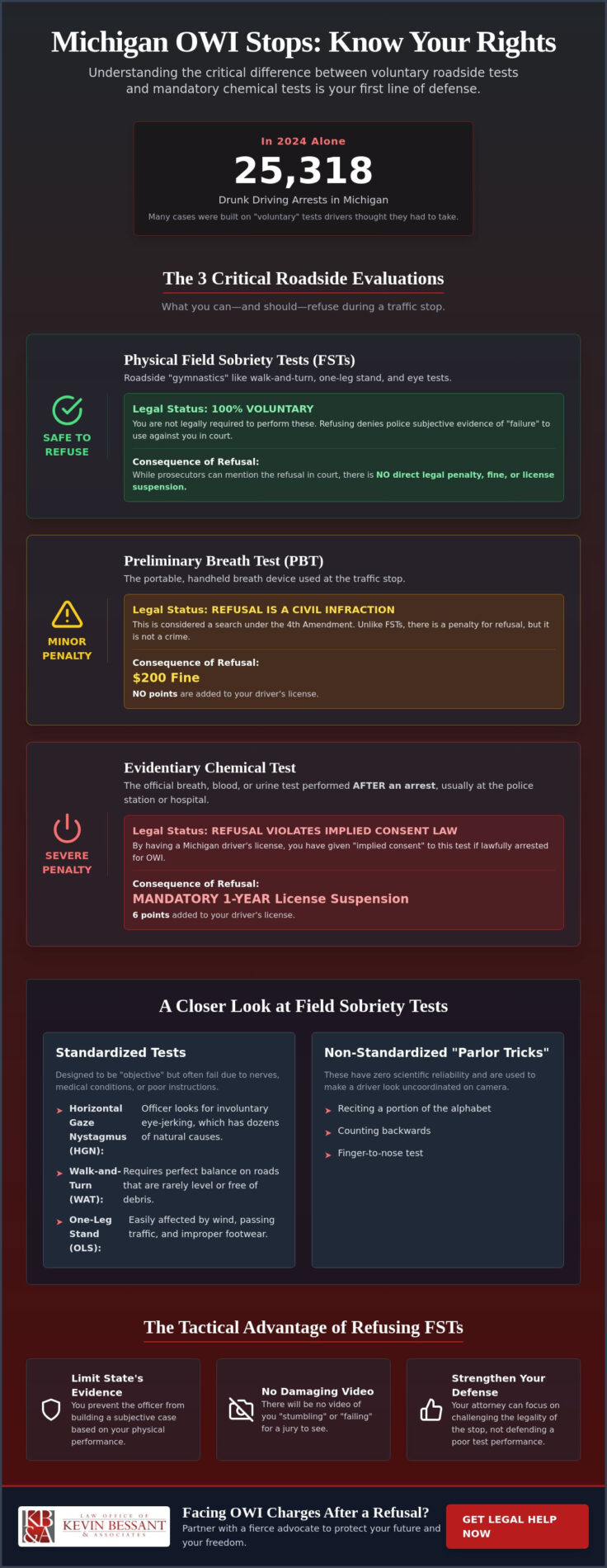
You aren’t legally required to perform a roadside balancing act for the police, yet thousands of Michigan drivers do it every year because they’re terrified of an immediate arrest. In 2024 alone, Michigan law enforcement made 25,318 arrests for drunk driving, and many of those cases were built on the very “voluntary” tests drivers thought they were forced to take. If you’re currently facing the fallout of a field sobriety test refusal Michigan, you’re likely feeling the weight of the state’s aggressive OWI tactics and the crushing anxiety of the Implied Consent law.
We understand that the confusion between a roadside “balloon” test and the station breathalyzer feels like a trap designed to strip away your driving privileges. You shouldn’t have to face this complex system alone. This article will clarify the critical legal distinctions between refusing roadside assessments versus post-arrest chemical tests, giving you the knowledge to shield your driver’s license from permanent damage. You’ll discover exactly how a $200 civil infraction for a PBT refusal differs from the mandatory one-year suspension of a chemical test refusal, and how a battle-ready advocate can challenge the legality of your arrest to protect your future.
Key Takeaways
- Stop the police from building a case against you by understanding that physical field sobriety tests are entirely voluntary under Michigan law.
- Navigate the high-stakes consequences of a field sobriety test refusal Michigan, including the 2016 statute that allows prosecutors to twist your refusal into evidence of guilt.
- Identify the crucial differences between a $200 roadside PBT civil infraction and the mandatory one-year license suspension caused by violating the Implied Consent law.
- Protect your future by limiting the state’s evidence, ensuring there is no subjective video footage of “stumbling” or “failing” to use against you in court.
- Partner with a fierce advocate who knows how to dismantle the officer’s vague observations and shield your driving record from aggressive OWI prosecution.
The Legal Reality of Field Sobriety Test Refusal in Michigan
When a police officer pulls you over on a dark Michigan road, they aren’t looking to be your friend. They’re hunting for evidence. You need to understand that Standardized Field Sobriety Tests (SFSTs) are essentially subjective “gymnastics” designed to build a case against you. These physical and mental exercises are not scientific measurements of sobriety. Instead, they’re tools used to establish probable cause for an OWI arrest. Most drivers believe they must comply to avoid trouble. That’s a dangerous misconception. You are not legally required to perform physical FSTs in Michigan.
Choosing a field sobriety test refusal Michigan is often the only way to prevent an officer from documenting every slight sway or missed heel-to-toe step as “proof” of intoxication. These tests are rigged. Even perfectly sober individuals can fail due to nerves, fatigue, or medical conditions. The officer’s goal is simple: gather enough “clues” to justify putting you in handcuffs. By refusing, you deny them the subjective video evidence they need to secure a conviction in court later.
What Are the Three Standardized Tests?
The Horizontal Gaze Nystagmus (HGN) test involves tracking a pen with your eyes. Officers look for “jerking,” but dozens of medical conditions cause this naturally. The Walk-and-Turn (WAT) test demands perfect balance on a roadside that’s rarely level. If you step off the line once, it’s a “failure.” Finally, the One-Leg Stand (OLS) is frequently ruined by environmental factors like high winds, passing traffic, or uneven pavement. Police rarely account for these variables; they just check the “fail” box and move toward an arrest.
Non-Standardized Tests to Watch Out For
Officers may also demand you count backward or recite a specific portion of the alphabet. These aren’t NHTSA-validated and have zero scientific reliability. The finger-to-nose test is another favorite used to make you look uncoordinated on camera. Kevin Bessant understands how to dismantle these non-standardized parlor tricks in court. If you’ve been arrested after performing these tests, you need a battle-ready advocate who can challenge the officer’s “gymnastics” and expose the lack of actual evidence. Don’t let a subjective roadside performance dictate your future. Protect your rights from the moment the lights flash behind you.
FSTs vs. PBTs vs. Chemical Tests: Knowing What You Can Legally Refuse
Police officers often intentionally blur the lines between roadside “requests” and legal “requirements.” They want you to believe that every test they offer is mandatory. This is a calculated tactic to trick you into providing the evidence they need for a conviction. In reality, Michigan law treats physical tests, roadside breath tests, and station chemical tests very differently. Understanding these distinctions is the only way to navigate a field sobriety test refusal Michigan without falling into a legal trap that could cost you your license for a year or more.
The criteria for these evaluations are outlined in Michigan Compiled Laws Section 257.62a, which references the standards used to justify an OWI arrest. While physical exercises are entirely voluntary, the breath tests carry specific penalties that you must weigh carefully before saying no. If you’ve already been stopped and are facing the fallout of a refusal, you need to speak with a fierce advocate who can dissect the officer’s conduct and protect your record.
The Preliminary Breath Test (PBT) Roadside
The Preliminary Breath Test (PBT) is the portable “balloon” device an officer asks you to blow into at the scene. Under the Fourth Amendment, this is considered a search. Unlike physical exercises, refusing a PBT does carry a penalty; however, it’s remarkably light. A PBT refusal is merely a civil infraction, not a crime. You’ll face a fine of up to $200, but no points are added to your license. The Preliminary Breath Test is a roadside tool used solely for establishing probable cause for an arrest. For many, paying a $200 fine is a small price to pay to avoid handing the state a digital reading of their BAC before they’ve even reached the station.
The Station Test: Michigan’s Implied Consent Law
This is where the stakes become life-altering. Once you’re under arrest and taken to the station or a hospital, the officer will request a chemical test of your breath, blood, or urine. By holding a Michigan driver’s license, you’ve already given “implied consent” to this test. Refusing at this stage triggers aggressive administrative penalties that are separate from your OWI charge. A first-time refusal results in an automatic, mandatory one-year license suspension and six points on your record. You only have 14 days to appeal this suspension. The Law Office of Kevin Bessant & Associates takes a battle-ready approach to these hearings at the DLAD, fighting to restore your driving privileges even when the system is stacked against you. Don’t let a moment of confusion at the station destroy your ability to work and live.
The 2016 Michigan Law Change: Can Your Refusal Be Used Against You?
The prosecutor’s favorite weapon in an OWI case isn’t always a breathalyzer result. Often, it’s your silence. In 2016, a significant shift in Michigan statute altered how courts view your decision to decline roadside testing. While a field sobriety test refusal Michigan is not a criminal act, the law now allows prosecutors to argue that your refusal is evidence of a “consciousness of guilt.” They want the jury to believe you said no because you knew you were intoxicated and feared failing. This is a calculated attempt to turn your constitutional protections into a confession.
You need a defense that refuses to let the state control the narrative. We don’t just “manage” these arguments; we dismantle them. By filing aggressive motions to suppress, Kevin Bessant works to exclude any mention of your refusal from the trial. If the jury never hears about the refusal, the prosecutor’s “consciousness of guilt” argument dies before it even begins. Protecting your future requires a shield against these high-stakes legal maneuvers.
People v. Hammerlund and Your Fourth Amendment Rights
Recent Michigan case law, including the landmark People v. Hammerlund, reinforces the sanctity of your Fourth Amendment rights against warrantless searches. The police cannot force you to perform physical “gymnastics” on the side of the road against your will. They may try to intimidate you, but the Constitution stands in their way. Refusal is an exercise of a constitutional right, not an admission of intoxication. We use these legal precedents to remind the court that exercising your rights should never be penalized or used as a substitute for actual, scientific evidence of impairment.
Fighting the Prosecutor’s Narrative
When the state tries to twist your refusal into an admission of guilt, we flip the script. There are dozens of valid, non-incriminating reasons to decline a roadside test. We highlight these factors to show the jury that your decision was about protection, not evasion:
- Medical Conditions: Chronic back pain, inner ear issues, or old leg injuries make these tests impossible to pass even for sober drivers.
- Environmental Stress: Extreme nervousness, blinding police lights, and the roar of highway traffic create a biased testing environment.
- Legal Advice: Smart citizens know that providing the police with subjective evidence is never in their best interest.
An aggressive defense turns “refusal” into “protecting oneself from biased testing.” You shouldn’t be punished for being cautious. To see how we’ve successfully defended clients against these aggressive tactics, learn more about Why Us and our track record in Michigan OWI cases. We stand in the gap to ensure the system doesn’t steamroll your rights.
Tactical Defense: Why Refusing Field Sobriety Tests Often Saves Your Case
Choosing a field sobriety test refusal Michigan is about more than just saying no; it’s about denying the state the visual ammunition they need to lock you up. Whether you are a resident or a traveler, your priority during a stop should be to limit the evidence gathered against you. When you agree to these tests, you’re essentially providing the prosecution with a high-definition video of your “failure.” Even if you think you’re performing well, the officer is trained to document every minor twitch or hesitation as a “clue” of impairment. By refusing, you ensure there is no footage of you stumbling or losing your balance to be played in front of a jury. You force the state to rely on the officer’s vague, subjective memories rather than a recorded performance.
This tactical move often forces a “bad arrest.” If a police officer takes you into custody without the data from physical tests, their probable cause for that arrest becomes incredibly thin. We frequently see cases where the only evidence is a supposed “smell of alcohol” or “watery eyes.” These observations are notoriously easy to challenge in court. Without the “scientific” backing of the roadside tests, the legal foundation of the OWI charge begins to crumble. Denying the officer this evidence preserves your dignity and, more importantly, keeps your legal options for a plea bargain or a total dismissal wide open.
The ‘Designed to Fail’ Nature of SFSTs
You must realize that these tests are not fair. Even Olympic athletes struggle with the One-Leg Stand or the Walk-and-Turn when they’re standing on a sloped shoulder in the middle of the night with sirens wailing in their ears. Medical conditions like chronic back pain, old sports injuries, or inner ear imbalances mimic intoxication perfectly on camera. Official NHTSA studies confirm that these tests have high error rates even when officers follow every instruction perfectly. Don’t let a physical limitation be twisted into a criminal conviction.
What to Say to the Officer During a Stop
The key to a successful refusal is maintaining a “Respectful Refusal.” You don’t need to be combative or aggressive. Simply state, “Officer, I’m not comfortable performing any physical tests or providing a roadside breath sample without my attorney present.” This is a clear exercise of your rights that doesn’t escalate the situation. Never fall for the trap of admitting to “just having two beers.” Admitting to any alcohol consumption gives the officer the legal ammunition they need to justify a search and an arrest. If you’ve already been stopped, you need an aggressive DUI Defense Lawyer Detroit to step in and shield your future from the fallout.
Stop handing the prosecution the evidence they need to ruin your life. If you’re facing charges after a roadside stop, contact us immediately so we can begin dismantling the officer’s narrative and protecting your freedom.
Facing OWI Charges After a Refusal? How Kevin Bessant Protects Your Freedom
An OWI arrest isn’t just a legal hurdle; it’s an assault on your future. When you’re standing on the side of a highway in Royal Oak or Warren, the system is already working to strip away your license and your livelihood. Kevin Bessant brings over 20 years of battle-ready experience to the courts of Detroit, Southfield, and across Metro Detroit. We don’t just “manage” your case file or wait for the prosecutor to offer a deal. We take an aggressive Advocate-vs-System approach designed to expose the flaws in the state’s case from the very first hour. You’re facing a complex machine, and you need a shield that won’t buckle under pressure.
Dealing with a field sobriety test refusal Michigan requires a lawyer who isn’t intimidated by the badge. We immediately move to secure dashcam and bodycam footage to see exactly what the officer saw. If the initial stop lacked probable cause, or if the officer’s commands were confusing and unlawful, we file motions to suppress the evidence. We challenge the officer’s training and their adherence to strict NHTSA standards. Our goal is to dismantle the narrative that you were “impaired” simply because you chose to protect your rights. We fight for clients in Troy, Royal Oak, and throughout the region who refuse to be steamrolled by aggressive prosecution.
Aggressive Representation for High-Stakes OWI Cases
The moments following an arrest are the most critical. You need to be out of a jail cell to fight your case effectively. We specialize in Bond Hearings, providing the forceful advocacy needed to secure your immediate release so we can focus on the defense. We scrutinize every detail of the stop, from the calibration of the station breathalyzer to the specific language the officer used when asking for your consent. If you want a shield against the power of the state, you need a defender who has spent two decades winning these battles. Reach out today for a free, confidential case evaluation and let us start dismantling the charges against you.
Contact the Law Office of Kevin Bessant & Associates Today
Time is your greatest enemy right now. In Michigan, you have a strictly enforced 14-day window to appeal your license suspension after a refusal. If you miss this deadline, your ability to drive is gone. Don’t wait for the system to decide your fate. Call us now to begin building your shield and protecting your freedom. We stand ready to fight for you in Detroit and throughout the region. Contact Us immediately to schedule your consultation and take the first step toward reclaiming your life. Your defense starts today.
Take Control of Your OWI Defense Today
Legal Authority: Statute and Case Law
Michigan’s implied consent law is codified at MCL 257.625c, with field sobriety test standards at MCL 257.62a.
- People v Hammerlund, 504 Mich 442, 451 (2019) — the Michigan Supreme Court held that a warrantless OWI arrest made without probable cause requires suppression of the resulting breath-test results and statements, underscoring that voluntary field tests cannot substitute for the probable cause an officer must independently establish.
For the current statutory text, see the Michigan Legislature’s MCL database.
The state of Michigan is already building its case against you. Every second you wait is a second the prosecution uses to solidify their narrative. You now understand that physical roadside tests are voluntary and often rigged for failure, while the station breathalyzer carries high-stakes administrative penalties that demand immediate action. Navigating a field sobriety test refusal Michigan requires more than just knowing your rights; it requires the strength of a defender who knows how to exploit the system’s weaknesses. Don’t let a single roadside stop dictate the rest of your life.
Kevin Bessant offers 20+ years of criminal defense experience as an aggressive advocate for Detroit, Southfield, and the entire Metro Michigan area. As a specialist in high-stakes felony and OWI defense, he stands in the gap to protect your freedom and your future. Whether we’re challenging the officer’s training or fighting for your license at a DLAD hearing, we’re your vital shield. Secure Your Aggressive DUI Shield—Contact Kevin Bessant Now. You don’t have to face this overwhelming legal system alone. We’re ready to fight for you.
Frequently Asked Questions
Is it a crime to refuse a field sobriety test in Michigan?
No, refusing physical field sobriety tests in Michigan is not a criminal offense. These tests are strictly voluntary under state law. Choosing a field sobriety test refusal Michigan won’t result in jail time, license points, or a criminal record. You have the legal right to decline these subjective roadside exercises without facing immediate punishment from the court or the Secretary of State.
Will I lose my license if I refuse the roadside breathalyzer (PBT)?
You won’t lose your license for refusing the Preliminary Breath Test (PBT) at the roadside. Refusal is a civil infraction that carries a fine of up to $200. Unlike the chemical test at the station, a roadside PBT refusal does not add points to your record or trigger a mandatory suspension. It’s a minor penalty compared to the risk of providing evidence for an OWI conviction.
Can the police get a warrant to draw my blood if I refuse the station test?
Yes, Michigan police can and frequently do obtain a search warrant to draw your blood if you refuse the station test. Once a judge signs that warrant, the draw becomes mandatory and you cannot legally resist. Refusing the initial request still triggers the Implied Consent penalties, including a one-year suspension, even if the police eventually get the blood sample through a warrant.
What happens if I refuse the field sobriety tests but fail the chemical test later?
If you refuse the roadside tests but fail the station chemical test, you’ll face OWI charges based on your BAC results. However, your initial refusal of the physical tests means the prosecutor has no video of you stumbling or swaying to use against you. This leaves your defense team with more room to challenge the chemical test’s accuracy and the legality of the initial stop.
Can I change my mind and take the test after initially refusing?
Generally, once you’ve officially refused a chemical test at the station, the officer isn’t required to give you a second chance. The refusal is recorded immediately and the 14-day appeal window begins. While some officers might allow a delayed test, the law treats your initial “no” as a final decision. You must act decisively from the start to protect your driving privileges.
Does refusing a field sobriety test make me look guilty to a jury?
Prosecutors will likely argue that your refusal shows a “consciousness of guilt,” but this is a narrative your lawyer must dismantle. We file motions to explain that your refusal was an exercise of your constitutional rights, not an admission of intoxication. We highlight factors like medical conditions or poor roadside conditions to prove that saying no was a logical choice to avoid biased testing.
How long does a refusal stay on my Michigan driving record?
An Implied Consent refusal stays on your Michigan driving record permanently, though the six points associated with it will eventually expire. This record can be used to enhance penalties if you’re arrested for a subsequent OWI within seven years. Because a refusal carries such long-term weight, you must challenge the suspension immediately through a DLAD hearing to keep your driving record as clean as possible.
Do I need a lawyer if I refused the tests and was still arrested?
You absolutely need a battle-ready advocate if you’ve been arrested after a refusal. The system is designed to penalize your silence and fast-track your conviction. A lawyer will secure dashcam footage, challenge the officer’s probable cause, and represent you at the critical license appeal hearing. Don’t let the state steamroll your future; hire a shield to stand between you and the prosecution.