

A single gram of cocaine in your pocket can permanently dismantle the professional life you’ve spent decades building. In Michigan, the legal system doesn’t see a mistake; it sees a Schedule 2 controlled substance and a reason to lock you away. You’re likely feeling the crushing weight of anxiety as you realize that cocaine possession penalties Michigan courts hand down are among the most severe in the country. It’s a high-stakes crisis where your career, your housing, and your freedom are all on the line.
You don’t have to face this machine alone. This guide breaks down the brutal reality of the Michigan Public Health Code, from the four year maximum for less than 50 grams to the life sentences facing those with larger amounts. You’ll learn how an aggressive legal shield can help you avoid jail time and keep a felony off your permanent record. We’re going to examine the specific weight thresholds that dictate your future and the tactical defense strategies that prove you are more than a case number. Stop waiting for the system to show mercy. Start building your defense now.
Key Takeaways
- Understand why any amount of cocaine possession is treated as a severe felony under the Michigan Public Health Code, putting your future at immediate risk.
- Learn how the total weight of the substance dictates your prison exposure and why cocaine possession penalties Michigan judges impose remain among the strictest in the nation.
- Identify the hidden collateral consequences that can dismantle your livelihood, including mandatory driver’s license sanctions and the permanent loss of professional licenses.
- Discover aggressive defense strategies, such as challenging the legality of police searches and utilizing 7411 status to keep a conviction off your public record.
- Find out how a battle-ready advocate stands in the gap to protect your freedom and prevent the legal system from overwhelming you.
Cocaine Possession in Michigan: A High-Stakes Felony Reality
The state of Michigan does not view cocaine possession as a minor lapse in judgment or a simple health issue. It is a high-stakes felony battle from the moment the handcuffs click. Under the strict guidelines of MCL 333.7403, the prosecution is already building a case designed to strip you of your rights and your reputation. Unlike some other states that have moved toward decriminalization for small amounts, Michigan remains a zero-tolerance battleground. If you are caught with any detectable amount of cocaine, you aren’t looking at a ticket; you’re looking at a felony record that follows you for life.
To secure a conviction, the prosecutor must prove beyond a reasonable doubt that you had “knowing” possession of the substance. This is where the fight begins. The law doesn’t just punish people who are caught holding a baggie. It targets anyone the state can link to the drug through a complex web of evidence. Understanding the Michigan’s Public Health Code is the first step in realizing that the cocaine possession penalties Michigan courts enforce are designed to be punitive and life-altering. You need an advocate who understands these statutes better than the police do.
The Legal Classification of Cocaine
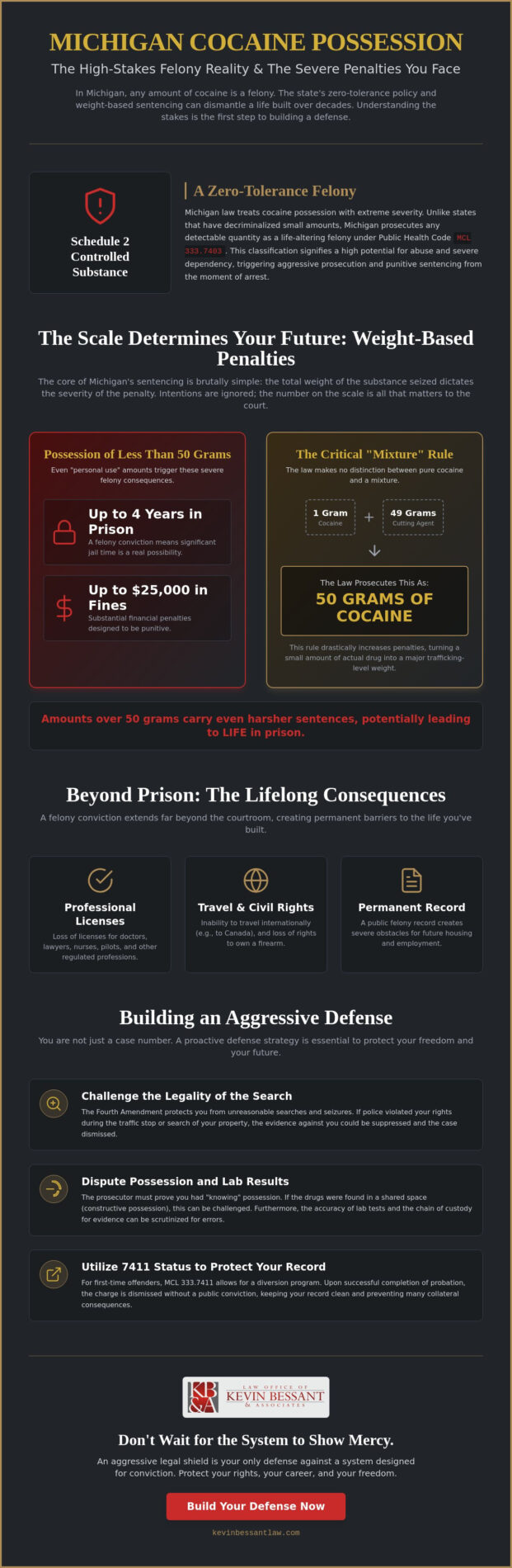
Cocaine is classified as a Schedule 2 controlled substance. This designation means the state believes the drug has a high potential for abuse and severe psychological or physical dependence. This classification is why the sentences are so aggressive. Michigan law also makes no distinction between the pure drug and a mixture containing the drug. If you have 49 grams of baking soda mixed with one gram of cocaine, the law treats the entire 50 grams as pure cocaine. Prosecutors also use “constructive possession” to charge you even if the drugs weren’t in your pocket. If they were in your car, your glove box, or your bedroom, the state will argue you had the intent to control them. You must challenge these assumptions immediately.
Why a Felony Charge Demands Immediate Action
You don’t have the luxury of time. In jurisdictions like Wayne County and Oakland County, prosecutors move with calculated speed to secure early admissions of guilt. Never speak to investigators without a lawyer present. They aren’t looking for the truth; they’re looking for evidence to support a conviction. A felony charge is an immediate threat to your civil liberties, including your right to own a firearm and your ability to travel. You need to know why our firm is the shield you need. We step between you and the system to ensure your rights aren’t trampled in the rush to judgment. Every hour you wait is an hour the prosecution uses to solidify their case against you. Don’t give them that advantage.
Calculating the Penalties: Michigan’s Weight-Based Sentencing
The scale is the ultimate arbiter of your future in a Michigan courtroom. Judges and prosecutors don’t care about your intentions; they care about the total weight of the mixture seized. Under the strict framework of Michigan’s weight-based sentencing, even a microscopic amount of cocaine triggers a felony prosecution. In 2026, these guidelines remain some of the most punitive in the Midwest, designed to isolate and punish rather than rehabilitate. If you’re caught in this web, the cocaine possession penalties Michigan authorities demand are intended to be life-altering. You’re fighting against a system that prioritizes conviction numbers over human lives.
Repeat offenders face an even more terrifying reality. Michigan’s habitual offender laws allow prosecutors to enhance these already brutal maximum sentences. If you have prior felony convictions, a standard possession charge can quickly evolve into a sentence that ensures you never see the outside of a prison cell again. You need to reach out for an aggressive defense before the prosecution locks in their sentencing strategy. We know how to challenge the lab results and the methods used to weigh the evidence against you.
Small Amounts and Personal Use (Under 50 Grams)
Possessing less than 50 grams is a felony carrying up to 4 years in prison and $25,000 in fines. It’s enough to derail your career and strip your rights. Prosecutors also frequently look for any excuse to upgrade this to “Intent to Deliver.” If they find a scale or cash, you suddenly face 20 years. They’ll try to paint you as a dealer. Don’t let them.
Major Felony Thresholds (50g to 1,000g+)
Once the weight exceeds 50 grams, the penalties become catastrophic. The state treats these amounts as high-level trafficking. 50g to 449g carries up to 20 years and $250,000 in fines. 450g to 999g jumps to 30 years and $500,000. Over 1,000 grams can lead to life in prison and a $1,000,000 fine. These are not just numbers; they are the end of your freedom.
The financial impact is equally devastating. Fines can reach seven figures for major trafficking amounts, ensuring that even if you eventually regain your freedom, your financial life is destroyed. This is why you cannot afford to take a “wait and see” approach. The prosecution is already calculating your prison time based on a scale that might not even be accurate. We demand precision and fairness where the system offers only aggression. Your defense starts with a refusal to be intimidated by these numbers.
The Hidden Cost: Collateral Consequences of a Drug Conviction
Prison time is a terrifying prospect, but the damage doesn’t stop when you walk out of the cell. A felony conviction for cocaine possession acts as a permanent anchor on your life. Under Michigan Compiled Laws § 333.7403, the state doesn’t just take your time; it takes your future. You’ll face mandatory driver’s license sanctions. It doesn’t matter if you were nowhere near a car when the arrest happened. The Secretary of State will suspend your driving privileges, making it nearly impossible to maintain a normal life or commute to work. This is the brutal reality of cocaine possession penalties Michigan courts enforce beyond the courtroom walls.
The reach of a drug conviction extends into your home and your bank account. Federal student aid eligibility is often stripped away, halting your education in its tracks. Housing applications become a minefield. Many landlords in Michigan run background checks that specifically flag drug felonies, leading to immediate denials. You aren’t just fighting a court case; you’re fighting for the right to live a normal life. Don’t let a single mistake dictate where you can live or how you can learn.
Professional and Career Destruction
If you hold a professional license, a drug felony is a death sentence for your career. Boards for nursing, medicine, and law rarely show mercy to those with Schedule 2 convictions. You’ve spent years building your reputation, but the Detroit job market is unforgiving toward a public criminal record. HR departments will see the word “felony” and immediately discard your application. You must fight to keep your record clean from the very first hearing. Once the conviction is entered, the damage to your earning potential is often permanent. We protect the career you’ve worked so hard to build.
Loss of Constitutional Rights
Your Second Amendment rights are gone the moment you’re convicted of a drug-related felony. You’ll be disqualified from legally owning or possessing a firearm for life. This isn’t a temporary restriction; it’s a total loss of your right to protect your home and family. Beyond firearms, you lose the right to serve on a jury and your ability to vote while you’re incarcerated. These are the fundamental pillars of citizenship that the state will strip away without hesitation. This is why you need to learn why an aggressive shield is vital to your defense. We don’t just look at the jail time. We look at your life, your rights, and your future. Stop the system before it takes everything from you.
Building Your Defense: Aggressive Tactics to Protect Your Freedom
The prosecution wants you to believe that a conviction is inevitable once the lab results return. They’re wrong. Fighting cocaine possession penalties Michigan prosecutors seek requires a technical, aggressive assault on every piece of evidence the state plans to use. We don’t wait for a plea deal. We go on the offensive by scrutinizing the police report for every procedural error, constitutional violation, and logical inconsistency. If the police violated your rights, the evidence they found belongs in the trash, not a courtroom. You need a shield that is not intimidated by the badges or the bench.
Beyond the initial stop, we attack the “chain of custody.” Controlled substances pass through many hands between the street, the evidence locker, and the lab. If there’s a gap in the logs or a failure in lab protocol, the integrity of the evidence is compromised. We also challenge the “knowing” requirement of the law. If the substance was found in a shared space or a vehicle you didn’t exclusively control, the state must prove you actually knew it was there. Proving “unwitting” possession is often the key to dismantling a case that looks solid on the surface.
Fourth Amendment Violations and Suppressing Evidence
Many drug arrests begin with a routine traffic stop that quickly spirals out of control. If a Michigan officer pulled you over without a valid reason or extended the stop longer than necessary to wait for a K-9 unit, they may have violated the Fourth Amendment. We look for “unreasonable search and seizure” tactics where probable cause was fabricated. By filing a Motion to Suppress, we can challenge the legality of the search itself. If the judge agrees the search was illegal, the cocaine cannot be used against you, often leading to a total dismissal of all charges.
Diversion Programs and 7411 Status
For those facing their first drug charge, Michigan’s 7411 status offers a vital lifeline to protect your future. This specific provision of the law allows you to plead guilty while the court withholds the entry of a conviction. If you successfully complete a term of probation, the case is dismissed, and the record remains non-public. This is a critical strategy for mitigating the cocaine possession penalties Michigan law otherwise mandates. However, qualifying for 7411 requires a persuasive argument to the judge. Your priority should be securing release via bond hearings so you can assist in building this defense from outside a jail cell.
You cannot afford to be passive when the system is moving against you. The sooner we can review the body cam footage and the officer’s notes, the sooner we can find the crack in the prosecution’s foundation. If you’re ready to stop the state’s momentum and fight for your life, contact us to start your aggressive defense today.
Why Kevin Bessant is Your Shield in Detroit Drug Cases
The state has already assigned a prosecutor to your case whose only goal is to maximize the cocaine possession penalties Michigan law allows. You need a formidable counter-force. Kevin Bessant brings over 20 years of aggressive criminal defense experience directly to your side. He isn’t a detached corporate lawyer; he’s a battle-ready advocate who has spent decades standing in the gap for individuals facing high-stakes felony charges. When your freedom is the prize, you don’t want a consultant. You want a shield. We don’t just review your case; we live it. We understand the terror of a felony charge and we respond with the vigor and determination required to win.
Our approach is centered on one goal: achieving the best possible outcome for your life. This isn’t just about legal theory; it’s about your career, your family, and your basic civil liberties. We are not intimidated by the prosecution’s tactics or the weight of the evidence they claim to have. We’ve seen the inner workings of the system, and we know exactly where the cracks are. From the moment you retain our firm, we move into a proactive defensive posture, challenging every assumption the state makes. We don’t wait for the system to act; we force the system to respond to our defense.
Aggressive Advocacy in Local Courts
Navigating the drug dockets in Detroit, Warren, and Southfield requires more than just knowing the statutes. It requires an intimate understanding of local court dynamics and the specific tendencies of Oakland County judges. A local Detroit drug lawyer provides a strategic advantage that an outsider simply cannot match. We know how the local prosecutors build their cases, and more importantly, we know where they cut corners. For those facing these life-altering charges, our Aggressive Detroit Drug Lawyer services are designed to dismantle the state’s narrative before it takes root in the courtroom. We understand the nuances of local police departments and the specific ways they handle evidence in Southeast Michigan.
Take Control of Your Case Today
Waiting is the most dangerous move you can make. Every hour you spend without representation is an hour the police and prosecutors use to solidify their evidence against you. They are already working to ensure you face the maximum cocaine possession penalties Michigan courts can provide. Stop the clock. Our firm is committed to standing in the gap for our clients, providing a voice of strength when the system tries to silence you. We act as a seasoned guide through treacherous territory, ensuring you never stand alone against the weight of the state. Your life is too important to leave to chance or a public defender who is overwhelmed by their caseload. Contact the Law Office of Kevin Bessant & Associates now to secure the aggressive representation you deserve. Let us start building your defense today.
Take Command of Your Legal Defense and Protect Your Future
You are standing at a crossroads where the state is attempting to dictate the rest of your life. We have examined how the weight-based cocaine possession penalties Michigan enforces can dismantle your livelihood and strip away your civil liberties. A felony conviction is not just a sentence; it is a permanent barrier to professional licensing and a total loss of your Second Amendment rights. However, you’ve also seen that aggressive defense tactics, from challenging Fourth Amendment violations to securing 7411 status, can stop the prosecution’s momentum in its tracks.
Don’t wait for the system to show mercy. Kevin Bessant brings over 20 years of aggressive felony defense experience and specializes in high-stakes drug and weapons offenses. With expert local knowledge of Detroit and Oakland County courts, he acts as the vital shield you need to navigate this crisis. It is time to stop the fear and start the fight. Protect Your Freedom – Schedule Your Consultation with Kevin Bessant today. You have the power to fight back, and we are ready to stand in the gap for you.
Frequently Asked Questions
Is cocaine possession a felony or misdemeanor in Michigan?
Cocaine possession is strictly a felony offense in Michigan regardless of the quantity found. While the “use” of cocaine is classified as a misdemeanor, having any detectable amount of the substance in your pocket, car, or home triggers felony prosecution under the Public Health Code. This means you face immediate risks to your civil rights and a permanent criminal record from the moment of your arrest. You must take this charge seriously because the state does not offer misdemeanor leniency for possession.
What is the “7411” program for first-time drug offenders?
The 7411 program is a specific legal provision that allows first-time drug offenders to keep a conviction off their public record. Under MCL 333.7411, the court defers proceedings and places you on probation without entering a judgment of guilt. If you successfully complete all requirements, the case is dismissed. This ensures that the cocaine possession penalties Michigan courts usually impose don’t destroy your future employment prospects or professional licensing. It is a one-time lifeline that requires an aggressive argument to secure.
Can my driver’s license be suspended for a cocaine possession charge?
Yes, a conviction for any drug offense in Michigan triggers mandatory driver’s license sanctions. The Secretary of State will suspend your license for six months for a first offense, and you’ll be ineligible for a restricted license during the first 30 days. These sanctions apply automatically upon conviction even if your case had nothing to do with operating a motor vehicle. This is a critical collateral consequence that can make it nearly impossible to maintain your employment or manage daily responsibilities.
How much cocaine is considered “intent to deliver” in Michigan?
There is no specific weight that automatically triggers an “intent to deliver” charge, but prosecutors look for specific indicators beyond the substance itself. While possessing more than 50 grams often leads to delivery charges, even small amounts can be upgraded if police find digital scales, individual packaging, or large amounts of cash. You must aggressively challenge these assumptions. Prosecutors use these indicators to paint you as a dealer to secure much harsher prison sentences than a simple possession charge would carry.
What should I do if the police found cocaine during an illegal search?
You must remain silent and demand an attorney immediately. If evidence was obtained through an illegal search, your lawyer will file a Motion to Suppress to prevent that evidence from being used against you in court. Do not try to argue the law or Fourth Amendment rights with officers at the scene; those conversations only provide them with more evidence. Save those challenges for a battle-ready advocate who can use constitutional violations to force a total dismissal of your charges.
Can a cocaine possession charge be expunged in Michigan?
Yes, cocaine possession convictions can be expunged under Michigan’s “Clean Slate” laws. Most drug felonies require a waiting period of five to seven years after you complete your sentence, including any term of parole or probation, before you can petition the court. Successfully removing a felony from your record is a technical process that requires proving your rehabilitation to a judge. It is a vital step in reclaiming your life and opening doors to housing and career opportunities that were previously closed.
What is the difference between Schedule 1 and Schedule 2 drugs?
Schedule 1 drugs are classified as having no accepted medical use and a high potential for abuse, while Schedule 2 drugs like cocaine have a high potential for abuse but some severely restricted medical applications. In the eyes of a Michigan prosecutor, this distinction is minor. Both classifications carry severe felony penalties that are dictated primarily by the weight of the mixture seized. Regardless of the schedule, the state’s goal remains the same: secure a conviction and impose maximum penalties.
How much does a Detroit drug defense lawyer cost?
The cost of a drug defense lawyer in Detroit depends on the complexity of the felony charges and the attorney’s level of experience. High-stakes cases involving large weights or “intent to deliver” allegations require more intensive investigation, expert testimony, and motion practice, which influences the total investment. You should prioritize finding an advocate with a proven track record in local courts like the 36th District or Oakland County Circuit Court. Your freedom is an investment that requires the strongest possible shield.