

How can the state charge you with a life-altering felony when they never even saw you sell a single gram? It is a terrifying reality for many people in our community. You might have been carrying a personal supply, yet suddenly you are facing intent to distribute charges Michigan because a police officer found a digital scale or a few extra plastic bags in your vehicle. It feels like the system is jumping to conclusions about your life. The anxiety of facing decades in prison is overwhelming, and you are right to be concerned about how a simple possession charge was suddenly upgraded to a major felony.
You need a defense that refuses to be intimidated by the prosecution’s assumptions. This article reveals the specific ways Michigan law enforcement attempts to turn circumstantial evidence into a conviction. More importantly, you will learn how to fight back. We will explore aggressive strategies to dismantle their case, from challenging illegal search tactics to proving that intent is often just a flawed opinion rather than a fact. Discover how to protect your future and pursue a reduction or total dismissal of these high-stakes charges.
Key Takeaways
- Understand the critical legal distinction between simple possession and intent to distribute charges Michigan to better protect your rights.
- Learn how prosecutors use circumstantial evidence like digital scales, packaging, and cell phone data to build a distribution case without witnessing a sale.
- Examine the severe sentencing tiers for different drug schedules and the dangerous mandatory prison time added by “Felony Firearm” enhancements.
- Discover aggressive defense tactics used to challenge the legality of police stops and file motions to suppress evidence obtained through illegal searches.
- Identify how a proactive legal strategy can dismantle the prosecution’s evidence to secure a charge reduction or a full dismissal of your case.
Understanding Intent to Distribute Charges Under Michigan Law (MCL 333.7401)
Under Michigan law, MCL 333.7401 is the primary tool prosecutors use to dismantle your future. This statute defines the manufacture, creation, delivery, or possession with intent to deliver controlled substances. The distinction between simple possession and intent to distribute charges Michigan is not just a legal technicality; it is the difference between a misdemeanor or a short jail stay and decades behind bars. Prosecutors in Detroit and Southfield often use this statute to seek maximum penalties because it carries much heavier weight than simple use. While state charges are severe, they differ from federal drug trafficking indictments which often involve larger quantities and interstate activity tied to the Illegal drug trade in the United States. If you are facing these allegations, you need a battle-ready advocate who knows how to navigate these high-stakes courtrooms.
Possession vs. Distribution: Where Michigan Draws the Line
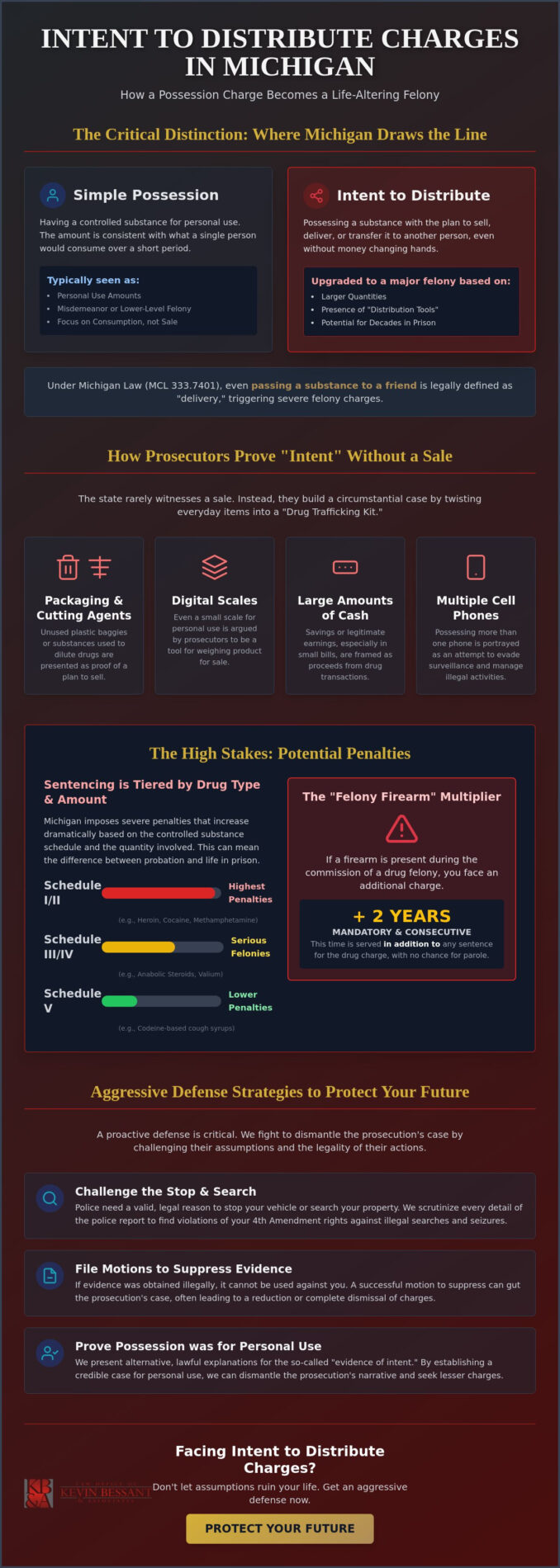
Where does the law draw the line? There is no “magic number” in the statute that automatically converts possession into intent. However, if you are caught with an amount that exceeds what a single person typically consumes in a few days, the police will immediately suspect you are a dealer. Prosecutors “up-charge” to intent when their evidence of actual sales is weak, relying instead on “Drug Recognition Experts” (DRE) to testify that your behavior or the way the substances were stored indicates a plan to sell. This is a tactic designed to force a plea deal. Don’t let them intimidate you. We challenge the testimony of these so-called experts to prove that your possession was for personal use, not distribution.
The Legal Definition of ‘Delivery’ in Michigan
In Michigan, “delivery” has a surprisingly broad and dangerous definition. You don’t need to be a kingpin or even exchange a single dollar to be charged with a felony. Passing a joint to a friend at a party or sharing a prescription pill counts as delivery under the law. Michigan law defines delivery as the actual, constructive, or attempted transfer from one person to another of a controlled substance, regardless of whether there is an agency relationship or an exchange of money.
Constructive possession is another trap the system uses to catch the unwary. If the drugs are in a shared apartment or a car you are driving, the state can argue you had the “intent” to control and distribute them even if they weren’t in your pocket. This aggressive interpretation of the law requires an even more aggressive defense. It’s time to stand up for your rights. If you are caught in this legal web, contact Kevin Bessant immediately to start building your shield.
How Michigan Prosecutors Prove ‘Intent’ Without a Sale
It is a common misconception that police must catch you in the act of selling to secure a conviction. In reality, the state rarely relies on eyewitness accounts of a transaction. Instead, they build a story based on “indicators of intent.” Under Michigan Compiled Law (MCL 333.7401), the prosecution only needs to prove that you possessed the substance and intended to deliver it to someone else at some point. This allows them to “up-charge” what should be a simple possession case into a high-stakes felony based purely on circumstantial evidence. If you’ve been targeted, you need to understand the tools they use to manufacture this narrative.
Circumstantial Evidence: The Prosecution’s Building Blocks
Police look for what they call a “Drug Trafficking Kit” during every search. If they find digital scales, unused plastic baggies, or “cutting agents,” they will immediately claim you are a distributor. Large amounts of cash, especially in small denominations, are treated as “proceeds” of illegal sales rather than personal savings. Even the presence of multiple cell phones or “burner” devices is used as a red flag by the Michigan State Police to suggest you are avoiding surveillance. They take these everyday items and twist them into proof of a criminal enterprise. We work to provide the alternative, lawful explanation for these items to dismantle the state’s assumptions.
Digital Forensics and Surveillance in 2026
In 2026, the digital trail is often the centerpiece of the prosecution’s case. Law enforcement now uses advanced tools to intercept messages on encrypted platforms like Signal, Telegram, and WhatsApp. They don’t just look for direct talk of sales; they use GPS “ping” logs to show a pattern of frequent, short stops that they claim are “consistent with drug distribution.” Perhaps most dangerous is the use of police “experts” who testify about the meaning of slang in your text messages. These officers often misinterpret casual conversations to make them sound like coded drug deals. Challenging the accuracy of these digital “interpretations” is a vital part of protecting your freedom.
Beyond physical and digital evidence, prosecutors frequently rely on “Cooperating Individuals,” commonly known as snitches. These are often people facing their own charges who are looking to trade your freedom for their own. They may set up “controlled buys” under police supervision to create the appearance of a sale where none existed. Your location also plays a role; being arrested near a school, park, or library can trigger automatic assumptions of intent to distribute. If you are facing the weight of the state’s digital and physical evidence, speak with a battle-ready attorney who knows how to expose the flaws in these tactics. Don’t let a collection of assumptions define your future. We fight to ensure that intent to distribute charges Michigan are met with a vigorous, evidence-based defense.
The High Stakes: Penalties and the ‘Felony Firearm’ Multiplier
The state of Michigan treats drug distribution as a war, and you are the target. Sentencing for intent to distribute charges Michigan is calculated with cold, mathematical precision. It doesn’t matter if you have a clean record or a family depending on you; the quantity of the substance alone can trigger decades of prison time. Prosecutors in Wayne and Oakland Counties use these rigid guidelines to pressure defendants into unfavorable plea deals. If you’re caught in the crosshairs of DEA enforcement actions or local task force stings, the penalties are designed to be life-altering. You need to know exactly what you’re up against before you set foot in a courtroom.
Michigan Drug Schedules and Sentencing Ranges
Michigan law categorizes controlled substances into five schedules based on their potential for abuse. Schedule 1 and 2 substances, including heroin, cocaine, and methamphetamine, carry the most devastating consequences. If you’re convicted of possessing 1,000 grams or more with intent to deliver, you face life imprisonment and a fine of up to $1,000,000. Even smaller amounts are high-stakes; 50 to 449 grams can result in up to 20 years in prison and a $250,000 fine. In 2026, we see prosecutors pursuing fentanyl cases with unprecedented aggression. This is driven by the fact that fentanyl or tramadol accounted for 51% of the 2,736 drug overdose deaths in Michigan in 2023. Schedule 3 and 4 drugs, like certain prescription pills or “club drugs,” carry lighter but still serious penalties, ranging from 4 to 7 years. Don’t underestimate a lower schedule charge; it’s still a felony that ruins careers.
The Weapons Enhancement: A Defense Attorney’s Nightmare
The most dangerous trap in the Michigan legal system is the “Felony Firearm” statute, MCL 750.227b. If you have a firearm in your possession while committing a drug felony, the law requires a mandatory, consecutive two-year prison sentence for the first offense. “Consecutive” means you serve those two years first, and then your drug sentence begins. You cannot get parole or probation during that mandatory term. Most people don’t realize that “possession” doesn’t mean the gun was in your hand. If a pistol is found in a drawer in the same house as the drugs, the state will charge you. This enhancement turns a difficult case into a catastrophe. If you’re facing this double threat, you need an experienced Gun Charge Lawyer Detroit to fight the weapons charge alongside the drug allegations. We work to sever that link and protect your freedom from these mandatory sentencing multipliers.
Aggressive Strategies to Fight Intent to Distribute Charges
The prosecution wants you to believe their case is airtight. It isn’t. We win by attacking the foundation of their evidence before it ever reaches a jury. When facing intent to distribute charges Michigan, the most powerful weapon in your arsenal is a Motion to Suppress. If the police violated your constitutional rights during the initial stop or search, the evidence they found is “fruit of the poisonous tree” and cannot be used against you. We don’t just manage your case; we hunt for the technicalities and constitutional violations that lead to dismissals. Every drug bust has a weak point, and we are trained to find it.
4th Amendment Shields in Drug Cases
Your 4th Amendment rights are your primary shield against the state. We scrutinize the “facts” police use to obtain search warrants; if an officer lied or exaggerated in their affidavit, the entire warrant can be tossed. In cities like Warren and Royal Oak, police often perform warrantless vehicle searches during routine traffic stops. They claim “probable cause” based on a “smell” or “nervous behavior,” but we challenge these fishing expeditions. If the officer moved items to bring them into “plain view,” they’ve crossed the line into an illegal search. The police need more than a “hunch” to pull you over or search your bag. We review every second of bodycam and dashcam footage to catch officers in contradictions. If the stop was pretextual or lasted longer than legally allowed, any evidence found after that point must be suppressed.
Dismantling the Prosecution’s Witnesses
Prosecutors rely heavily on the word of “undercover” officers and confidential informants. We expose the truth. Informants are rarely motivated by justice; they are often desperate individuals trading your life for their own leniency. We dig into their criminal histories and the specific promises made by prosecutors to ensure the jury sees the “deal” behind the testimony. We also demand proof of the “Chain of Custody.” If the lab-tested substances were handled improperly or sat in an unsecured locker, the results are compromised. We scrutinize the lab work to ensure the Michigan State Police followed strict protocols; if they failed, the chemical identity of the substance itself can be called into question.
By presenting a qualified “personal use” expert to testify about high-tolerance consumption patterns, we can effectively counter a police officer’s biased “intent” testimony and reframe the evidence as a struggle with addiction rather than a criminal enterprise. You don’t have to accept the prosecution’s narrative. If you are ready to dismantle the state’s case and fight for your freedom, contact Kevin Bessant today for an aggressive defense.
Why Kevin Bessant is Your Shield Against Michigan Drug Felonies
The Michigan legal system is a machine designed to process you into a statistic. When you face intent to distribute charges Michigan, you aren’t just fighting a legal case; you’re fighting for the next twenty years of your life. We don’t believe in “managing” your situation or waiting for the prosecutor to make the first move. We believe in aggressive, proactive advocacy that puts the state on the defensive from day one. You need a battle-ready advocate who understands that your freedom is the only acceptable outcome. We stand in the gap for you, offering a confident and unwavering voice in the face of these serious personal challenges.
The Law Office of Kevin Bessant & Associates Difference
With over 20 years of experience navigating the treacherous waters of the Michigan court system, Kevin Bessant has built a reputation as a fierce defender of the accused. Our firm specializes in high-stakes felony litigation. We’ve successfully handled cases ranging from complex homicide trials to major drug trafficking indictments. We know the inner workings of the courts in Detroit, Southfield, and throughout Wayne and Oakland Counties. This local knowledge isn’t just a credential; it’s a tactical advantage we use to dismantle the state’s narrative. You aren’t just another file on a desk. To learn more about our commitment to excellence, read about why us is the right choice for your defense.
Take Action Before the Prosecution Builds Their Case
Time is your greatest enemy in a drug felony case. While you’re processing the shock of an arrest, the police and prosecutors are already aggregating evidence and interviewing witnesses. Early intervention is the key to a successful outcome. We prioritize securing a reasonable bond so you can fight your case from home, not a jail cell. Our team aggressively challenges the prosecution at the preliminary examination, often exposing the flaws in their “intent” theories before the case even reaches the trial court. As an experienced Detroit Drug Lawyer, Kevin Bessant knows how to navigate this treacherous territory with precision.
Don’t wait until the state has finalized its case against you. Every hour you wait is an hour the prosecution uses to strengthen their position. You are more than a case number on a docket; you are a person with a future that deserves protection. We provide the personalized, high-intensity defense required to survive a felony charge. We act as your seasoned guide, projecting the confidence you need during this crisis. Take the first step toward reclaiming your life and protecting your future from a permanent felony record. Contact the Law Office of Kevin Bessant & Associates today for a free consultation.
Take Control of Your Future Before the System Takes Your Freedom
Legal Authority: Statute and Case Law
Michigan’s delivery and manufacture statute is codified at MCL 333.7401, with the Felony Firearm add-on at MCL 750.227b.
- People v Wolfe, 440 Mich 508, 524 (1992) — the Michigan Supreme Court held that intent to deliver may be proven entirely by circumstantial evidence, such as the quantity possessed or how the substance was packaged, without requiring proof of an actual completed sale.
For the current statutory text, see the Michigan Legislature’s MCL database.
The prosecution is already building a case against you based on assumptions and circumstantial evidence. As we have explored, intent is often just a theory used to upgrade simple possession into a life-altering felony. You cannot afford to wait and see what happens when the stakes include decades in prison and mandatory sentencing multipliers. Whether you are facing intent to distribute charges Michigan in Detroit, Southfield, or Warren, your defense must be as aggressive as the charges against you.
With over 20 years of criminal defense experience, Kevin Bessant provides the battle-ready advocacy you need to dismantle the state’s narrative. We specialize in high-stakes felony drug and weapon litigation, ensuring your rights are protected against illegal searches and unreliable witnesses. Don’t let the legal system dictate your future. Secure Your Aggressive Defense—Contact Kevin Bessant Now. Your freedom is too valuable to leave to chance; it’s time to fight back with a proven shield by your side.
Frequently Asked Questions
What is the difference between possession and intent to distribute in Michigan?
Possession is the act of having a controlled substance for personal use, while intent to distribute means you plan to transfer or sell it to another person. Michigan law allows prosecutors to upgrade simple possession to a felony distribution charge based purely on how the substances are stored. If you have large quantities or packaging materials, the state will aggressively assume you are a dealer rather than a user.
How much of a drug is considered intent to distribute in Michigan?
There is no single “magic number” in the statute that triggers a distribution charge, but quantity is the primary factor used by police. For Schedule 1 or 2 substances like Heroin or Cocaine, possessing even less than 50 grams can result in up to 20 years in prison. Officers also look for “dealer weights” that exceed what a typical individual would consume in a single day to justify the higher charge.
Can intent to distribute charges be dropped to simple possession?
Yes, intent to distribute charges Michigan can often be reduced to simple possession through aggressive negotiation or by successfully suppressing evidence. We challenge the state’s “indicators of intent,” such as the presence of scales or baggies, to prove the substances were for personal addiction. A reduction to simple possession can mean the difference between a decades-long prison sentence and a rehabilitation program.
Is intent to distribute a mandatory prison sentence in Michigan?
While not every drug felony carries a mandatory minimum, the maximum penalties are devastating, including life imprisonment for 1,000 grams or more of Schedule 1 or 2 drugs. The real danger lies in enhancements; if you are also charged with a Felony Firearm violation, you face a mandatory two year prison sentence. This sentence must be served consecutively, meaning you cannot get parole or probation during that time.
What happens if I had a gun and was charged with intent to distribute?
Having a firearm during a drug arrest triggers Michigan’s Felony Firearm law, which adds a mandatory two year prison sentence to your underlying drug charge. This sentence is served first and cannot be suspended or reduced by a judge. Even if the gun was legally owned and was not on your person at the time of the bust, the state will use it as a sentencing multiplier.
How do police prove intent if they didn’t see a transaction?
Police prove intent through circumstantial evidence such as digital scales, large amounts of cash, and packaging materials like unused baggies. In 2026, digital forensics play a massive role; officers search your cell phone for text messages, social media chats, or GPS logs that suggest a distribution pattern. They don’t need to witness a transaction if they can convince a jury that your “kit” proves a plan to sell.
Can a drug charge be expunged in Michigan under the Clean Slate law?
Many drug convictions are eligible for expungement under Michigan’s laws, but major felonies involving very large quantities or weapons are often subject to stricter rules. The process is complex and requires a specific waiting period without any new criminal offenses. We provide specialized representation for criminal expungement to help you navigate this system and clear your record so you can move forward with your life.
Do I need a lawyer for a first-time intent to distribute charge?
You must never face a distribution charge alone, even if it is your first time in the legal system. The state will not show you leniency just because you have a clean record; they will use your inexperience to pressure you into a plea deal that ruins your future. A battle-ready advocate can identify constitutional violations and pursue programs like HYTA to keep a permanent felony off your record.